How Cold Is Too Cold for Cats? The Indoor Comfort Number and the Outdoor Danger Number Aren’t the Same
How cold is too cold for cats? Most guides give you one number, usually 45°F, and leave it there. The trouble is that “too cold” means two different things. There’s the temperature at which an indoor cat stops being comfortable, and there’s the temperature at which a cat outdoors starts to be in real danger. Those aren’t the same number, and mixing them up leads people to worry about the wrong things. Some owners panic over a 68°F living room, while others leave a door open for an indoor-outdoor cat on a 30°F night.
This guide separates the two. We’ll go through what the major sources actually say (they disagree more than you’d think), where the oddly high “86°F” figure comes from, which cats feel the cold first, and how to keep both your own cat and the community cats on your block safe this winter.
One thing first. If a cat is weak, confused, collapsing, or very cold to the touch after time outside, stop reading and call your veterinarian or the nearest emergency clinic now. Everything below is for planning, not emergencies.
How cold is too cold for cats? Two different numbers
Here’s the short version, and then we’ll unpack it.
- Outdoors, for a healthy adult cat: the sources cluster around 45–50°F as the point where time outside starts to become a risk, and 32°F (freezing) as the point where frostbite and hypothermia become a real danger with prolonged exposure.
- Indoors: a typical heated home is not “too cold” for a healthy cat. Your cat may still prefer to be warmer than you do, which is a comfort question, not a safety one.
The sources don’t agree, and that’s useful
If you’ve read a few articles on this, you’ve probably seen several different numbers. Here’s what each source actually says:
- PetMD says most cats start feeling uncomfortable below 45°F, that temperatures below 32°F are dangerous for all cats, and that cats with weight loss or arthritis may be uncomfortable even at 50–60°F.
- Hill’s sets the line higher: most healthy adult cats “can handle temperatures dropping to 50 degrees Fahrenheit,” and below that, time outside becomes risky.
- Vets Now, a UK emergency-vet group, works in Celsius. They call 10–19°C (50–66°F) generally safe, 7–9°C (about 45–48°F) uncomfortable, 0–6°C (32–43°F) medium risk, and 0°C (32°F) and below dangerous.
- Texas A&M’s veterinary school, in a Pet Talk column, gives the most careful version of the 45°F rule. Indoor pets that aren’t used to the cold “should not be left outside when the average daily temperature is below 45 degrees Fahrenheit,” and kittens, older cats, and sick cats should never be kept outdoors below 45°F.
Notice that last qualifier. Texas A&M’s 45°F is an average daily temperature, and it applies to pets that aren’t acclimated. Most articles that repeat “45°F” drop both details. A 45°F average day includes a colder night, and a cat who lives indoors hasn’t grown the winter coat an outdoor cat has.
There’s also one place where the line is written into law. Under the federal Animal Welfare Act regulations (9 CFR 3.2), licensed facilities that keep cats indoors can’t let the temperature fall below 50°F for cats that aren’t acclimated, short-haired breeds, and sick, old, or young cats, unless the attending vet approves. They must provide dry bedding below 50°F, and they can’t let the room sit below 45°F for more than four hours in a row. That’s a legal minimum for commercial facilities, not a comfort target for your home. Still, it’s reassuring that it lands in the same 45–50°F band the vets do.
So how cold is too cold for cats in practice? Treat 50°F as “start paying attention,” 45°F as “an indoor cat shouldn’t be out for long,” and 32°F as “no cat should be out without real shelter.” Then adjust for your cat, which is what the rest of this guide is about.
Why your cat seems cold at 72°F: the “86°F” figure, explained
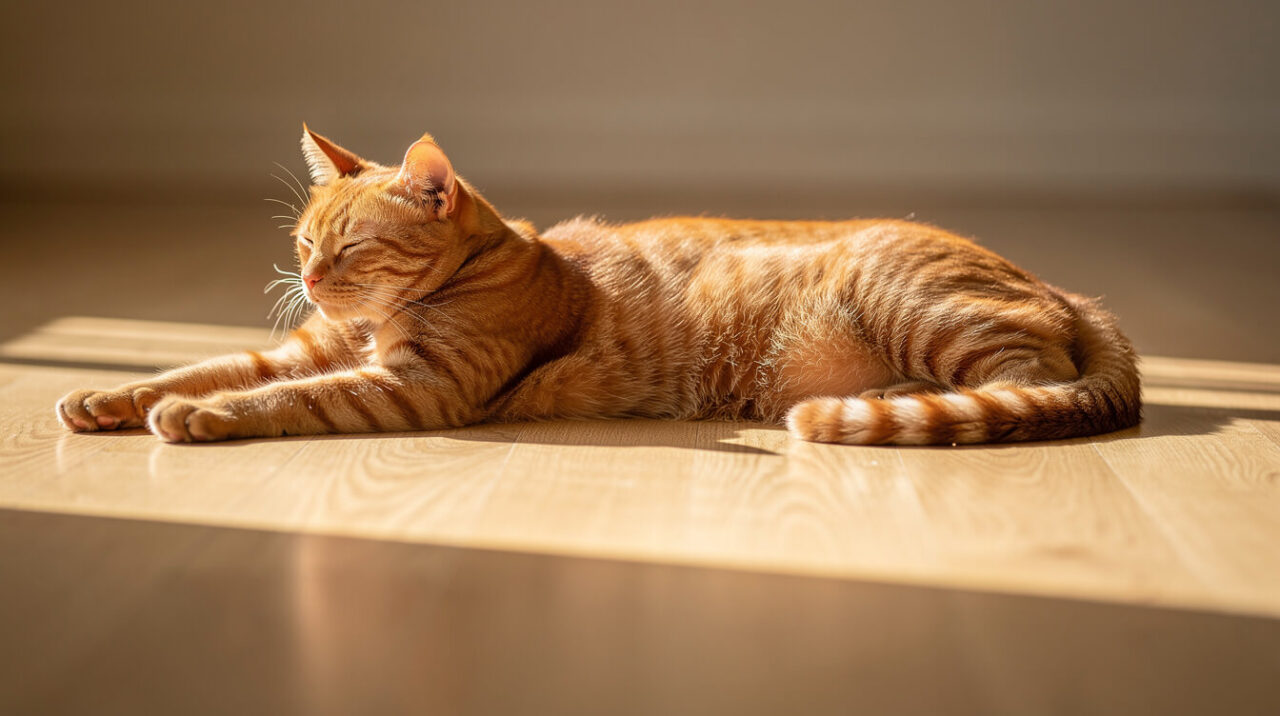
Maybe you’ve seen the claim that cats are chilly below 86°F, which can make a perfectly normal 70°F house sound like a problem. The number is real, but it’s often misread.
It traces back to a concept called the thermoneutral zone: the range of air temperatures where an animal doesn’t have to spend any extra energy to keep its body temperature steady. A 2016 review from Purdue’s Center for Animal Welfare Science (Stella and Croney) gives the thermoneutral zone for domestic cats as 30–38°C (86–100.4°F), citing a 2006 National Research Council nutrition reference. It also notes that most homes are kept around 22°C, give or take 2 (roughly 68–75°F).
Here’s the part that often gets lost. The thermoneutral zone is where a cat spends zero extra energy staying warm. It isn’t a safety line. Below 86°F, a healthy cat isn’t in danger. It’s just doing what every warm-blooded animal does, using a little energy and a few behaviors to stay warm. Most of us aren’t in our own thermoneutral zone most of the day either, and we’re fine. We put on a sweater.
The cat’s version of a sweater is behavior. That’s the review’s actual recommendation: give cats the chance to thermoregulate behaviorally with warm bedding, resting spots, boxes, and safe heat sources, so they can choose how warm they want to be. Most of us have seen a cat follow a sunbeam across the floor. That’s normal thermoregulation, not distress.
One more honest caveat. We weren’t able to trace the 86°F figure to a study of pet cats, so treat it as a textbook estimate, not a precise threshold. The practical takeaway holds either way: you don’t need to heat your house to 86°F. Give your cat warm spots to choose from. Hill’s suggests keeping the thermostat at least 60°F for cats, and most homes run well above that.
Cats who feel the cold sooner
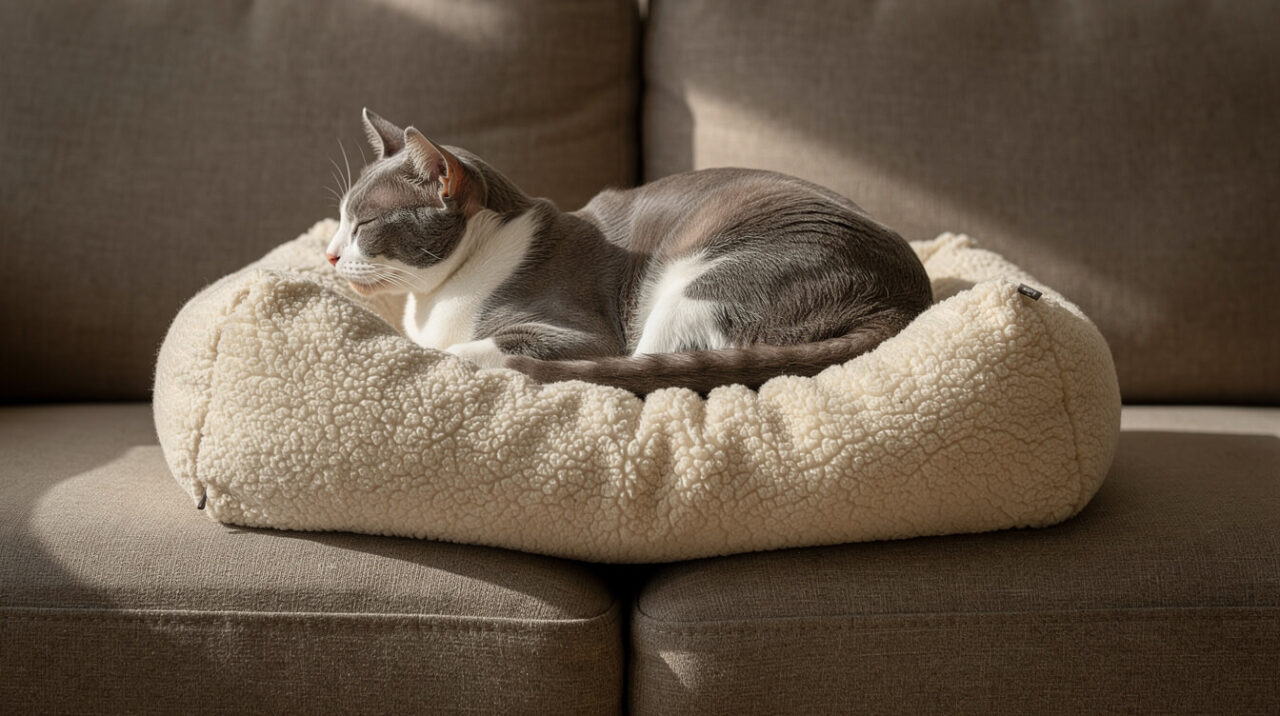
Every source agrees that the numbers above describe a healthy adult cat. These cats reach their limit sooner, so start paying attention earlier with them:
Kittens
Kittens have a large surface area for their body size, and very young kittens can’t fully regulate their own temperature. Keep them indoors and out of drafts. If you’re raising a new kitten this winter, our first-time kitten owner FAQ covers the basics.
Seniors, and cats with arthritis
Older cats often carry less muscle and fat, and many have arthritis. PetMD notes that cats with arthritis can be noticeably uncomfortable at 50–60°F, and Hill’s says cold weather can make arthritis signs worse. A senior who suddenly stops jumping to her favorite shelf in January may be telling you something. Our guide to caring for senior cats has more on keeping older cats comfortable.
Thin or ill cats
Body fat is insulation, so underweight cats lose heat quickly. Hill’s adds cats with endocrine disease, heart disease, or any chronic illness. If your cat has lost weight without a clear reason, that’s worth a vet visit for its own sake. Here’s why cats lose weight and what your vet will look at.
Short-haired and hairless breeds
A Sphynx has almost no insulation at all, and many hairless cats are happier in a sweater indoors. Short-haired breeds and breeds from warm climates also feel the cold sooner. Long-haired, thick-coated breeds such as Maine Coons and Norwegian Forest Cats cope better, but they’re not immune, especially when their coat gets wet.
Cats who aren’t used to the cold
Cats who live outdoors year-round grow thicker coats as the seasons turn. An indoor cat who slips out on a January night hasn’t done that. This is why a “tough” community cat and your indoor cat aren’t really comparable.
And for every cat, wet changes everything. Chewy’s guide makes the point that wet fur loses its insulating value, and Merck notes frostbite is more likely in wet or windy conditions. A 40°F rainy night can be harder on a cat than a dry, still 30°F afternoon.
Signs your cat is too cold, and when it’s a vet-now call
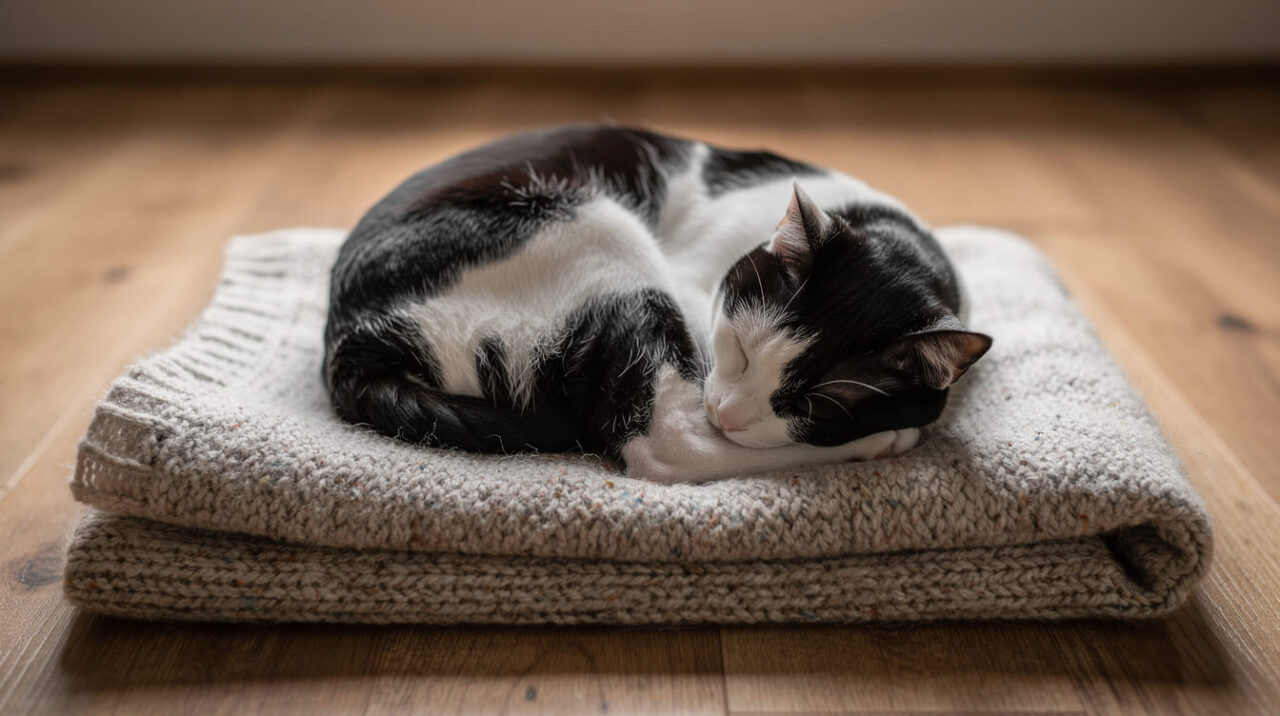
Cats are subtle about discomfort. PetMD points out that cats often don’t shiver or vocalize until they’re quite cold, unlike many dogs. So learn the early signs.
“I’m chilly” (adjust the environment)
- Seeking out warm spots: sunny windows, heat vents, the top of the fridge, your lap
- Curling into a tight ball, sometimes with the tail wrapped over the nose
- Burrowing under blankets or into closets
- Ears, paws, or tail tip that feel cool to the touch
Indoors, these signs usually just mean your cat would like a warmer spot. Offer one (the next section has ideas), and you’ve solved it.
“This is a vet visit” (call now)
Hypothermia means a dangerously low body temperature. Cats’ normal body temperature runs about 100.4–102.5°F, according to PetMD. The Merck Veterinary Manual lists the signs of hypothermia in dogs and cats as:
- Slow pulse and shallow breathing
- Confusion or disorientation
- Weakness, collapse, or unconsciousness
Merck also says plainly, “Shivering is not a reliable sign of hypothermia.” A cat who has stopped shivering isn’t necessarily warming up. Chewy notes shivering can lessen as hypothermia progresses.
Frostbite most often affects the tips of the ears, the feet, and the tail. Merck describes affected skin as pale or red, swollen, and painful at first. In severe cases it can later turn black and hard. It’s often hard to judge frostbite at first, so any suspected case is a vet visit.
If you see any of these signs, call your vet or an emergency clinic and head in. On the way, Merck’s first-aid guidance is simple: if the cat is wet, dry them first, then wrap warm (not hot) water bottles around the body. If you suspect frostbite, don’t rub the area, and don’t apply snow or very hot water. Rewarming a hypothermic animal properly is veterinary work, so your job is to dry, wrap, and drive.
Antifreeze is a separate emergency. Merck’s winter safety editorial notes that just 1–2 teaspoons of ethylene glycol antifreeze can be lethal to a cat. If you think your cat has licked any, don’t wait for symptoms. Call your vet, an emergency clinic, or the ASPCA Animal Poison Control Center at (888) 426-4435 (a consultation fee may apply) immediately.
The weekly care guide
Get it right for your animal, every week
One email a week: new care guides, species deep-dives, and the safety answers keepers search for, written by our specialists. No spam. Unsubscribe anytime.
How to keep an indoor cat warm (including in a power outage)
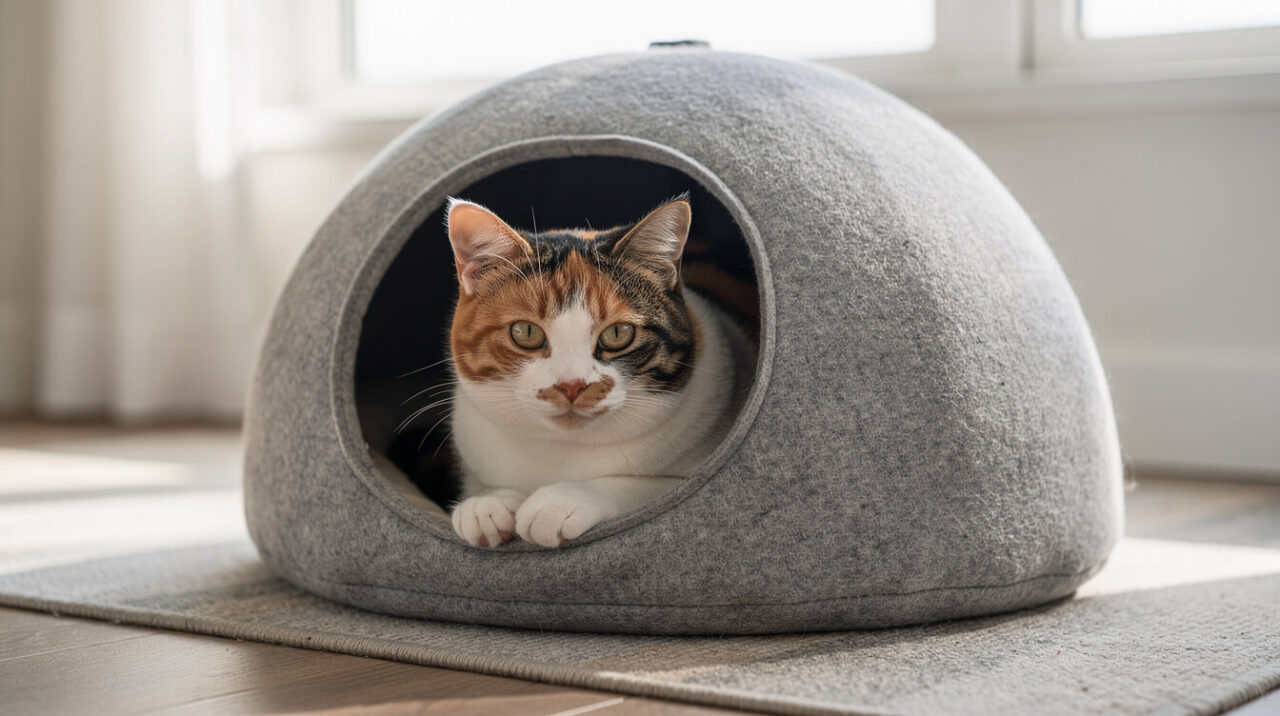
This is the good-news section. Keeping an indoor cat comfortable through winter is easy, inexpensive, and mostly about giving your cat choices.
Give them warm spots to choose from
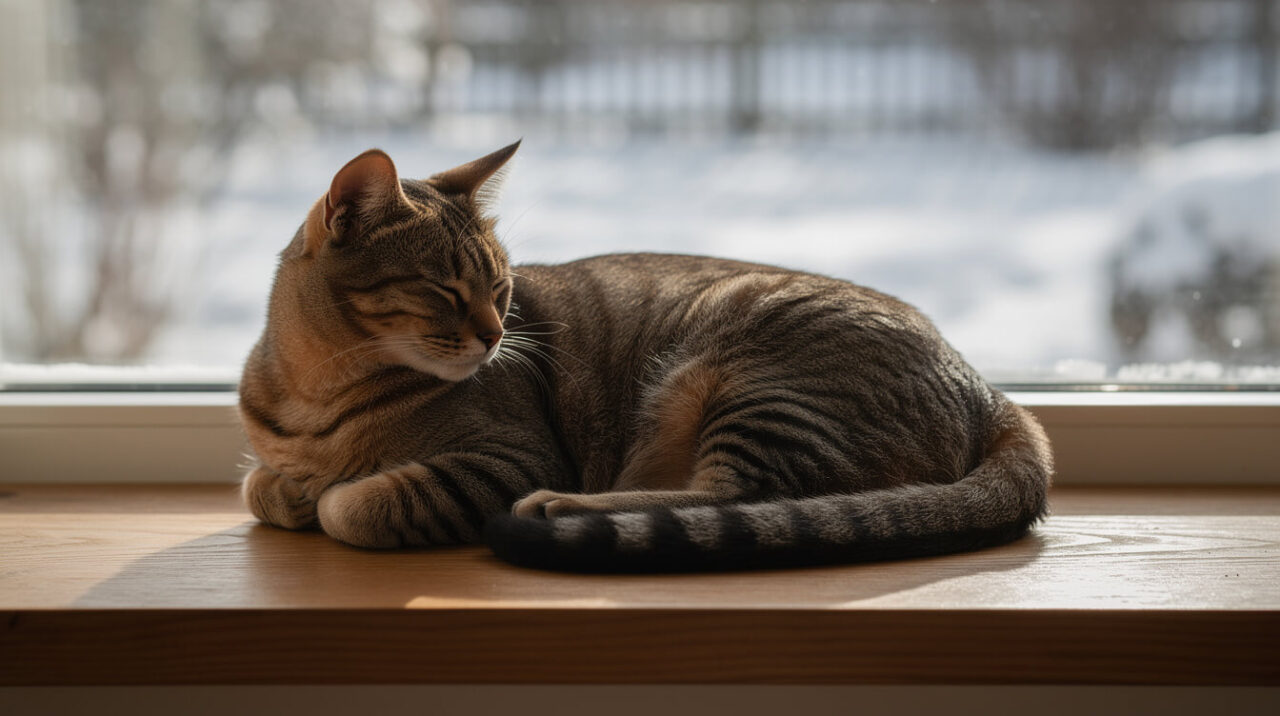
- Sunny perches. A window shelf or cat tree by a south- or west-facing window is free heat. Move a bed to follow the sun if your cat already does.
- Enclosed beds. Cave beds, covered beds, and even a cardboard box with a fleece blanket inside trap body heat. That’s a big part of why cats love boxes.
- Get beds off cold floors. Tile and concrete pull heat out of a resting cat. A raised bed or a thick mat makes a real difference.
- Block drafts near favorite sleeping spots, especially by exterior doors.
- Self-warming beds have a reflective layer that bounces the cat’s own body heat back. They need no power, which makes them a safe default for any cat.
And since so many of us share the house with more than one kind of animal, here’s our one bit of merch for the season. Our Bearded Dragon Crown Sunglasses King T-Shirt is for the reptile keeper whose cat has claimed the warmest lap in the house. It won’t warm your cat, but it’s a good layer under your own sweater.

Wear the obsession
Our Bearded Dragon Crown Sunglasses King tee is for the multi-species household: a soft everyday shirt for keepers who take their animals seriously and themselves a little less so, whether the cat has claimed your lap or not.
Heated beds and pads: use the right kind
Heated beds can be a gift to seniors and arthritic cats, but the type matters. Hill’s advises avoiding ordinary electric heating pads made for people, which can burn a cat’s skin, and choosing a temperature-controlled bed made for pets instead. Whatever you use, follow three rules:
- Make sure your cat can always move off the heat source. The warm spot should be one option, not the whole bed.
- Keep cords out of reach of chewers, and follow the maker’s instructions. Many say not to use an extension cord.
- Be extra cautious with cats who can’t easily move away, like very old, weak, or recovering cats, and with microwavable heat discs. Follow the directions and always use the cover.
Space heaters, fireplaces, and radiators
Cats love heat sources and don’t always know when to back away. Use space heaters with tip-over shutoff, keep them where a cat can’t knock or sleep against them, and screen fireplaces. Never leave a cat alone with an open flame or a candle. A swishing tail and a candle are a bad combination.
If the power goes out
Winter storms knock out power, and this is where many guides fall short. Here’s what actually helps:
- Use unpowered warmth. One widely read guide suggests a heated cat mat for power outages, but many of those mats are plug-in products, so check yours. Without electricity, a plug-in heated bed is just a mat. Self-warming beds, a box lined with blankets, and closing your cat into the warmest small room with you all work without power.
- Keep everyone in one room. Shut the doors to a small interior room, bring in the litter box, food, and water, and let body heat (yours and theirs) build up.
- Watch out for carbon monoxide. None of the top-ranking guides we read mentions this, and it’s the outage risk that can hurt the whole household. The CDC says never to run a generator inside your home or garage, even with doors and windows open, and to keep it outdoors more than 20 feet from windows, doors, and vents. Don’t use a grill, camp stove, or gas oven to heat the house. Pets are affected by carbon monoxide too, and a cat sleeping low in a closed room has no way to warn you. A battery-powered CO detector protects everyone.
- Don’t leave your cat behind. If it gets cold enough that you have to leave, take your cat with you. Look up pet-friendly shelters or hotels before storm season, not during the storm.
For a broader cold-season checklist across species, see our guide to pet safety during the winter. If your cat shares the house with a dog, the companion piece is how cold is too cold for dogs.
Community and outdoor cats: shelters, straw, and the car check
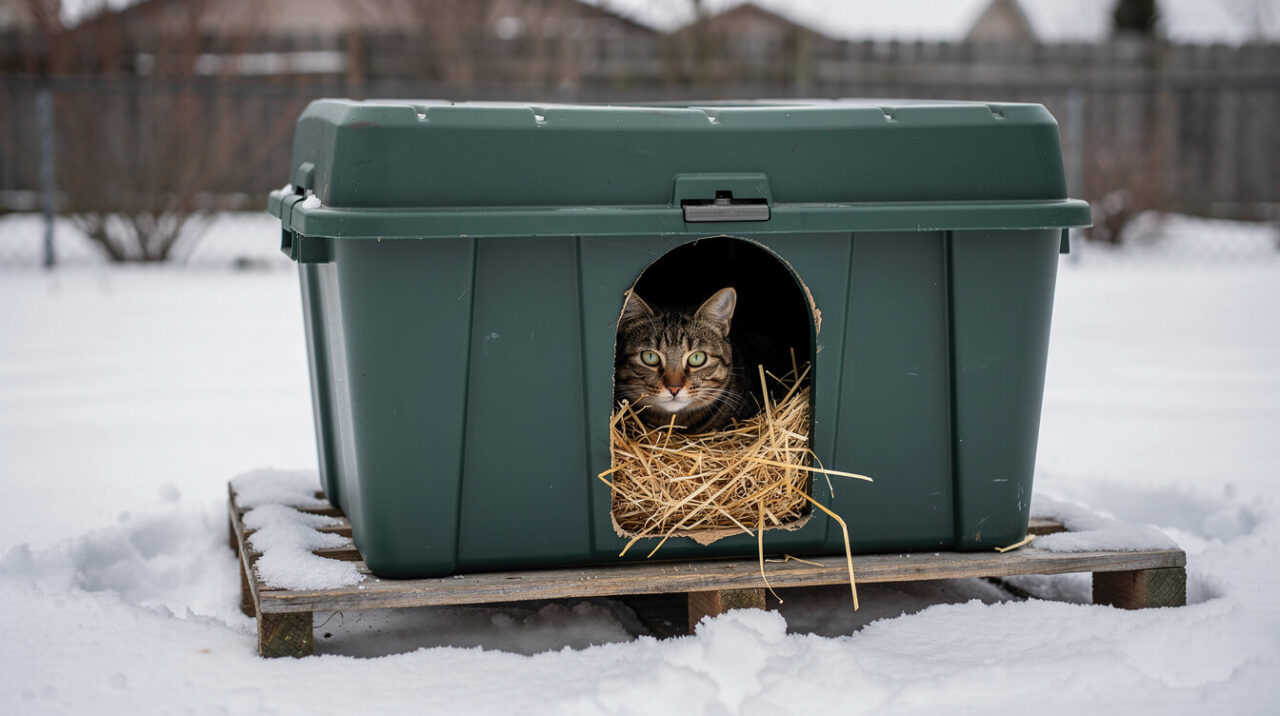
Whether you care for a feral colony or one neighborhood regular, winter is when your help matters most. The safest place for any owned cat in freezing weather is indoors. Merck says it plainly: “Ideally, cats should be inside in winter.” For cats who live outside, a good shelter is the most important thing you can give them.
Use straw, not blankets
This is the most common mistake, and some popular articles even recommend blankets. Alley Cat Allies, the national community-cat advocacy group, is emphatic: insulate shelters with straw, which repels moisture. “Do not use hay, or things like blankets and towels!” Blankets, towels, and hay soak up moisture, then freeze or mold, and they leave the shelter damp and cold. Straw stays loose and dry, so a cat can burrow into it.
Straw and hay look similar, which is where people slip up. Straw is the hollow, dry stalk left after a grain harvest. Hay is dried grass grown as animal feed. If the bag says “hay,” it’s the wrong one.
What a good shelter looks like
Alley Cat Allies’ guidance on building and placing shelters comes down to a few points:
- Small. The cats’ own body heat is what warms a shelter, and heat disperses quickly in a big one. Alley Cat Allies suggests about 2 by 3 feet and at least 18 inches high for three to five cats, and smaller still if only one or two cats use it.
- A doorway only big enough for cats, several inches above the ground to keep out rain and snow. A door flap keeps out cold air and potential predators.
- Raised off the ground, on a pallet or boards, so it’s not sitting on frozen, wet earth.
- Entrance facing away from the wind, and preferably facing a wall so only cats can get in and out.
- Insulated. Their DIY design nests a smaller plastic tote inside a larger one with straw packed between the walls and more straw inside as bedding.
Check the straw through the winter and replace it if it gets wet or dirty, and clear the entrance after heavy snow so the cats don’t get snowed in. Texas A&M’s vets give the same advice for any outdoor bedding: keep it clean and dry, and change it often.
Food and water that don’t freeze
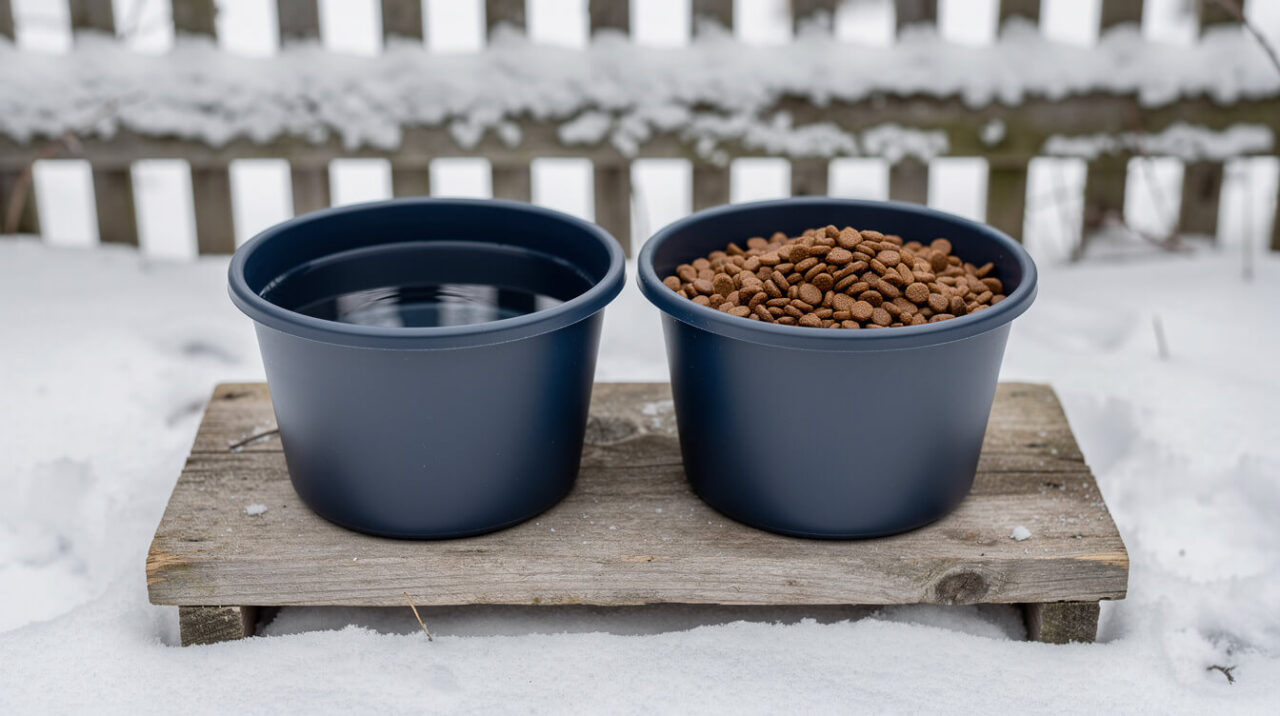
Cats burn more calories staying warm, so a reliable meal matters. Alley Cat Allies recommends:
- Deep bowls rather than wide ones, placed in the sun when possible, so water takes longer to freeze.
- Plastic, not metal, bowls.
- Dry food won’t freeze. Wet food will, so serve it warmed or switch to dry in deep cold. Heated electric bowls are another option if you have a safe outdoor outlet.
Keep food and water near the shelter but outside it, so spills don’t soak the bedding. Alley Cat Allies also suggests an insulated feeding station, built like a shelter, to keep food, water, and cats out of the weather.
Bang on the hood, and watch the antifreeze
A warm engine is a tempting bed. Before you start the car on a cold morning, knock on the hood or honk, and check the wheel wells. Both Hill’s and Alley Cat Allies recommend it, and it takes five seconds.
Store antifreeze sealed and out of reach, clean up spills right away, and look for pet-safer deicers. Rock salt and chemical ice melt can irritate paws and make a cat sick if licked off. If an indoor-outdoor cat comes in from salted sidewalks, rinse or wipe the paws with warm water, as Hill’s suggests.
FAQ about how cold is too cold for cats
What temperature is too cold for cats inside the house?
A normally heated home is fine for a healthy cat. Trouble starts when indoor temperatures fall into the 50s or below, for example in an unheated room or during a power outage. PetMD notes that indoor temperatures below about 45–50°F can be uncomfortable for many cats, and Hill’s suggests keeping the thermostat at least 60°F. Kittens, seniors, thin cats, and hairless breeds may want extra warmth even at normal room temperature, which a warm bed or sunny perch can usually provide.
Can my cat stay in the garage in winter?
An unheated garage is a poor place for a cat to spend a cold night. It can get nearly as cold as outdoors, and garages tend to hold antifreeze, de-icers, and cars. If a cat has to stay there briefly, give them an insulated, enclosed bed off the floor, unfrozen water, and a space with no chemicals. Never run a car or generator in a garage with a cat inside. PetMD notes that a cat in a closed garage with a running car can reach toxic carbon monoxide levels in about ten minutes.
Is 40°F too cold for an outdoor cat?
For an indoor cat who isn’t used to the cold, yes: 40°F is below the 45°F most vets use as a cutoff, so bring them in. An acclimated community cat with a dry, insulated shelter can cope, but by every source here, 40°F is a temperature where shelter stops being optional. Wind and rain make it worse.
Should my cat wear a sweater?
Most cats don’t need one, and many hate them. Hairless cats and some thin or senior cats can benefit from a well-fitted sweater indoors. Introduce it slowly with treats, make sure it doesn’t restrict movement, and take it off if your cat seems stressed.
Do cats need more food in winter?
Outdoor and community cats often do, since staying warm takes energy. Indoor cats usually don’t, and many are less active in winter, so watch the scale before increasing portions. If your cat’s weight is drifting either way, your vet can help set the right amount.
The bottom line on how cold is too cold for cats: your indoor cat is almost certainly fine in your heated home, as long as there’s a warm spot to choose. The real winter danger is outside, below about 45°F for most cats and below freezing for all of them. That’s where a dry, straw-filled shelter, a quick bang on the hood, and a careful eye on antifreeze matter most. If you’re reading this to get it right for your cat, you’re already doing the most important part.
Before you go
Keep learning your animal
We publish a new guide every day. The best of them land in one short weekly email, so you never miss the one about your species.
Dr. Lila Monroe is a seasoned veterinarian with a passion for feline health and behavior, boasting over 20 years of experience in the field. With her extensive knowledge of cat medicine combined with a deep understanding of the nuanced dynamics of cat behavior, Lila offers readers invaluable insights into creating a nurturing environment for their feline friends.