Cockatiel Cage Setup: Real Minimum Size, Safe Bar Spacing, and How to Check a Used Cage
Buying a cockatiel cage is the one purchase where a well-meaning mistake can genuinely hurt your bird — and the pet aisle is not going to warn you about it. Search the term and you get category pages, marketplace listings, and forum threads where ten keepers give you eight different numbers. Somewhere in there is a bird standing in a box that is too narrow, too tall, or built with bars spaced just wide enough for a cockatiel-sized head to pass through.
So here is the straight version of how to choose a cockatiel cage. This guide covers the real minimum size, the bar-spacing number that matters more than any other spec, the one place where “bigger is better” stops being true, how to vet a secondhand cage before a bird ever goes in it, and where in your home the cage should actually live. Great question to be asking — and if you are asking it before you bring the bird home, you are already ahead of most people.
The real minimum cockatiel cage size (and why width beats height)
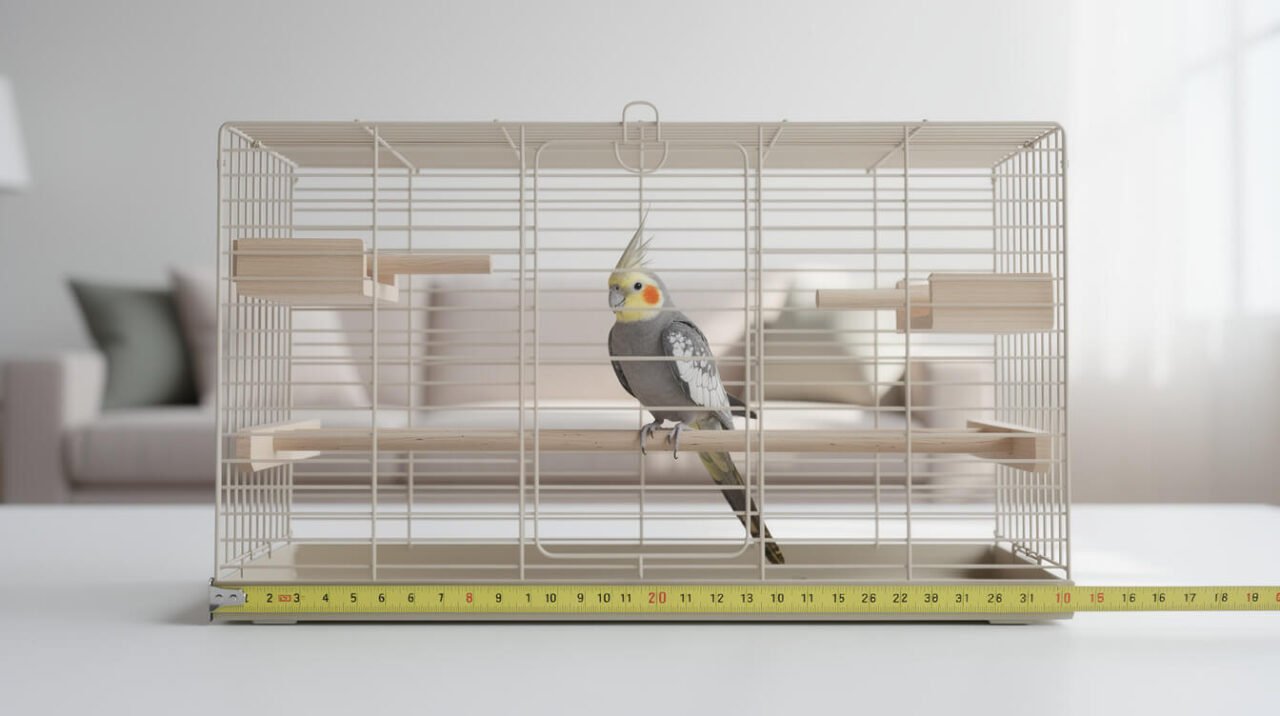
The most commonly cited minimum for a single cockatiel is 24 inches long by 24 inches wide by 30 inches high. That figure comes from PetMD’s vet-authored cockatiel care sheet, and the major retail care guides use the same numbers. STAR Avian Rescue sets its adoption minimum at a 24″ x 24″ footprint for a single cockatiel, and a 31″ x 20″ flight cage once you have two or more birds.
Treat those as the floor, not the goal. An adult cockatiel runs 11 to 14 inches from head to the end of its tail, and that tail is a real part of the measurement — a bird that can’t turn around on a perch without dragging its tail against the bars will wear it ragged. Keeper communities often push past the published minimum for exactly this reason, citing a cockatiel’s roughly 19-inch wingspan and arguing for something nearer 32″ x 21″ of floor space. That is community practice rather than a published veterinary standard, but the reasoning behind it is sound and it points the same direction every source does: wider.
Width and depth are the numbers. Height mostly isn’t.
Here is the part the spec sheets bury. Cockatiels are horizontal fliers. They cross a space, they don’t hover up it. STAR Avian Rescue is blunt about it in their cage requirements: always use the width and depth of the actual cage, not the height. Their published minimums don’t list a height figure at all.
Which means the tall, narrow, dome-topped cages that dominate the “cockatiel cage” shelf are selling you cubic inches your bird can’t use. The eighteen inches of empty air above the top perch is decoration. The eight extra inches of width is flight.
Measure the inside, not the listing
Advertised dimensions routinely include seed guards, playtops, and the stand the cage sits on. STAR’s worked example is worth memorizing: a cage with 24″ x 22″ of usable interior space can legitimately be listed as 30.5″ x 32″, or even as 68.5″ if the seller is quoting the full height including the stand. Before you buy, find the internal measurements — most good listings include a diagram showing how they measured.
One more thing, because it is the most common consolation offered to someone with a small cage: generous out-of-cage time is wonderful, and it is not a size substitute. STAR says so directly. Your bird spends most of its hours in that cage, including every hour you are at work and asleep.
Cockatiel cage bar spacing: the number to get right first
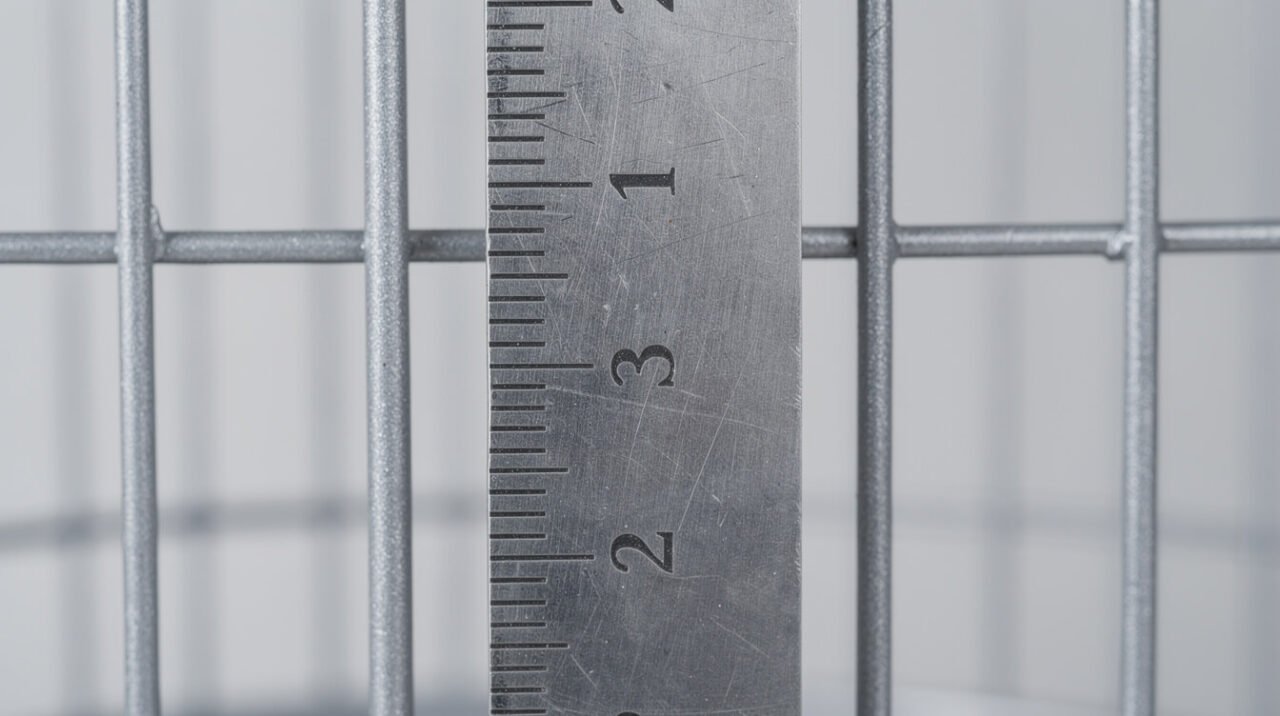
If you check one spec, check this one. And you should know up front that reputable sources do not fully agree on it, so here is the actual spread rather than a tidy single number:
- PetMD (written by Maria Zayas, DVM): a half-inch apart or smaller.
- STAR Avian Rescue: no larger than 0.6″, noting that ½” is also perfectly appropriate and common.
- BirdTricks, in their species-by-species table: ½” to ⅝” for cockatiels.
- Chewy’s education desk: no more than ½” to ⅝”, adding that spacing over ⅝” poses a severe risk of head entrapment, cervical dislocation, or strangulation.
- Northern Parrots (UK): 13–19 mm, which tops out at ¾”.
Four of those five land between ½” and ⅝”. One sits meaningfully wider. We are not going to pretend that disagreement away — but we will tell you which side of it to stand on, and why.
Our read: ½” is the number every source agrees is safe, ⅝” is the widest any of them will defend for a cockatiel, and ¾” is where the documented failure mode lives. If you are choosing a cage today and the spacing is ½”, you never have to think about this again. If it is ⅝”, you are inside mainstream guidance. If it is ¾” or wider, the cage was designed for a conure, an Amazon, or an African grey, whatever the box says.
Why too-wide bars hurt, mechanically
A cockatiel’s skull is narrower than it looks under all those feathers, and a head will pass through a gap that the body never could. Getting it back out is the problem: the hinge of the jaw catches on the way back, and a bird that can’t retreat panics. BirdTricks published an account of exactly this — a keeper who upgraded her cockatiel to a far larger cage came home to find him dead with his head caught between the bars, with the attending vet’s view being that he’d had a heart attack during the struggle.
Spacing that is too narrow has its own failure mode, which is why ¼” finch spacing isn’t the safe default either: toes and leg bands catch in gaps that are too tight to climb. Wings get caught in gaps that are too wide. The species-matched range exists because both edges are real.
If you are reading this with a ¾”-spaced cage already in your living room and a bird already in it — that is a very common situation and it does not make you a bad keeper. It makes you someone who trusted a product label, which is what labels are for. Watch for your bird putting its head through the bars at all, and plan a correctly spaced replacement. Retrofitting mesh or liner panels over wide bars is a stopgap people do try; it introduces its own chewing and entanglement questions, and it does not make the cage right. The fix is a cage with the right spacing.
“Bigger is better” has one exception — and this is it

Everything above says get the biggest footprint you can. Everything in the last section says get narrow bars. In the real cage market, those two pieces of advice fight each other — and almost nobody tells you that before you spend the money.
The pattern is consistent across manufacturers: large cages come with wide bar spacing, and narrow bar spacing comes on small cages. BirdTricks has made this point for years, describing a long and unsuccessful search for a safe, affordable “mansion” for their own cockatiels. A genuinely huge cage with ½” bars is rare and expensive, because it needs far more bars, which means more material and more weight.
So the rule isn’t “buy the biggest cage.” It is:
Buy the biggest cage you can find at cockatiel-safe bar spacing. Size is capped by spacing, never the other way around.
In practice that pushes you toward a specific product category: flight cages marketed for budgies, finches, and canaries. They are built wide rather than tall, they almost always come with ½” spacing, and they’re frequently cheaper than a dome-top sold as a “cockatiel cage.” Check the interior dimensions against the 24″ x 24″ floor, confirm the bars, and you have solved both problems with one purchase.
And treat the words “cockatiel cage” on a product page as a marketing category, not a certification. Nobody enforces it. The spec sheet is the only thing that tells you the truth, which is also the argument we make in our broader complete parrot cage guide — the same trap catches people shopping for conures and greys.
What goes inside: perches, dishes, and toys
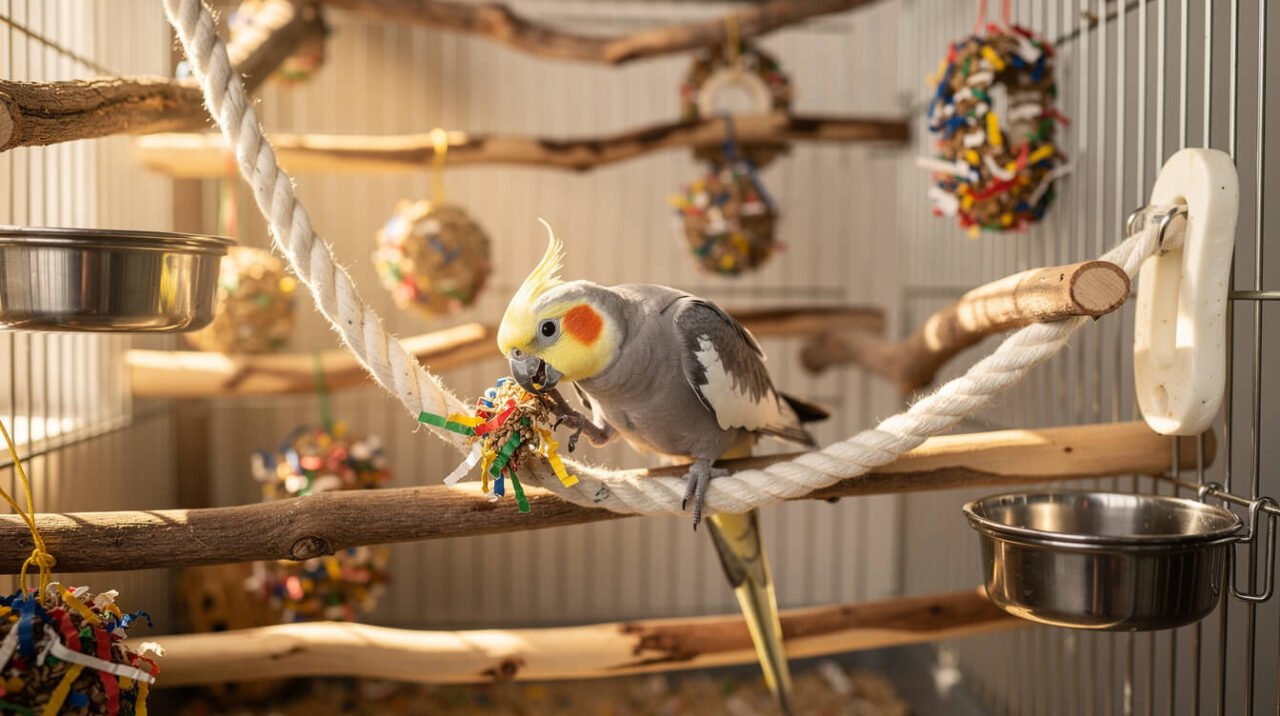
A correctly sized cockatiel cage with the wrong furniture is still a poor home. The good news is that the inside is cheap to get right, and it is the part you get to enjoy.
Perches first, and vary them. The round dowel that ships with most cages gives your bird one grip, held identically all day, which is how pressure sores and stiff joints start. Chewy’s care desk gives a usable spec: perches at least 5 inches long and roughly ½” to ¾” in diameter, with some wider ones up to an inch, sized so the foot wraps about two-thirds of the way around without the claws overlapping. Natural wood — apple or manzanita — gives irregular diameters in a single branch, which is exactly the point. Rope perches are good too; check them often and trim any fraying, because loose fibers wrap around toes.
Mount perches at different heights and angles, and leave the middle of the cage open. Every perch you add across the center is flight space you just removed. Put the highest perch where your bird can sit without its tail touching the bars or its head touching the roof.
Dishes should be stainless steel or ceramic and properly secured — a dish a cockatiel can tip becomes a project. Keep food and water away from directly beneath a favorite perch for obvious reasons. Below everything, you want a removable metal grate with a paper-lined tray underneath, so droppings fall away from your bird’s feet rather than being walked through. PetMD specifically recommends the grate-and-paper arrangement.
Toys are not optional enrichment for a cockatiel; they are how the bird spends its day. Shreddable paper and soft wood, a foraging toy that makes it work for a treat, a cuttlebone, and something to chew. Rotate two or three in and out weekly rather than cramming eight in at once — novelty is doing most of the work. If you want to go deeper on what’s safe and what isn’t, our parrot toy guide covers materials and real costs across species.
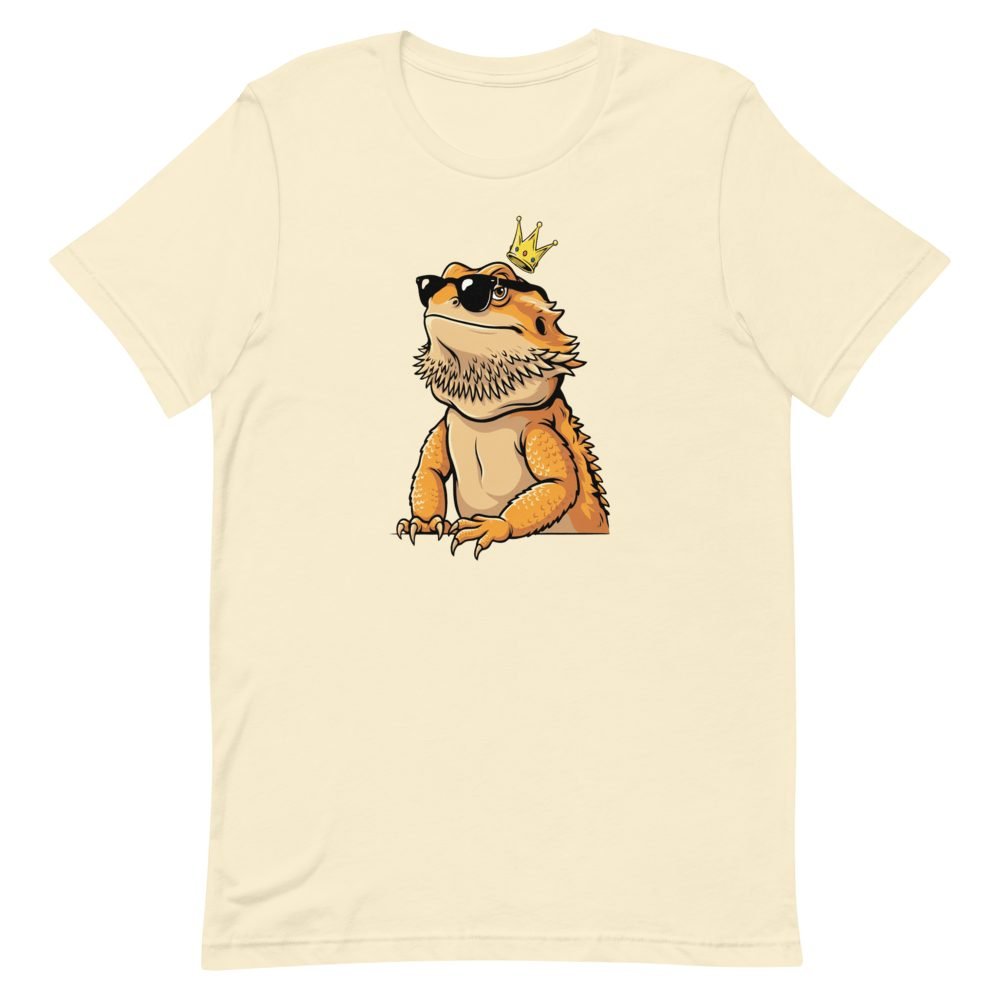
And if you have reached the stage of cheerfully explaining bar spacing to people who did not ask, you may enjoy our Bearded Dragon Crown Sunglasses King T-Shirt — it’s from the keeper side of our shop, for the people who read the spec sheet before they buy.
Wear the obsession
For keepers who measure the bar spacing before they measure the shelf. Soft cotton tee from the GeoZoo shop, built for people who take their animals seriously and themselves a little less so.
One habit worth building from day one: do a thirty-second scan of the cage interior every time you change the water. Frayed rope, a cracked perch, a toy chewed down to a sharp edge, a loosened dish clip. Cockatiels find the one failing component faster than you will.
Daily out-of-cage time still matters enormously for a bird this social — it’s enrichment and exercise and company. Just hold the two ideas separately: free time is for the bird’s mind, cage size is for the bird’s body, and neither one buys you out of the other.
The weekly care guide
Get it right for your animal, every week
One email a week: new care guides, species deep-dives, and the safety answers keepers search for, written by our specialists. No spam. Unsubscribe anytime.
Buying a used cage: how to check one before a bird goes in it
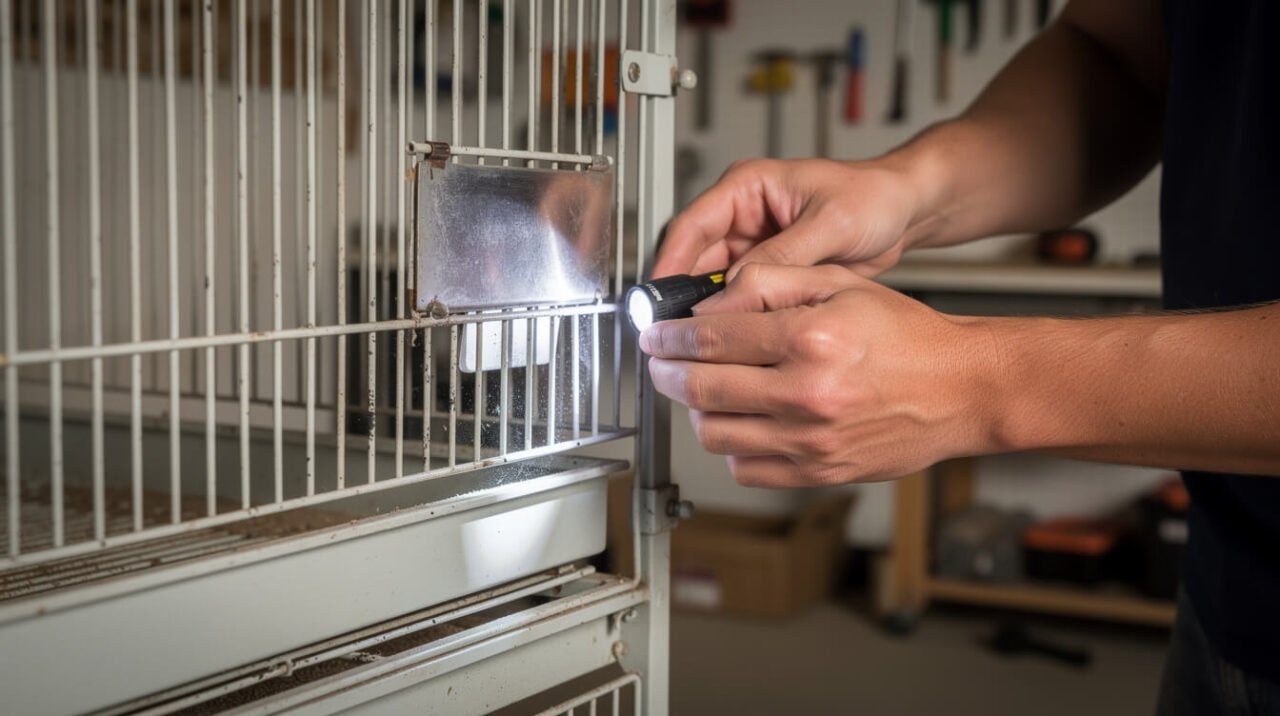
Secondhand is how a lot of people afford a properly sized cage, and we are not going to talk you out of it. A good used cage is often a better buy than a new one at the same price. But a used cage needs an inspection, and almost nothing written about cockatiel cages tells you how to do one. STAR Avian Rescue publishes a used-cage guide, and it is the best checklist we have found.
Before you hand over money
- Internal measurements. Same trap as new cages, worse on marketplace listings. Ask for a tape measure photo of the actual interior width and depth.
- Bar spacing and bar gauge. Measure, don’t trust the seller’s species guess. Also look at the bars themselves — a previous large-parrot owner may have left bent or sprung bars behind.
- Materials. Rule out galvanized steel, which is zinc-coated and a documented poisoning risk if chewed or flaked. Rule out wood, which is porous, holds bacteria, and a cockatiel will work through it. Rule out repainted metal unless you know the paint is bird-safe, and plastic components that have gone scratched and grubby. What you want is powder-coated steel or stainless.
- Rust, flaking, and damage. Visible rust, peeling powder coat, bent or loose bars, or sharp edges are a pass. Look specifically around the food bowls, the bottom grate, and the door frames — STAR notes that is where rust hides, and a cage can look spotless from six feet away and be corroded at the fittings.
Why rust is a hard no, not a cosmetic issue
Birds chew bars. That is the whole problem. Ingested rust and metal particles cause heavy-metal poisoning, which can produce neurological signs and blindness and can be fatal. STAR makes two points that are easy to miss: symptoms may not appear right away, and some metals don’t show up in blood tests, so “my bird seems fine” is not evidence. Particles can also damage the crop and digestive tract lining directly.
People do ask about refurbishing a rusted cage. It is possible — professional sandblasting and re-powder-coating is the honest route — but by the time you’ve paid for it, you have usually paid for a new cage. Budget accordingly rather than talking yourself into a project.
Once it’s home, before the bird goes in
Clean and disinfect with something bird-safe: F10, plain vinegar, or diluted hydrogen peroxide are the agents STAR lists. Rinse thoroughly, and let it dry completely — fully dry, not nearly dry. Then inspect it again under good light now that the grime is gone, because the second look finds things the first one missed. Swap out any damaged grates and hardware, and replace the dowel rods with natural-wood perches in varied diameters while you’re at it.
Where to put the cage — and the kitchen problem

You can buy the right cockatiel cage and furnish it perfectly and still put it in the wrong room. Placement is a welfare decision, and there is one hazard that outranks all the others.
Keep it away from the kitchen
Birds have extraordinarily efficient respiratory systems, which is wonderful for flight and terrible for airborne toxins. PetMD’s cockatiel sheet is explicit that these birds should be kept away from products that emit toxic fumes — appliances with nonstick coating, candles, air fresheners, and aerosol sprays. Overheated PTFE (the nonstick coating best known as Teflon, also found on drip pans, some irons, and some heat-lamp covers) releases fumes that can kill a bird very quickly, at temperatures that merely annoy a human.
In a house with separate rooms, this is simple: the cage does not live in or next to the kitchen. In an open-plan apartment it takes more thought — put the cage as far from the stove as the floor plan allows, run the extractor and open a window whenever you cook, and move to non-stick-free pans if you’re replacing cookware anyway. This is not a fringe precaution; it is the single most common preventable household death in pet birds.
The rest of the checklist
- One solid wall behind the cage. A cage marooned in the middle of a room leaves a prey animal exposed on all four sides. A wall or corner gives your bird a direction nothing can come from.
- No drafts, no direct sun, no air-conditioning vent. PetMD puts cockatiels comfortable in ordinary household temperatures of roughly 65–80°F, and warns against sudden swings. A sunny window looks lovely and can cook a cage by mid-afternoon with no shaded side to escape to.
- Out of reach of dogs and cats. Not just physically — a cat that can sit and stare is a full-time stressor even through bars.
- In the social room, not the spare room. Cockatiels are intensely social and bond hard with their people. A bird parked in a quiet back bedroom is being kept, not lived with. The living room, a little off to one side, is usually the right answer.
- Roughly chest height. Common keeper practice is to place the cage so the bird’s main perch sits somewhere around your chest-to-shoulder level — low enough that you aren’t looming over it, high enough that it doesn’t feel exposed from above. That’s convention rather than a published standard, but it’s convention for a reason.
Cockatiel cage questions, answered
What is the “3-3-3 rule” for cockatiels?
It isn’t one. The 3-3-3 rule — three days to decompress, three weeks to settle, three months to feel at home — is a shelter framework written for newly adopted dogs and cats, and it has drifted onto bird pages by repetition. There is no avian version of it, and no avian organization publishes it.
What actually matters in a new cockatiel’s first week is simpler. Let the bird come to you: set the cage up fully before it arrives, keep handling minimal for the first few days, and let it choose its own favorite perch rather than rearranging things around it. Sit near the cage and talk or read aloud so your voice becomes ordinary. Expect reduced eating for a day or two and keep a quiet eye on it. Settling looks like preening, stretching one wing and leg together, eating normally, and eventually vocalizing — a quiet, motionless, fluffed-up bird past the first day or two is not settling, it’s a reason to call a vet.
What does a cockatiel cage setup actually cost?
Honestly, less than people fear on the cage and more than they expect on everything else. At the time of writing, a cockatiel cage with a suitable footprint and correct bar spacing ran roughly $90 to $300 at mainstream retailers, with wide flight cages often sitting at the cheaper end of that range and playtop or stand models at the upper end. Budget on top of that for a set of varied natural-wood and rope perches (roughly $10–$15 each, and you want three or four), stainless or ceramic dishes, a cuttlebone and holder, paper liner you’ll keep buying, and a starting rotation of toys. A realistic all-in figure for a correctly equipped first setup is a few hundred dollars, and the cage is the part you buy once. We take the same itemized approach in our bearded dragon tank setup breakdown, if you like seeing the real numbers before you commit.
Do two cockatiels need a bigger cage?
Yes, and not by a token amount. Chewy’s guidance is to increase cage size by 50–100% for a second bird; STAR Avian Rescue moves to a 31″ x 20″ flight cage minimum for two or more. Add perches and dishes in duplicate at opposite ends as well, so neither bird can monopolize the resources. For three or more, keep expanding horizontally or move to an indoor aviary.
Is a round cage okay for a cockatiel?
Rectangular is the standard recommendation for a cockatiel cage, and the reasoning is straightforward: a round cage gives a bird no corner to retreat into, and the curved walls waste usable floor area at the edges. Round cages also tend to be tall and narrow, which is the opposite of what a horizontal flier needs. If you already have one and the bird is settled and well, it isn’t an emergency — just make the next cage a rectangular one.
When does a cage problem become a vet visit?
Immediately, more often than people realize. Birds are prey animals and they mask illness until masking stops working, which is why avian medicine runs on a shorter clock than dog and cat medicine. Call an avian veterinarian the same day for labored or open-mouth breathing, tail-bobbing with each breath, a bird sitting fluffed and silent at the bottom of the cage, any fall or visible injury, or any bird found caught in the bars — even one that seems fine afterward, because soft-tissue and neck injuries don’t always show immediately. Female cockatiels are chronic egg-layers, and a hen straining without passing an egg may be egg-bound, which is an emergency. We can help you set a cage up well; we can’t diagnose a sick bird, and nothing on this page is a substitute for a vet who knows birds. Worth finding one and saving the number before you need it.
Get the cockatiel cage footprint right, get the bar spacing right, put it somewhere your bird can see its people and can’t smell your cooking, and you have handled the decisions that actually matter. Everything after that — the perches, the toys, the slow business of a cockatiel deciding you’re acceptable — is the fun part. If you’re still choosing a bird, our guide to white-faced cockatiel care and personality is a good next read, and African grey care is worth a look if you’re weighing a larger parrot and want an honest picture of the commitment first.
Before you go
Keep learning your animal
We publish a new guide every day. The best of them land in one short weekly email, so you never miss the one about your species.

Emily Chen is a passionate avian specialist with over a decade of experience in nurturing and training birds of all feathers. From the melodious canaries to the intelligent parrots, Emily’s expertise spans a wide range of avian care, including diet, habitat setup, and behavioral training.