The Complete Rabbit Care Guide: Housing, Diet, Health, and Bonding
Most rabbits arrive in a home that is set up wrong — not through neglect, but through bad information. The cage at the pet store is too small, the bag of colorful muesli-style food is the wrong food, the rabbit is alone when it should have a companion, and nobody mentioned that the animal in the box can live twelve years. This rabbit care guide fixes that in one sitting: what rabbits actually need, in real numbers, with the reasoning underneath so you can make good calls on the things we didn’t think to cover.
Rabbits aren’t difficult animals. They are specific animals. Get the space, the hay, the companionship, and the vet sorted and you have a litter-trained, affectionate, genuinely funny housemate who flops over sideways on your rug in total contentment. Get those four wrong and you have a bored, frightened, quietly unwell animal who hides all of it from you, because concealing illness is what prey species do.
What every rabbit care guide should tell you first

Before a single purchase, five things decide whether your rabbit thrives. Everything else here is detail hanging off these:
- Space — room-sized, not cage-sized.
- Unlimited grass hay — roughly 80% of the diet, available every hour of the day.
- A companion rabbit — neutered, bonded, ideally matched with a rescue’s help.
- Spay or neuter — for health and behavior, not only to prevent litters.
- A rabbit-savvy veterinarian — found and saved in your phone before you need one at 9pm.
Rabbits aren’t the easy first pet they’re sold as
The House Rabbit Society is blunt about this: rabbits are physically delicate, need specialized veterinary care, and what a small child means by "loving" — holding, cuddling, carrying around — is precisely what frightens a rabbit most. Rabbits can’t cry out when distressed, so they scratch or bite instead, and then get surrendered for it. Many are dropped and suffer broken legs or spines. That doesn’t mean rabbits and children can’t share a happy home; it means an adult has to be the primary caretaker, and children meet the rabbit on the floor, on the rabbit’s terms.
The honest cost and commitment picture
A well-cared-for indoor rabbit commonly lives eight to twelve years, and ten-plus is unremarkable — dog-length commitment in an animal people buy on impulse at Easter. The money is real too: the UK’s Rabbit Welfare Association and Fund estimates a pair can cost up to £11,000 across their lifetimes. Setup is the one-time hit, and buying the right pen once costs less than replacing a too-small cage. Recurring costs are modest but constant. Veterinary care is where rabbit budgets break — spay or neuter, annual exams, vaccination where it’s offered, and the one nobody plans for, an emergency fund. Gut stasis and dental disease don’t wait for payday. If that picture doesn’t fit your life right now, that’s a respectable answer, and your local rescue would rather you reached it before adopting than after.
Housing: how much space a rabbit actually needs
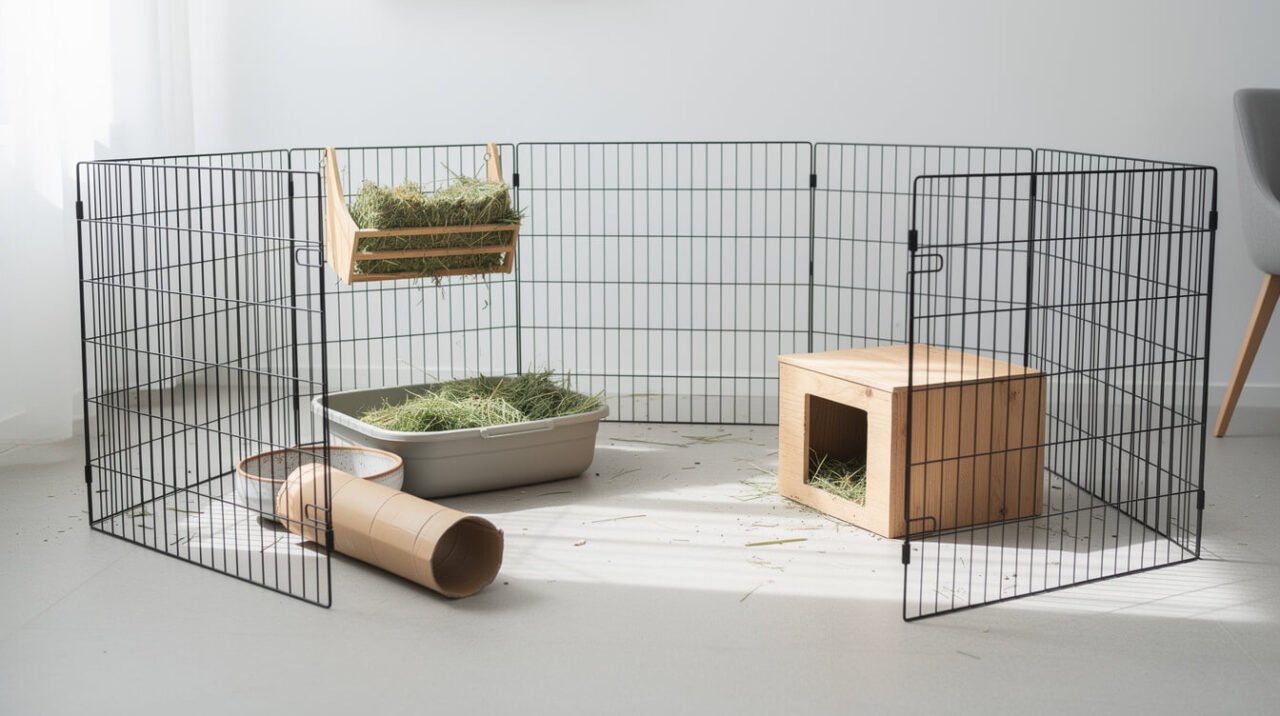
Most rabbit care guides start with the cage. This one starts with the room, because housing is the most common failure in pet rabbit keeping — and it isn’t the keeper’s fault: cages marketed as "rabbit cages" are overwhelmingly too small, closer to guinea pig dimensions. A rabbit has powerful hind legs built for running and jumping, and years in a small box cause real musculoskeletal and behavioral problems.
The numbers worth anchoring to
Guidance varies by organization because these are minimums, not targets. The RSPCA sets the clearest headline: at least 3m × 2m × 1m (roughly 10 × 6 × 3 feet) of combined living and exercise space, and a hutch alone is never enough. The House Rabbit Society gives a minimum pen footprint of about 2 × 2 × 4 feet for one rabbit, plus several hours of out-of-pen exercise daily. US shelter guidance commonly lands on no smaller than 12 square feet, scaling up with weight.
Rather than memorizing any of those, use the two behavioral tests they’re all approximating: your rabbit should take three or four full hops from one end of the enclosure to the other, and stand fully upright on their hind legs without their ears touching the top. If either fails, it’s too small, whatever the box said.
A pen beats a cage, and indoors beats out
A tall wire exercise pen — the kind sold for puppies — is usually cheaper than a rabbit cage, gives several times the floor area, and is far easier to clean: unclip a panel and vacuum. Use panels at least three to four feet high, because a motivated rabbit clears more than you’d expect. Think of the enclosure as a burrow inside a larger territory, not the territory itself — the pen is where they rest, eat, and use the tray; the room or run is where they live.
Outdoor hutches deserve a specific word. Beyond predators, weather, and flystrike, a hutch imposes isolation on a highly social animal, and domestic rabbits can die of heart attacks at the mere approach of a predator they can’t escape. Both the House Rabbit Society and the Animal Humane Society now recommend keeping rabbits indoors. Any outdoor access must be fully enclosed above and below, dig-proofed, and never unsupervised; cats, dogs, and birds of prey get around ordinary fencing easily.
Flooring, litter, and temperature
Use a solid floor. Wire mesh ulcerates rabbit feet — a painful condition called sore hocks — so cover an inherited wire bottom with a mat or plywood, and add rugs over slick floors so your rabbit has traction to run and stop without splaying. For bedding and litter there’s one firm rule: no pine or cedar shavings, whose aromatic phenols can irritate the respiratory tract and alter liver enzymes, which matters a great deal if your rabbit ever needs anesthesia. Skip clay litters too. Unscented paper-pellet or shredded-paper products are the safe default.
Litter training is mostly a matter of agreeing with your rabbit about where the bathroom is. They’re fastidious and pick a corner within days; put a large, low-sided tray in that corner, line it with newspaper, and fill it with grass hay, since rabbits like to eat while they go. Empty it daily and the setup stays odor-free. Most rabbits get this immediately; the ones who don’t are usually unneutered.
Rabbits wear a permanent fur coat and are far more vulnerable to heat than cold. A comfortable indoor band is roughly 60–70°F; keep rooms below about 75°F in summer and treat anything approaching 80°F as a genuine heatstroke risk, more so for long-coated breeds like lionheads. Choose somewhere quiet, dry, well-ventilated, and out of direct sun, and avoid placing a rabbit in full view of a cat — constant close-range predator cues keep a prey animal in low-grade stress indefinitely. Finally, rabbit-proof before the first floor session: cover every cable, block access behind appliances, protect baseboards, and remove houseplants, many of which are toxic.
Diet: hay first, greens second, pellets last
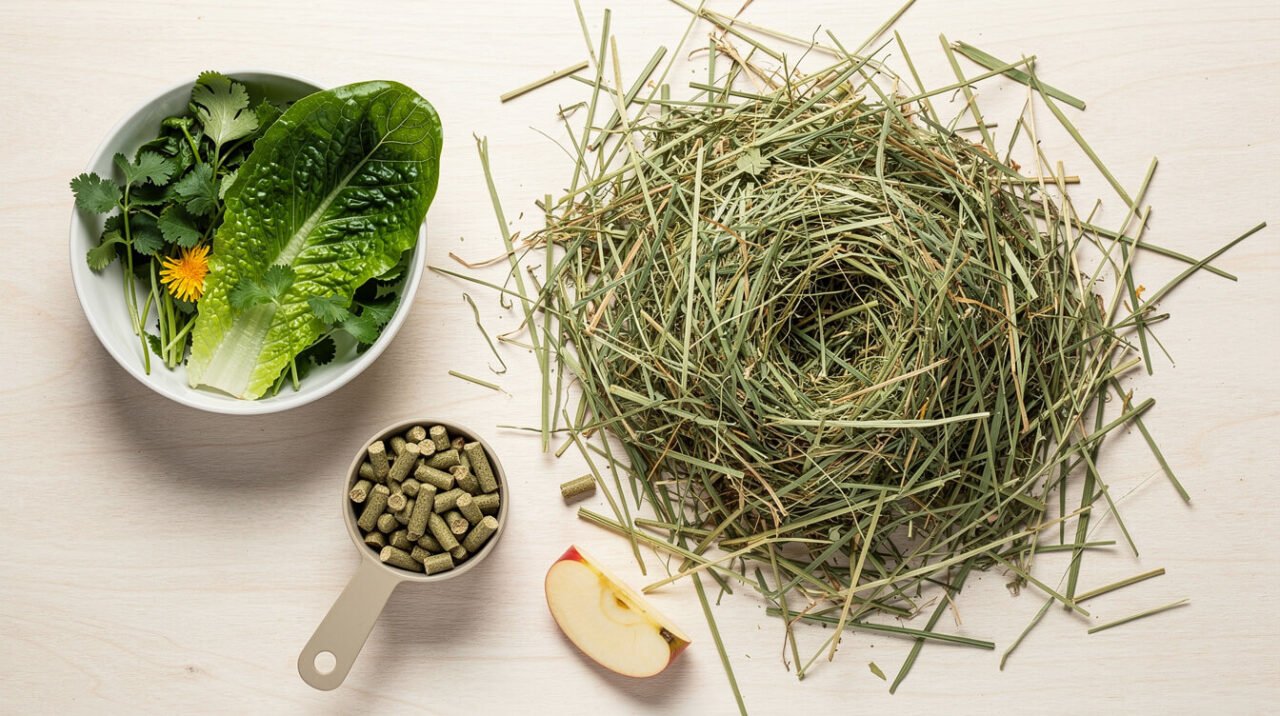
A rabbit’s digestive system is a fermentation vat that only works while it’s moving, and what keeps it moving is long-strand fiber. Nearly every serious rabbit health problem — gut stasis, dental disease, obesity, soft stool — traces back to too little hay and too much of everything else.
Hay is the whole game
The House Rabbit Society’s summary is that the three most important foods for a rabbit are hay, hay, and hay. Grass hay should be roughly 80% of total intake, available free-choice, twenty-four hours a day. Timothy, orchard, meadow, oat, brome, Bermuda, and prairie grasses all work, and a mix beats a single type. Two exclusions: alfalfa and clover are legumes, too rich in protein and calcium for an adult rabbit (they have a place for growing kits and some recovering rabbits, but that’s a conversation with your vet), and straw is not hay — it’s bedding with negligible nutrition.
Hay is also your rabbit’s dentistry. Rabbit incisors grow continuously — the RSPCA puts it at 2–3mm per week — and it’s the silicate and lignin in grass hay, worn down by hours of side-to-side chewing, that keeps them workable. Which rules something out: rabbits do not need salt licks, vitamin supplements, or hard wooden blocks sold as "tooth grinders." Hay does that job and nothing substitutes. Offer it in a rack, a box, and the litter tray, and refresh rather than top up, since rabbits won’t eat soiled hay.
Greens — and why reputable sources disagree
A widely used measure for fresh food is about one cup of greens per two pounds of body weight per day, with roughly 75% of the fresh portion leafy rather than root or fruit. Offer around three types daily, rotate week to week, wash everything, and remove uneaten fresh food after three or four hours.
Now the part that confuses every new keeper: read two excellent rabbit organizations back to back and one lists spinach and broccoli among good greens while the other says avoid them. Both are being careful. They’re weighing different risks.
- High-oxalate greens — spinach, chard, beet greens, parsley — are nutritious but best rotated rather than fed daily, because of the long-term urinary and calcium picture.
- Brassicas — broccoli, cabbage, cauliflower, kale — are fine for many rabbits and gas-producing for others. Some organizations exclude them because in a species that can’t easily relieve gas, the downside outweighs the benefit. We work through the same trade-off in our guide to whether guinea pigs can eat broccoli.
- Reliable everyday bases: romaine and other leaf lettuces, cilantro, basil, dandelion greens, carrot tops, and herbs. Never iceberg, which is water without fiber.
The resolution is behavioral, not theoretical. Introduce one new green at a time, in a small amount, and let the droppings tell you. Firm, round, plentiful droppings mean a happy gut; soft stool after a new food usually means too much fresh matter, so cut fresh foods back for a day, and call your vet if it doesn’t resolve. High-water vegetables deserve the same care, which is why we wrote a whole piece on whether rabbits can eat cucumber rather than a one-line yes. For a rabbit newly home, get them eating grass hay reliably for about two weeks before introducing greens.
Pellets, treats, and the droppings they’re supposed to eat
Pellets are a supplement, not a meal. Choose a plain, grass-hay-based pellet with no seeds, nuts, corn, or colored pieces — muesli-style mixes let rabbits eat the sugary bits and leave the fiber, which is exactly backwards — and use a bag within about 90 days of its manufacture date. Portions scale with weight, roughly ¼ cup per 4–5 pounds of body weight per day:
- Dwarf breeds: about ⅛ cup daily
- 5–7 pounds: about ¼ cup daily
- 8–10 pounds: about ½ cup daily
- 11–15 pounds: up to about ¾ cup daily
Serve them in a heavy ceramic bowl that can’t be tipped or chewed. If your rabbit is over or under weight, the pellet ration is the first thing a vet will adjust, so ask rather than guess. Non-leafy vegetables and fruit are treats, and the honest serving is small: about one tablespoon per two pounds of body weight per day, total. Carrot is a treat, not a staple, despite a century of cartoons. Never feed bread, crackers, or cereal — high-carbohydrate food can tip gut bacteria into dysbiosis, a serious illness rather than a minor upset. Water should be fresh daily, and a heavy ceramic crock beats a bottle: rabbits drink more from an open bowl, and bottle ball-valves fail silently.
Finally, if you see your rabbit eating their own droppings, that’s normal, healthy, and necessary. Those soft clustered pellets are cecotropes — a second pass through the gut delivering B vitamins and protein. A rabbit who stops eating them, or leaves them squashed around the pen, is telling you something is off. Mention it to your vet.
Companionship, handling, and the trust you have to earn

Bunnies need buddies
Wild rabbits live in colonies, and pet rabbits are the same animal under the fur. The research is consistent enough that UK welfare bodies treat it as a baseline requirement: rabbits kept alone suffer stress and loneliness. The RSPCA’s position is that rabbits should live in neutered pairs or compatible groups, and the RWAF notes they value companionship roughly as much as food. The classic pairing is a neutered male with a neutered female, which reduces fighting in both sexes. Neutering isn’t optional here: a doe can have a litter roughly every 30 days and can conceive again within minutes of giving birth, which is why shelters overflow with "accidental" rabbits.
One thing almost nobody tells new keepers: you cannot simply put two rabbits together. They’re territorial, and an unmanaged introduction can become a serious fight in seconds. Bonding happens gradually, in neutral territory neither rabbit has claimed, over sessions building from minutes to hours, with both rabbits already neutered and recovered. The easiest path by a wide margin is to adopt through a rescue — many keep already-bonded pairs, and most will run a "bunny date" to match your single rabbit with a compatible partner and coach you through it.
Why your rabbit hates being picked up
Being lifted off the ground is, to a prey animal, indistinguishable from being taken by a hawk. Most rabbits dislike it and some find it genuinely terrifying. That isn’t a personality flaw to train out — it’s the species. So interact at ground level: sit on the floor and let the rabbit come to you. When you must lift one, support the chest, always support the hindquarters, hold them against your body, and stay low. Never lift by the ears or scruff; a rabbit who kicks out mid-lift can fracture their own spine.
New rabbits also need a settling-in period. For the first three or four days, set the pen somewhere quiet, talk softly, offer gentle strokes on the forehead and cheeks, and don’t pick them up at all. When your rabbit starts coming over unprompted, you have your answer. With children, the house rule that works is simple: the rabbit comes to people, people don’t come to the rabbit.
Reading rabbit body language
- Flop — dropping onto their side, legs out. Deep relaxation, and the highest compliment in the house.
- Binky — a leaping mid-air twist. Pure joy, usually at exercise time.
- Soft tooth-purring while being stroked means happiness. Loud grinding, especially with a hunched posture, can mean pain — a very different signal.
- Thump — an alarm, or an opinion. Often both.
- Retreating to a hide — leave them. Forcing a rabbit out of their safe space is how calm rabbits learn to bite.
The weekly care guide
Get it right for your animal, every week
One email a week: new care guides, species deep-dives, and the safety answers keepers search for, written by our specialists. No spam. Unsubscribe anytime.
Enrichment, grooming, and a routine you’ll actually keep
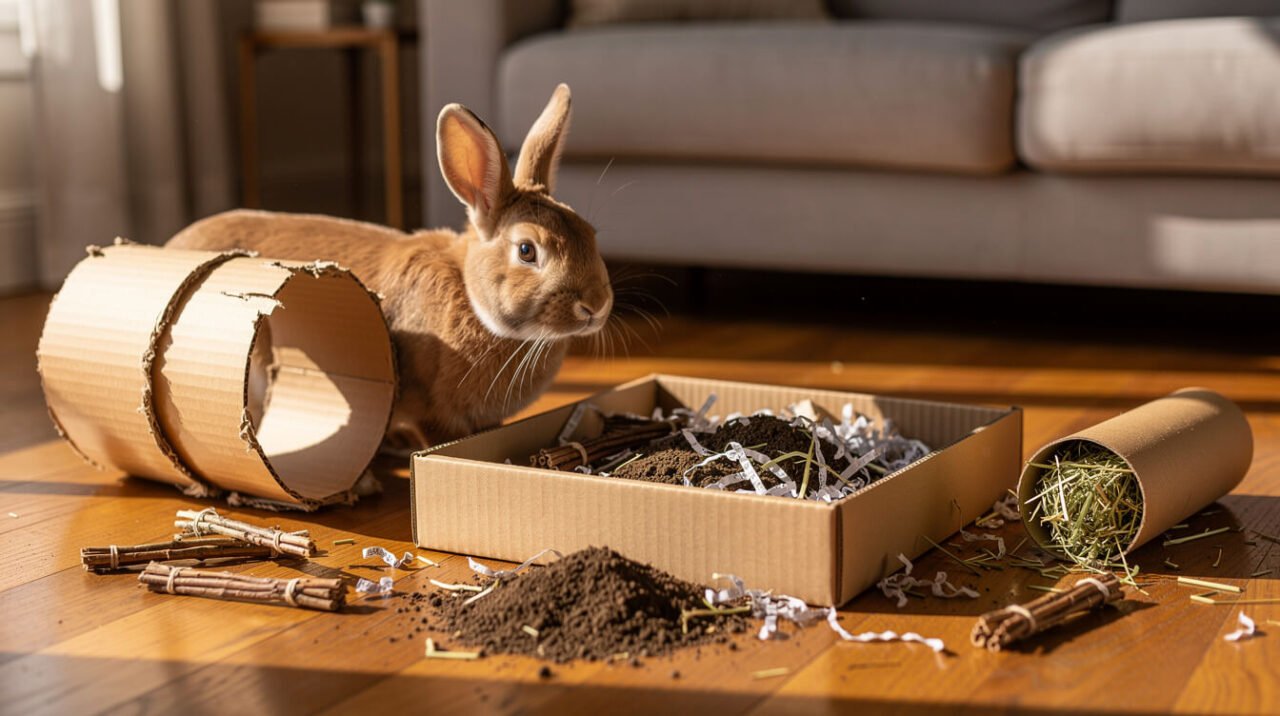
A rabbit with nothing to do becomes a rabbit who redecorates your baseboards. Enrichment isn’t a luxury layer on top of good care — for an animal that spends hours a day foraging and tunneling in the wild, it is good care.
Things to chew, dig, and destroy
Rabbits love what the House Rabbit Society charmingly calls "projects" — objects they can move, manipulate, and take apart. The best rabbit toys are mostly free: plain corrugated cardboard boxes with doorways cut in two sides; a digging box of topsoil or shredded paper with a hole cut halfway up the side, which redirects the digging instinct away from your carpet; willow and apple twigs, untreated wooden blocks, and hay-stuffed cardboard tubes; tunnels of large tube or rolled carpet; and foraging games — scatter a few herb leaves and let them hunt. Avoid painted wood, cedar, birch, and yew, none of which are safe for a species that chews everything, and rotate what’s available every few days, since novelty is most of the value.
Time it right, too. Rabbits are crepuscular, not nocturnal — most active around dawn and dusk — so a rabbit let out morning and evening uses that time far more enthusiastically than one let out at noon. And since a certain amount of keeper identity comes with the territory, our Bearded Dragon Crown Sunglasses King T-Shirt is the design that moves most from the GeoZoo shop; the reptile side of the house has had a head start on the merch.

Wear the obsession
The Bearded Dragon Crown Sunglasses King T-Shirt is the design keepers reach for most in the GeoZoo shop. If your rabbit shares a household with a lizard person — and in our experience it usually does — this is the one.
Grooming: molt season, nails, and why you don’t bathe a rabbit
Rabbits groom themselves meticulously, so your job is mostly about the fur they swallow doing it. Rabbits cannot vomit, so ingested fur has to pass all the way through, and during a heavy molt that’s a genuine gut risk. Brush several times a week normally and daily while molting, and keep hay intake high, because fiber is what moves fur through. Nails need trimming every few weeks; ask your vet or a rescue to show you once, since it’s a two-minute job with the right grip and a bad one to improvise.
Full-body baths are a different matter. Rabbit vets broadly advise against immersing a rabbit in water: the stress alone can be dangerous and a wet rabbit chills badly. Spot-clean with a damp cloth instead. More importantly, a persistently dirty rear end is a problem being shown to you — usually diet, obesity, dental pain, or arthritis making grooming impossible — and it needs a vet rather than a bath, not least because a soiled rear invites flystrike.
The daily and weekly rhythm
- Morning: fresh water, top up hay, serve the greens, empty the litter tray, and — the important one — look at your rabbit. Eating normally? Droppings normal? Rear end clean? Moving freely?
- Evening: exercise time, more hay, a quick hands-on check, rotate a toy.
- Weekly: full clean of the enclosure with soap and water or a dilute bleach solution (about 1:10), rinsed thoroughly, plus a nose-to-tail check of weight, nails, coat, and eyes.
- Annually: a veterinary exam even when nothing seems wrong, plus whatever vaccinations your vet recommends for your region.
Health: the daily checks that catch trouble early
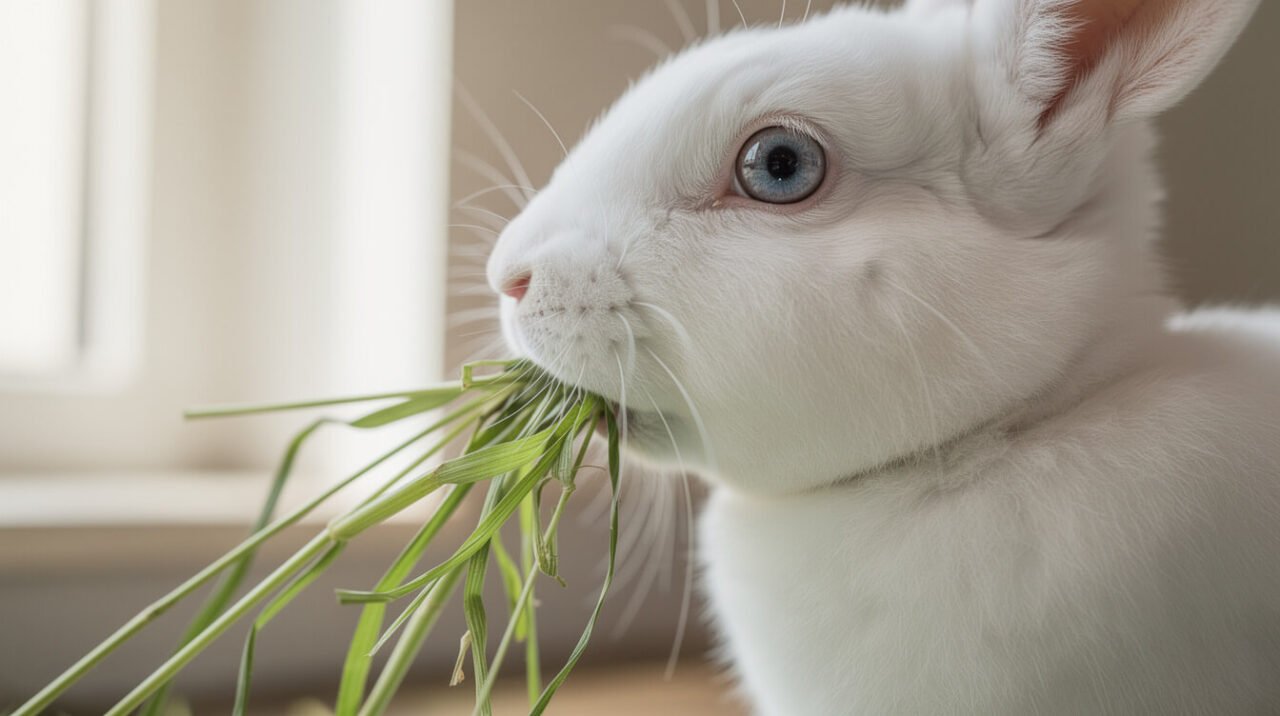
One fact organizes all rabbit health care: rabbits conceal illness for as long as they physically can. A prey animal that looks sick gets eaten, so by the time a rabbit looks unwell they’ve usually been unwell a while. That’s why the daily look-over isn’t fussiness — it’s the entire early-warning system.
GeoZoo is not a veterinary practice. Everything below is here to help you recognize when to make the call, not to diagnose or treat. Any sick or injured rabbit needs a qualified veterinarian, and with this species, sooner is dramatically better than later.
Read the litter box every morning
Rabbit droppings are the most honest daily health report you’ll ever get, and reading them takes five seconds. You want plentiful, round, firm, evenly sized droppings. What concerns a vet: fewer or smaller droppings than usual, gut motility slowing and the earliest signal you get; misshapen or strung-together droppings, often fiber intake or dental pain; soft, pudding-like stool, frequently too much fresh food but sometimes more; and no droppings at all, which is an emergency. Don’t wait to see whether it improves.
Signs that mean call the vet now
- Not eating — especially refusing a favorite treat, often the first crack in the facade
- Not passing droppings, or a bloated, tight-feeling abdomen
- Sitting hunched and still, or pressing the belly to the floor
- Loud tooth grinding, which in a rabbit often signals pain
- Lethargy, or hiding far more than usual
- Drooling, a wet chin, or dropping food while eating — classic dental signs
- Head tilt, loss of balance, or circling
- Labored breathing, or discharge from the eyes or nose
- A dirty or maggot-infested rear end — flystrike is a true emergency
A threshold used widely in rabbit care: if a rabbit hasn’t eaten or passed droppings for about twelve hours, get to a vet right away. The condition behind it — gastrointestinal stasis, where the gut stops moving — is the most common serious rabbit emergency and it progresses fast. Rabbits don’t have the metabolic reserve a dog or cat has, so "we’ll see how she is tomorrow" is the wrong plan for this species.
Spaying, neutering, and vaccination
Sexual maturity arrives at roughly four months in males and six in females, and intact rabbits develop both health and behavioral problems — territorial aggression, spraying, difficulty bonding, broken litter habits. Vets also widely describe a high rate of uterine cancer in unspayed does as they age, the most-cited medical reason to spay; ask your own vet how that applies to your rabbit.
Vaccination depends entirely on where you live, and this is one to raise with your vet rather than read off a page. In the UK and much of Europe, vaccination against myxomatosis and rabbit viral haemorrhagic disease (RVHD1 and RVHD2) is considered essential for indoor and outdoor rabbits alike, because both are usually fatal in unvaccinated rabbits and both can reach an indoor animal. In the United States, RHDV2 has been detected in a number of states and vaccine availability has varied by state and by year. Ask a rabbit-savvy vet what’s recommended and currently obtainable where you are — the answer genuinely changes. Also keep on your radar: sore hocks from hard flooring, dental disease, obesity from over-generous pellets, heatstroke in summer, and for any rabbit with outdoor access, fleas, ticks, and flystrike.
Find a rabbit-savvy vet before you need one
Rabbit medicine is not small-dog medicine — anesthesia, analgesia, dosing, and dentistry are all different, and a clinic that sees rabbits occasionally isn’t the same as one that sees them weekly. Look for a practice describing itself as exotic or small mammal, then ask how many rabbits they see and whether they do rabbit dentistry and spays routinely; the House Rabbit Society maintains a referral list that’s a good US starting point. Do this in your first week, not during your first emergency, and book a wellness exam when your rabbit comes home so there’s a healthy baseline on file. If you’re building a wider small-pet household, our guides to guinea pig care and ferret care apply the same find-the-specialist-early principle.
Rabbit care guide FAQ: the questions keepers ask most
How long do pet rabbits live?
Commonly eight to twelve years for a well-cared-for indoor rabbit, with ten-plus entirely normal. Breed and size play a part, and indoor living, neutering, and a hay-based diet all push the number up.
Can I keep just one rabbit?
You can, but the welfare evidence says you shouldn’t if there’s any alternative — solitary rabbits show measurable stress. If you currently have one, talk to a local rescue about a neutered, bonded partner, and in the meantime give that rabbit considerably more of your own floor-level company and enrichment.
Do rabbits really need to live indoors?
It’s strongly recommended: no predators, no weather extremes, far less flystrike risk, and much more interaction with the family, which a social species needs. A secure, fully enclosed, dig-proofed run attached to proper accommodation can work — but a lone hutch at the bottom of the garden is what welfare organizations have spent two decades arguing against.
Why isn’t my rabbit using the litter box anymore?
Three usual causes, in order of likelihood: the rabbit isn’t neutered and has started territorial marking; something changed in the environment (a new pet, a moved tray, a different litter); or the rabbit is unwell, since urinary problems and arthritis both break litter habits. A sudden change in a previously reliable rabbit is a reason to call your vet, not to retrain.
What vegetables can rabbits eat every day?
Romaine and other leaf lettuces, cilantro, basil, dandelion greens, and carrot tops make reliable daily bases. Rotate rather than repeat high-oxalate greens such as spinach, chard, and parsley, and treat broccoli and other brassicas cautiously since some rabbits get gassy on them. Keep carrots and fruit as occasional treats — about a tablespoon per two pounds of body weight per day, total. We work through individual foods one at a time, as with cucumber for rabbits and blueberries for hamsters.
Final thoughts: understand the rabbit, and the care follows
Almost everything in this rabbit care guide comes down to one idea: a pet rabbit is a wild rabbit in a living room. The space requirement, the hay obsession, the need for a companion, the hatred of being lifted, the hiding of illness, the compulsion to dig and chew — none of it is quirk. It’s the same animal that lives in a colony under a field, doing its best in your house. See it that way and the care stops being a checklist and starts being obvious. Of course they need room to run. Of course they want a friend. Of course they’d rather you sat on the floor.
So start with the four that matter most: real space, unlimited grass hay, a neutered companion, and a rabbit-savvy vet’s number saved before you need it. Add the thirty-second look at the litter box each morning. Everything else is refinement you can build over the years you’ll have together. First rabbit? You’re already doing the most important thing: reading up before you set anything in stone.
Before you go
Keep learning your animal
We publish a new guide every day. The best of them land in one short weekly email, so you never miss the one about your species.

Oliver Grant is your go-to expert for all things related to small mammals. With 15 years of hands-on experience raising and caring for rabbits, guinea pigs, hamsters, and ferrets, Oliver brings a wealth of knowledge to his readers.