The Complete Parrot Cage Guide: Sizing, Setup, and Safety
If you’re shopping for a parrot cage, you’ve probably already noticed the problem: most of what shows up in search is a product listing, not an answer. Retailers will happily sell you a cage — bar spacing, minimum dimensions, and whether that “gorgeous” dome-top model is actually big enough for your bird are things you have to figure out yourself. That’s what this guide is for.
A parrot’s cage isn’t a place you put them when you’re not around — it’s their home base, their safe retreat, and for many birds, the space they spend the most hours of their day in. Get it right and you’re setting your bird up for a calmer, healthier life. Get it wrong (too small, wrong bar spacing, bad placement) and you’re fighting an uphill battle against feather-destructive behavior, stress, and injury risk you didn’t have to create.
Here’s what you’ll walk away with: how to size a cage to your specific parrot species, the bar-spacing rule that actually matters, shape and material considerations, where to put it in your home, and how to set up the inside so it’s genuinely enriching — not just a box with a bird in it.
Parrot cage size: bigger than you think, sized to the species
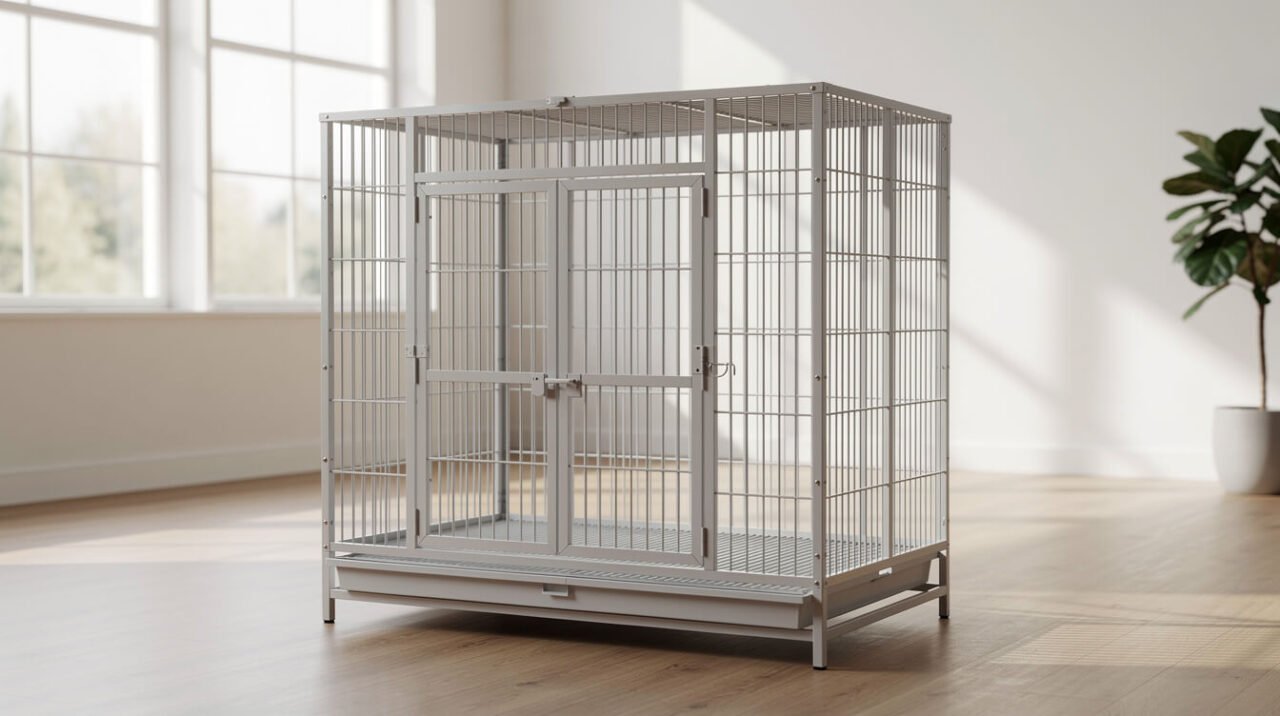
The single biggest mistake first-time parrot owners make is buying a cage sized like a starter home instead of a permanent one. The pet store cage that looked plenty big in the showroom is almost always undersized once you get it home and your bird starts actually living in it — flapping, climbing, and using every inch of space it can reach.
The rule of thumb breeders and avian vets use: your parrot should be able to fully extend both wings and flap without touching the bars on any side, and ideally have room to move between at least two perches without just turning around in place. Width matters more than height for most parrots, since they move side to side and climb more than they fly straight up.
As a starting-point guide by size class (always size up if you’re between categories or unsure):
- Small parrots (budgies, parrotlets, lovebirds): minimum roughly 18″ x 18″ x 24″, though bigger is always better — these small birds are surprisingly active.
- Small-to-medium parrots (cockatiels, small conures): at least 20″ x 20″ x 30″.
- Medium parrots (larger conures, quakers, Senegals, cockatiels who like room to roam): 24″ x 24″ x 36″ or larger.
- Medium-large parrots (African greys, Amazons, smaller cockatoos): 30″ x 24″ x 48″ and up — these are genuinely large housing commitments.
- Large parrots (macaws, larger cockatoos): the biggest cages made, often 36″ x 30″ x 60″+ — and even then, several hours a day of supervised out-of-cage time is non-negotiable.
These numbers are a floor, not a target — they’re the point where a cage stops being actively cramped, not the point where it’s ideal. If you’re choosing between two sizes for your species, size up. Species vary a lot in temperament and activity level even within the same size class, and a hyperactive Senegal will use a “medium parrot” cage very differently than a calm one will.
Bar spacing: the safety detail almost nobody explains clearly
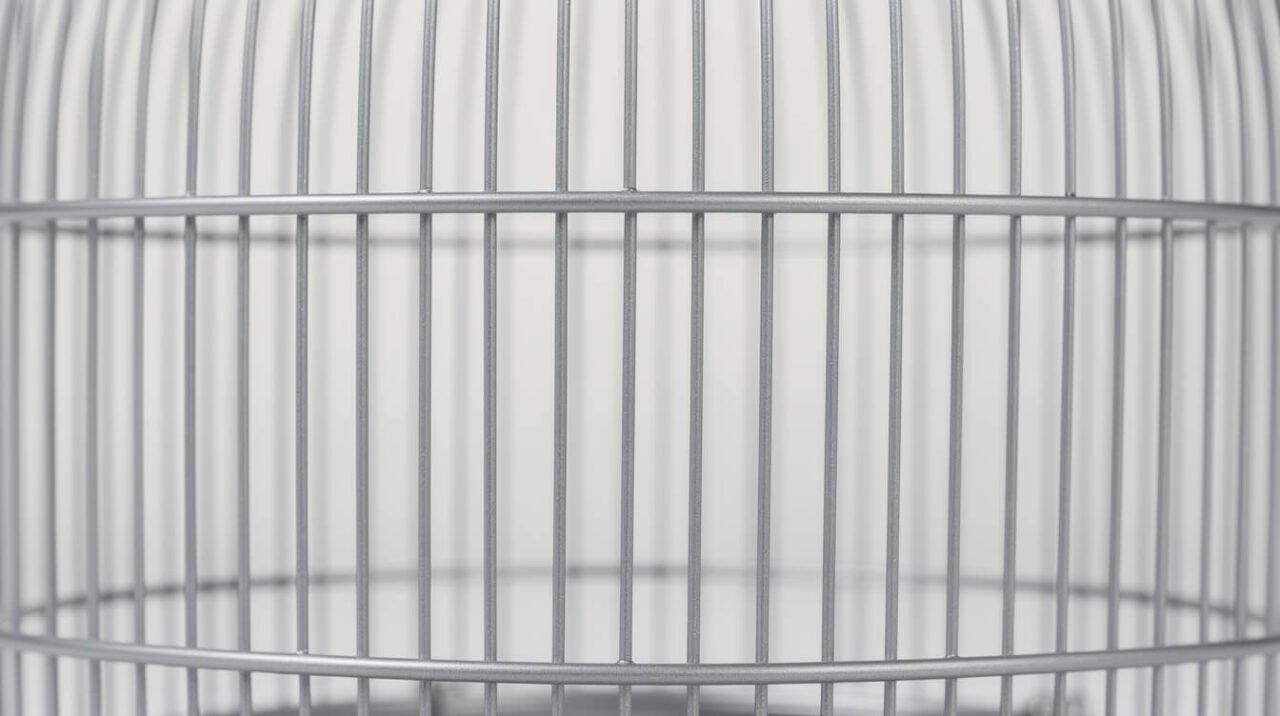
Bar spacing is where a beautiful cage can quietly become a dangerous one, and it’s the detail most product listings bury or skip entirely. Get it wrong in either direction — too wide for a small bird, too flimsy for a big one — and you’re looking at head or wing entrapment, escape, or a bent, chewed-through cage within months.
General bar-spacing guidance by size class:
- Small parrots (budgies, parrotlets, lovebirds, cockatiels): 1/2″ spacing or narrower. Anything wider risks a small head getting stuck between bars.
- Medium parrots (conures, quakers, Senegals, smaller Amazons): 1/2″ to 5/8″ spacing.
- Medium-large parrots (African greys, larger Amazons, smaller cockatoos): 5/8″ to 3/4″ spacing.
- Large parrots (macaws, larger cockatoos): 3/4″ to 1″ spacing is standard, but bar thickness and gauge matter just as much here — a macaw’s beak can bend or pry apart thin bars over time, so look for heavy-gauge, powder-coated steel or stainless steel construction rather than the thinner wire common on small-bird cages.
If you’re ever unsure which category your bird falls into, size down the spacing rather than up — a bar spacing that’s slightly tighter than “necessary” is an inconvenience; one that’s too wide is a genuine injury risk.
Choosing a cage material, shape, and finish
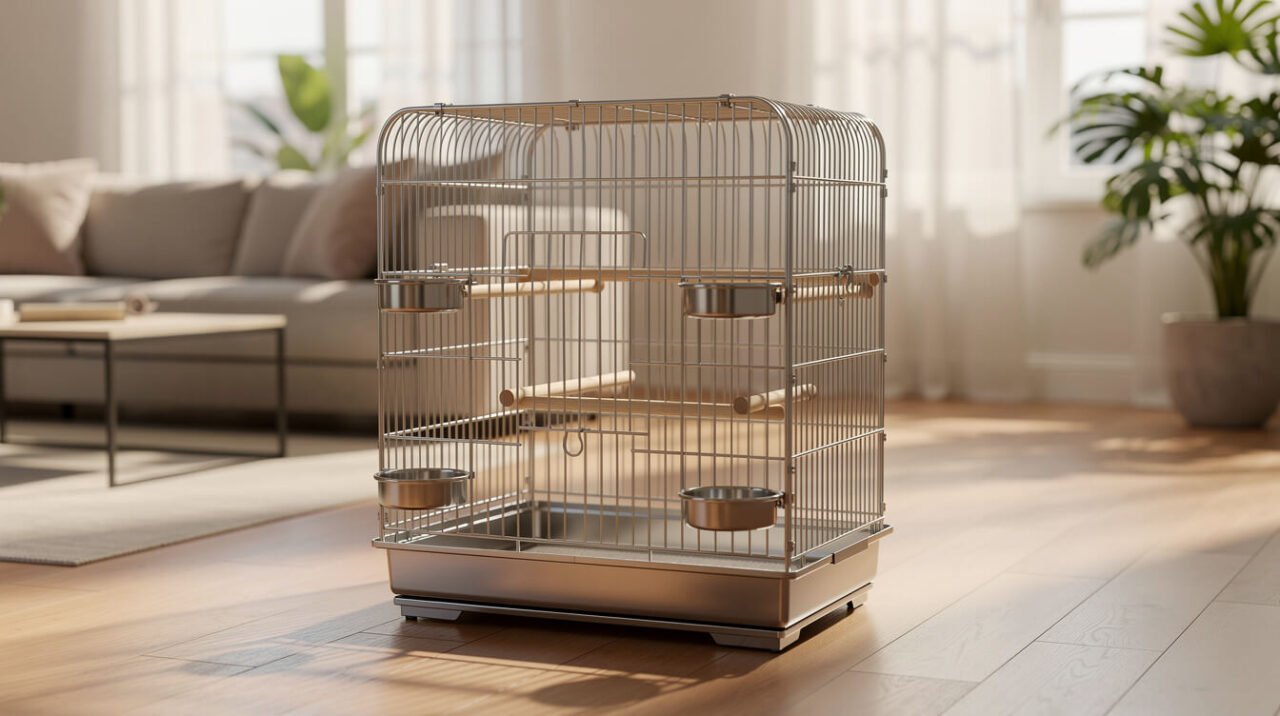
Once size and bar spacing are locked in, material and shape are where you can actually think about your home and your bird’s personality.
Material
Powder-coated steel is the standard for most parrot cages — it’s durable, easy to clean, and comes in enough finishes to match most rooms. The catch: powder coating can chip over years of beak contact, and a bird that finds a chipped spot may keep working at it. Check periodically and touch up or retire a cage once coating is significantly compromised, since flaking paint and exposed metal underneath aren’t something you want a curious beak investigating.
Stainless steel costs more but doesn’t chip, rust, or need repainting — it’s the long-term choice for large parrots with serious chewing power (macaws and cockatoos especially), and the easiest to keep genuinely sanitary.
Avoid cages with zinc or lead-containing hardware, galvanized wire not rated for pet use, and anything with visible rust — parrots are notorious chewers, and heavy-metal exposure from substandard cage hardware is a real, documented risk in pet birds.
Shape
Rectangular cages are almost always the better choice over round or dome-top designs. Round cages look striking, but corners actually matter to birds — many species use them as a sense of security, a defined “back” to retreat to. Round cages also waste usable space compared to a rectangular footprint of the same width.
Bar orientation
Horizontal bars on at least one or two sides make a real difference for climbing species — parrots are natural climbers, and horizontal bars give them something to grip and scale rather than just perch-to-perch hop. If you can find a cage with horizontal bars on the sides and vertical on the front/back, that’s often the best of both.
Where to put the cage in your home
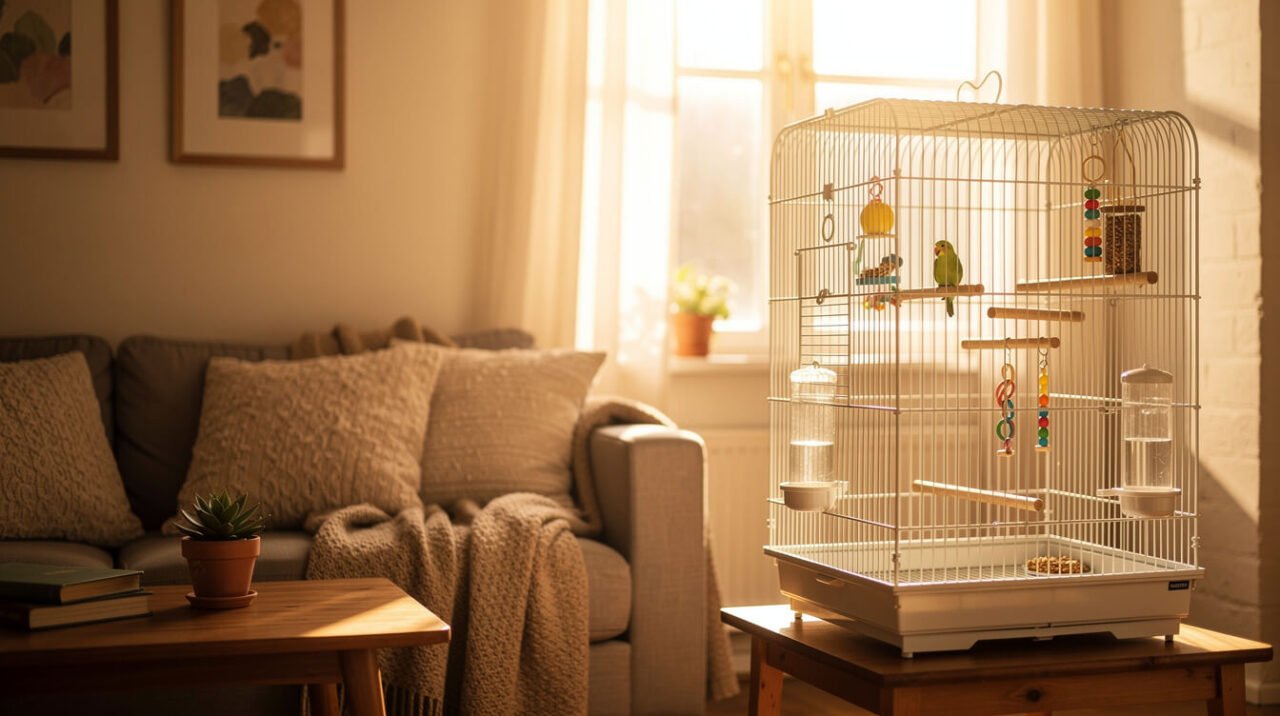
Placement affects your bird’s stress level as much as the cage itself does. A few rules that hold across almost every parrot species:
- Put it where the family actually is. Parrots are flock animals — a cage tucked away in a quiet spare room can leave a social species feeling isolated. Living rooms or family spaces (away from constant foot traffic in narrow hallways) tend to work best.
- Give it a “back to the wall.” One or two sides against a wall, rather than floating in the middle of a room, helps most parrots feel secure instead of exposed on all sides.
- Avoid the kitchen entirely. This one’s non-negotiable: overheated non-stick cookware (PTFE/Teflon) releases fumes that are lethal to birds in minutes, and even without that risk, kitchens run hot, greasy, and full of ingredients that are unsafe for parrots. Keep the cage in a separate room from any kitchen in active use.
- Skip direct sun and cold drafts. Near a window is great for natural light; directly in a sun-baked window with no shade option, or right in the path of an AC vent or drafty door, is not.
- Keep the cage height around eye level or slightly above. A cage on the floor can make a bird feel vulnerable to anything walking past (including other pets); too high above head height can encourage a sense of dominance over the room that shows up as territorial behavior.
If you’re setting up a cage for the first time alongside a new bird, our White Faced Cockatiel care guide walks through a lot of these same placement and comfort considerations for a smaller, apartment-friendly species — worth a look if you’re deciding between cage sizes for a first bird.
The weekly care guide
Get it right for your animal, every week
One email a week: new care guides, species deep-dives, and the safety answers keepers search for, written by our specialists. No spam. Unsubscribe anytime.
Setting up the inside: perches, bowls, and enrichment
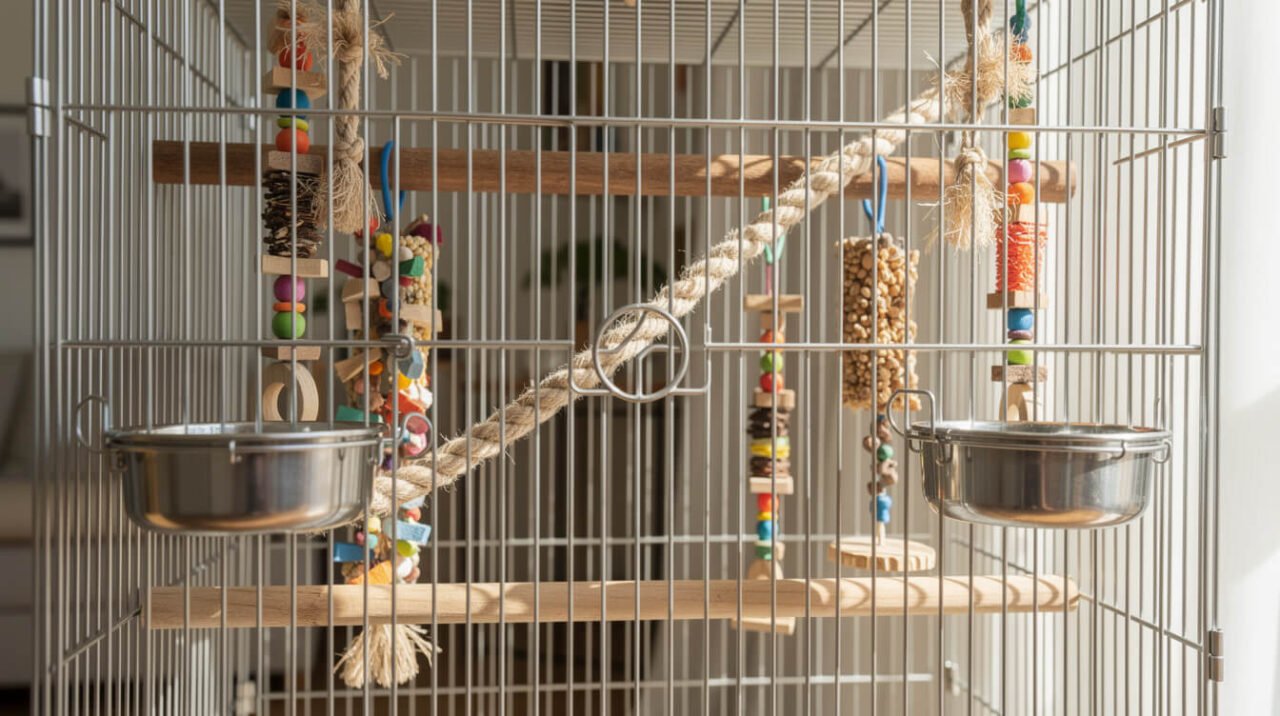
An empty cage, no matter how well-chosen, isn’t a home yet. What goes inside matters just as much as the four walls.
Perches
Skip the single dowel perch that ships with most cages — uniform diameter, uniform texture, everywhere, is genuinely bad for foot health over time (parrots can develop pressure sores and arthritis-like foot problems from standing on the same surface constantly). Mix at least 2–3 perch types: natural wood branches of varying diameter (which also give your bird something appropriate to chew), a rope perch for softer footing, and a concrete or calcium perch positioned near (not directly over) food/water, which helps naturally file nails with normal use.
Bowls and placement
Use separate bowls for food, fresh water, and any soft/wet food, and place them away from perches where droppings will land in them. Stainless steel bowls are easiest to keep sanitary and the safest chew-resistant option if your bird likes to investigate everything with its beak.
Enrichment
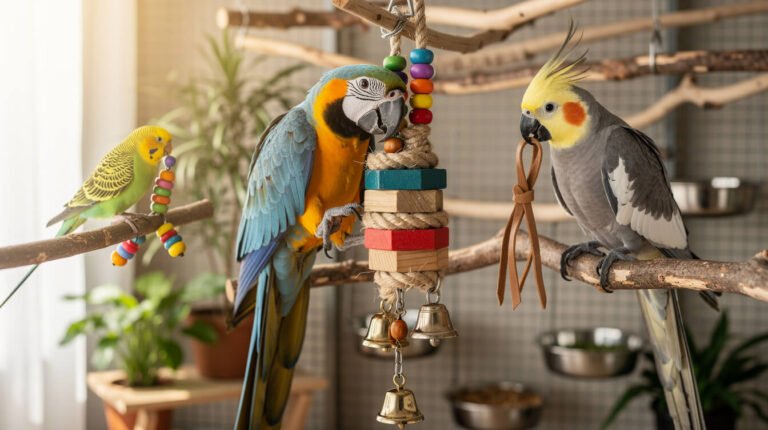
A cage without toys is a box, not habitat — enrichment is core to a parrot’s mental health, not an optional extra. Rotate in a mix of foraging toys (make food a small puzzle instead of a handout), shreddable toys (safe untreated wood, paper, natural fiber), and at least one chew-safe item, swapping a few out every week or two so the environment doesn’t go stale. If your bird already has a toy rotation you love, our backyard chicken treat-safety guide covers a similar “keep it varied, not just abundant” principle that applies just as well to enrichment as it does to food.
Multiple perch levels and cage accessories worth having
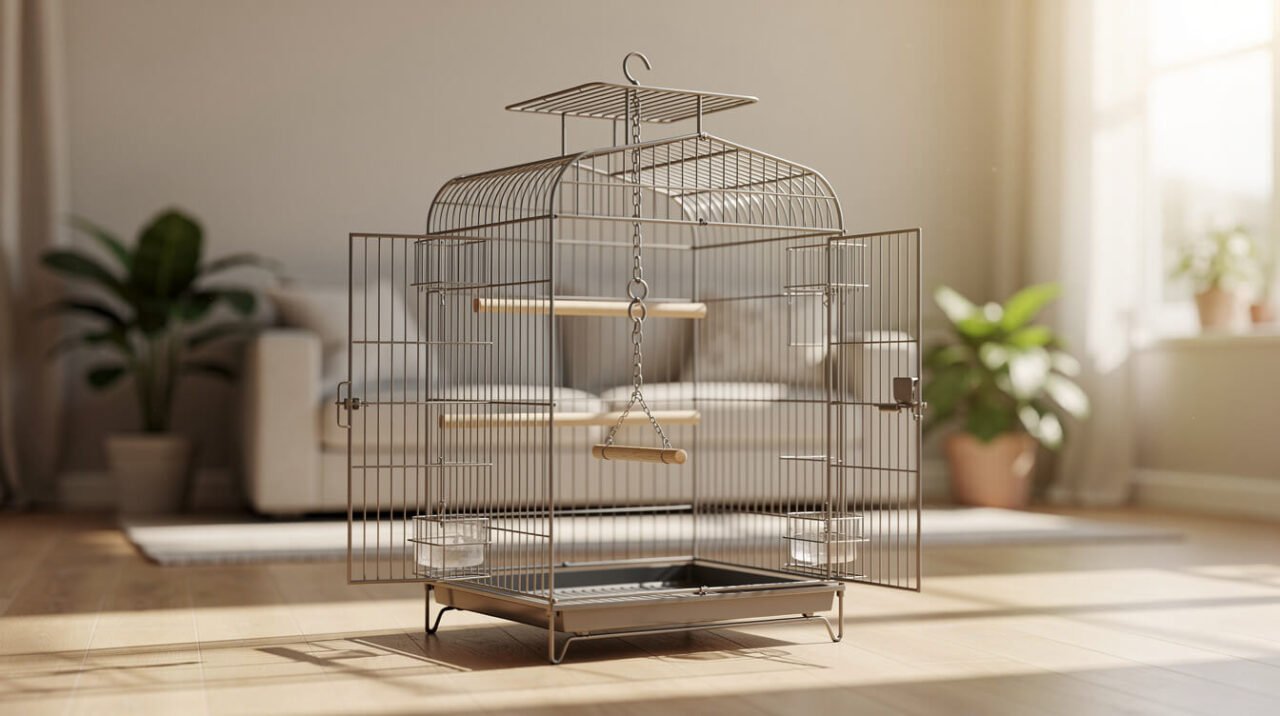
A few accessories consistently earn their keep beyond the cage basics:
- Play tops — an open platform on top of the cage gives supervised out-of-cage time a defined “home base” rather than free-roaming your furniture, and most parrots take to them quickly.
- Swings — genuinely enjoyed by most parrot species and a good low-effort enrichment add, as long as they’re sized appropriately and not the only perch option.
- Cage covers — useful for establishing a consistent sleep schedule (most parrots do best with 10–12 hours of uninterrupted darkness), but should be breathable fabric, not airtight, and removed each morning rather than left on all day.
- Seed/debris guards — a mesh or plastic skirt around the base cuts down dramatically on the mess a parrot’s normal flinging habits create, without affecting the bird at all.
If you’re building out a full habitat setup and want to see how the size-and-safety-first approach applies outside the bird world too, our leopard gecko tank setup guide covers a similar species-size-to-enclosure-size logic, even though the animal and materials are completely different.
What a good parrot cage actually costs — and where to spend vs. save
Parrot cages span an enormous price range, and it’s genuinely hard to tell from a photo alone whether a $150 cage and an $800 cage differ in ways that matter for your bird. Here’s the honest breakdown:
- Small parrot cages (budgies, cockatiels, small conures) run roughly $80–$250 for a well-built option. At this size, spending more mostly buys style and durability, not safety — a mid-range cage that meets the size and bar-spacing guidelines above is genuinely fine.
- Medium parrot cages (quakers, Senegals, larger conures) typically run $200–$500. This is the range where cheaper cages start cutting corners on gauge (bar thickness) rather than just finish — worth reading dimensions and material specs carefully rather than shopping on looks.
- Large parrot cages (African greys, Amazons, cockatoos, macaws) commonly run $400–$1,500+. At this size, spending more genuinely buys safety: heavier-gauge steel that resists a powerful beak, sturdier hardware, and a paint or plating finish that holds up to years of chewing.
Where it’s worth spending more, regardless of size class: bar gauge/thickness for a strong chewer, stainless steel over powder coating for a large parrot, and a genuinely secure locking mechanism (parrots are notorious escape artists and many learn to work simple latches). Where it’s fine to save: cage color, decorative shape details, and included accessories you’ll likely replace anyway (most stock perches and bowls are worth upgrading regardless of price point).
A secondhand cage from a reputable source can be a smart way to get a larger, better-built cage than your new-cage budget would otherwise allow — just inspect it closely for rust, chipped coating, bent bars, or non-standard bar spacing before bringing a bird anywhere near it.
Introducing your parrot to a new cage without added stress
Even a perfectly-chosen cage is still a new, unfamiliar object to your bird, and parrots — as a rule — are wary of change. Swapping cages abruptly, especially on the same day as bringing a new bird home, stacks two big stressors at once.
A gentler approach that works for most birds and situations:
- Set up the new cage a few days before the switch if possible, in its final location, so it’s already part of the environment before your bird has to use it.
- Move familiar items over first — the same perches, toys, and even a food bowl your bird already recognizes reduce how much feels “new” all at once.
- Let your bird choose to explore rather than being placed directly inside. Open both cage doors near each other (or use a play top as a bridge) and let curiosity do the work over a day or two.
- Keep the daily routine identical during the transition — same feeding times, same lights-out schedule, same amount of out-of-cage time — so the cage is the only variable that’s changed.
- Expect a quieter, more watchful bird for the first few days. Reduced vocalizing or eating a little less than usual is normal short-term adjustment; a bird that stops eating entirely or shows signs of distress beyond a few days is worth a call to an avian vet.
Frequently asked questions about parrot cages
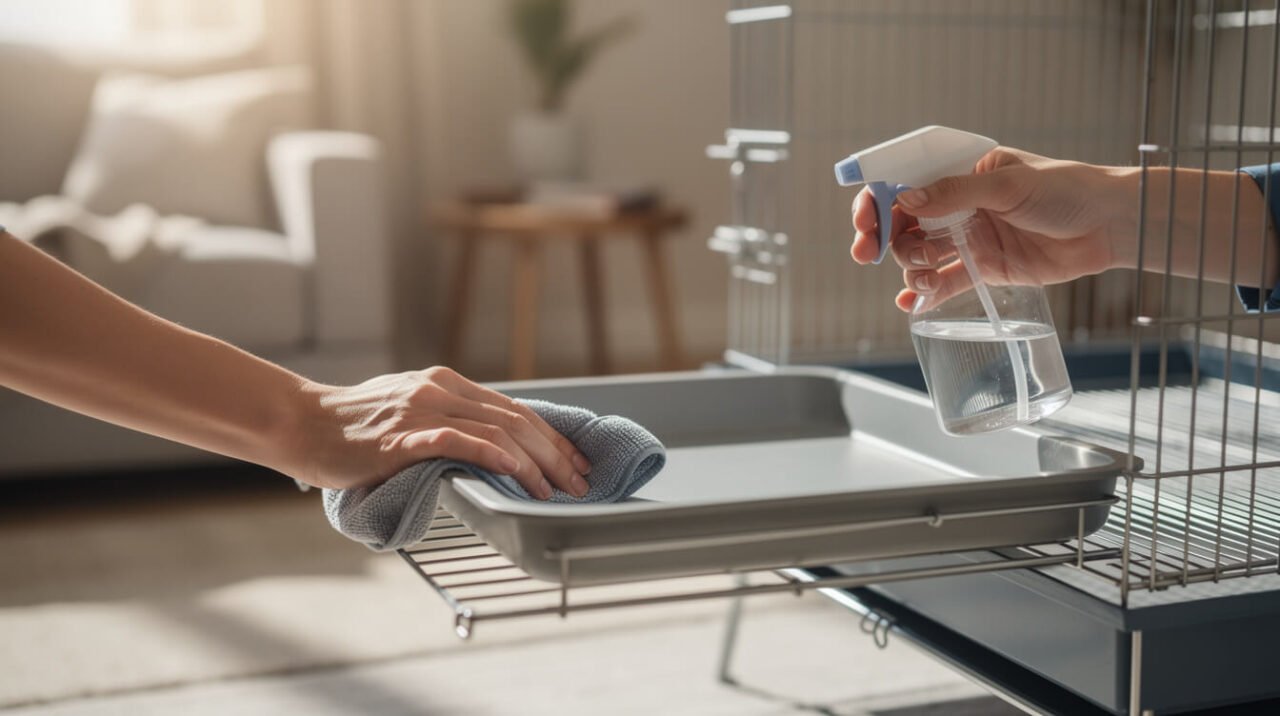
How often should I clean a parrot cage?
Wipe down bowls and spot-clean the tray/liner daily, and do a full scrub-down of bars, perches, and toys with a bird-safe disinfectant weekly. Parrots are messy by nature, and buildup on bars or perches becomes a bacterial and fungal risk fast.
Can two parrots share one cage?
Sometimes, but it depends heavily on species, individual temperament, and whether they’re a bonded pair. If you’re considering it, size up significantly beyond a single-bird recommendation, provide multiple full sets of food/water/perches so there’s no competition, and watch closely for aggression — if in doubt, house separately and let them interact during supervised time instead.
Is a cheap cage ever okay for a young or “starter” bird?
We’d gently push back on the idea of a true “starter” cage. Buying a smaller or lower-quality cage with the plan to upgrade later usually just means upgrading sooner than expected (and spending twice), and a too-small early cage can shape a bird’s stress baseline before you even notice it. If budget is the constraint, it’s worth buying one correctly-sized secondhand cage in good condition over a new but undersized one.
My parrot’s cage came with a bar spacing wider than recommended for their size — what now?
Don’t wait this one out. If a bird can fit its head between bars, entrapment and injury risk is real, not theoretical. Either return/replace the cage or ask an avian vet or experienced breeder about wire-mesh liner options that are safe to add — don’t just monitor and hope.
How do I know if my current cage has become too small?
Watch for feather damage from repeated bar contact, a bird that seems reluctant to move or flap even during out-of-cage time, or increased screaming/aggression that improves noticeably during time outside the cage. Any of these is worth a size-up conversation, and persistent feather-destructive behavior is worth a call to an avian vet to rule out other causes first.
Wear the obsession
Bearded Dragon Crown Sunglasses King T-Shirt
Price range: $24.99 through $26.99
Shop this designFinal thoughts: the cage is the foundation, not the whole picture
A well-chosen cage gets the fundamentals right — safe bar spacing, real room to move, sensible placement — so you can spend your energy on the parts that actually build a relationship with your bird: training, talking, foraging games, and supervised time out and about. Get the cage right once, size up when in doubt, and it becomes the quiet, safe backdrop for everything else you and your parrot build together.
Before you go
Keep learning your animal
We publish a new guide every day. The best of them land in one short weekly email, so you never miss the one about your species.

Emily Chen is a passionate avian specialist with over a decade of experience in nurturing and training birds of all feathers. From the melodious canaries to the intelligent parrots, Emily’s expertise spans a wide range of avian care, including diet, habitat setup, and behavioral training.