Can Dogs Eat Stuffing? What’s in the Pan, the Box, and the Bird (and How Much Onion That Really Is)
Can dogs eat stuffing? The short answer is that stuffing isn’t something to share with your dog on purpose. The bread isn’t the problem. Almost every stuffing, homemade or boxed, is built on onion, garlic, or both, and it’s usually cooked in plenty of butter or pan drippings. A cube that rolls off the table and gets snapped up is rarely an emergency for most dogs. A small dog who gets a full scoop, or any dog who gets into the leftover pan or a bag of dry mix, is a different story, and that’s worth a call to your vet.
We wanted to go past “it has onions, so no.” We checked 160 branded stuffing products in the USDA’s food database to see what’s actually on the labels. We worked out how much onion is really in a serving of a named, popular recipe, and set that against the amounts veterinary references link to illness. We also answered the questions keepers actually ask: is sage safe, what about stuffing cooked inside the bird, and what if your dog ate the other kind of stuffing, the fluff out of a toy. Every number below comes from a named source, so you can check our work.
Can dogs eat stuffing? The short answer
No, not as a treat, and here’s the honest breakdown so you know how worried to be:
- The base is fine. Plain bread cubes, celery, and sage aren’t toxic to dogs. If stuffing were only those, we’d be writing a much shorter article.
- The onion and garlic are the real issue. Onions, garlic, leeks, and chives are all Allium plants. They damage red blood cells in dogs, and the Merck Veterinary Manual notes that cooking doesn’t make them safe. Dogs have been affected after eating “raw, cooked, dehydrated, or granulated onions and garlic.”
- The butter and drippings matter too. A rich, fatty food that a dog isn’t used to can upset the stomach. In some dogs it’s linked to pancreatitis, which we cover below.
- The add-ins can change everything. Raisins, macadamia nuts, sausage, and cooked bone fragments turn up in some recipes, and a couple of those are “call now” ingredients.
So how worried should you be? It depends on how much, what kind, and how big your dog is. A forkful dropped near a 70-pound Labrador is a very different event from a 10-pound dachshund working through the leftovers dish. We’ll put real numbers on that in a moment.
If your dog has already eaten stuffing and you’re reading this in a hurry, skip to “My dog ate stuffing: what to do” below. If you’re unsure, call your vet or an animal poison line. The ASPCA Animal Poison Control Center is (888) 426-4435 and the Pet Poison Helpline is (855) 764-7661. Both may charge a consultation fee.
Can dogs eat stuffing from a box? We checked 160 labels
Most articles say stuffing “contains onions and garlic” and leave it there. We wanted to know how true that is for what’s actually on store shelves, so we searched the USDA FoodData Central branded-foods database for stuffing products and read every ingredient list. After removing stuffed fish and meat entries, we had 160 products. Here’s what they showed:
- Seasoned stuffing mixes and ready-made stuffing: 139 of 146 listed onion, garlic, or both (about 95%). That includes the familiar boxed mixes. One Kraft-branded stuffing mix lists onions third, right after flour and corn syrup, with garlic further down.
- 86 of those 146 used a concentrated form: dried, dehydrated, or toasted onion, onion powder, or garlic powder. This matters because Merck says Allium poisoning in dogs and cats “is most commonly associated with ingesting concentrated forms,” such as “dehydrated flakes, powders, or dry onion soup mixes.” Dry stuffing mix straight from the box is about as concentrated as stuffing gets.
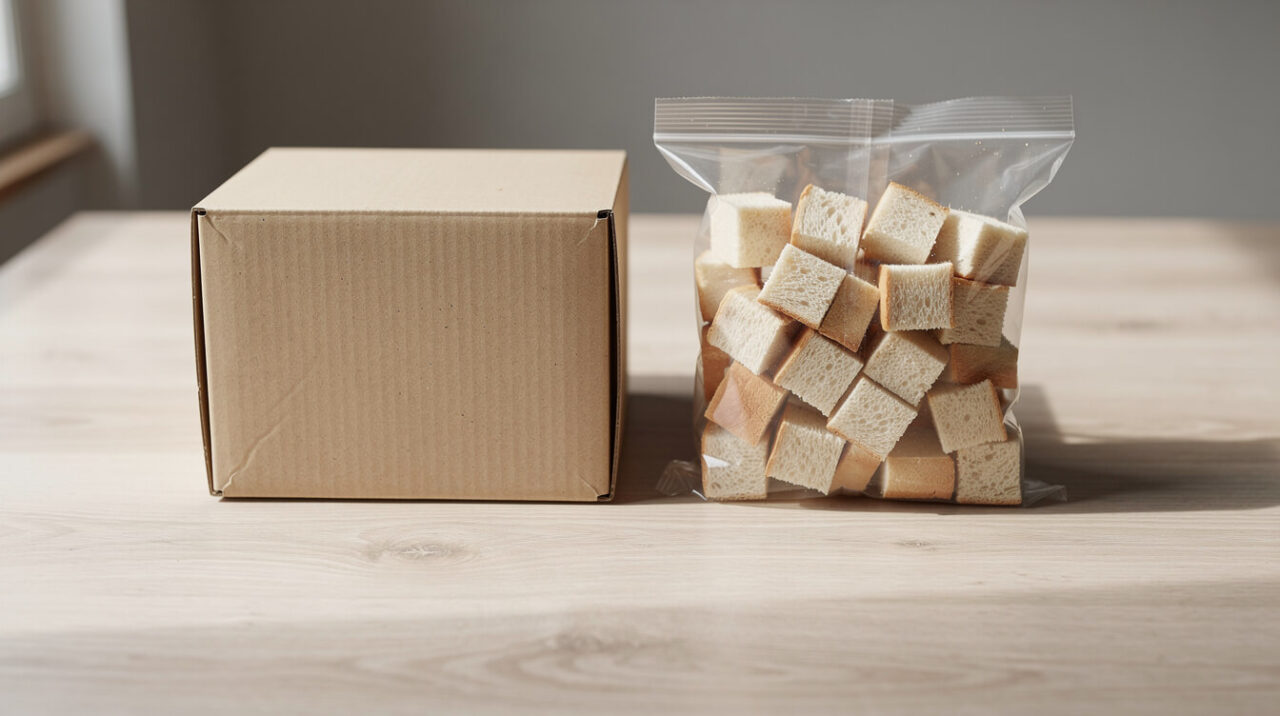
- Plain, unseasoned stuffing bread and bread cubes: 0 of 14 listed onion or garlic. These are just bread, toasted and cubed.
- Xylitol: 0 of 160. At least one popular pet-retailer article warns that store-bought stuffing may contain xylitol. We couldn’t find a single stuffing label that does. Xylitol is a real and serious danger in sugar-free baked goods and gum, but stuffing isn’t where it hides.
- Raisins: 0 of 160. Cranberries: 13. Raisins turn up in homemade family recipes far more than in boxed ones. Our guide to cranberry sauce for dogs covers cranberries.
“Spices” can’t hide onion or garlic powder
People often worry that a vague “spices” line on a label could be hiding onion. Under U.S. labeling rules, it can’t. The FDA’s definition of “spice” in 21 CFR 101.22 excludes foods like “onions, garlic and celery.” It also says that “powdered or granulated onions, garlic powder, and celery powder” must be “declared by their common or usual name.” If onion or garlic is in a U.S.-labeled product, it should be named. That makes the label genuinely useful, but only for boxed products. A homemade stuffing has no label, and nearly every homemade recipe starts by sautéing onion.
What about sage?
Good news on the herb that gives stuffing its smell: the ASPCA lists garden sage (Salvia officinalis) as non-toxic to dogs. Sage isn’t the problem. The onion it’s cooked with is. Celery is also fine for dogs in sensible amounts (here’s our celery guide), but it can’t cancel out the onion in the same pan.
How much onion is in a serving of stuffing? The math by dog size

“It depends on the amount” is true, but it doesn’t help much unless someone shows you the amounts. So let’s do that with one named recipe, clearly labeled as an estimate.
The recipe: The Kitchn’s classic Thanksgiving stuffing serves 8 and uses 2 medium yellow onions plus 4 garlic cloves. USDA puts a medium onion at 110 g and a garlic clove at 3 g. That works out to about 27 g of onion and 1.5 g of garlic per serving. The same recipe also lists the onion as “3 cups,” and USDA weighs a cup of chopped onion at 160 g. If you measure by the cup, that’s closer to 60 g of onion per serving. Real home cooking falls somewhere in that range, so we show both.
The reference point: Merck reports that in dogs, “ingestion of 15–30 g/kg of raw onion has resulted in clinical signs.” It also notes that garlic is “3–5 times more toxic than onion.” The table below uses the lower end, 15 g per kg, because that’s where signs have been reported, not where they’re guaranteed.
| Dog’s weight | Onion where signs have been reported (15 g/kg) | Servings at ~27 g onion each | Servings at ~60 g onion each |
|---|---|---|---|
| 10 lb (4.5 kg) | about 68 g | about 2½ | about 1 |
| 20 lb (9 kg) | about 136 g | about 5 | about 2¼ |
| 30 lb (13.6 kg) | about 204 g | about 7½ | about 3½ |
| 50 lb (22.7 kg) | about 340 g | about 12 | about 5½ |
| 70 lb (31.8 kg) | about 476 g | about 17 | about 8 |
Onion only. The garlic in each serving (about 1.5 g, which acts like roughly 4.5–7.5 g of onion at Merck’s 3–5×) pushes every number lower.
How to read this table, and how not to
- A dropped cube or a lick of the spoon is a tiny fraction of these amounts for almost any dog. That’s why most vets aren’t alarmed by a single forkful.
- A full serving for a small dog is a meaningful share of the threshold. For a 10-pound dog it can be most or all of it, depending on how onion-heavy the recipe is.
- The leftover pan is the real risk. A dog who gets into the dish after dinner can eat several servings in a minute.
- Dry boxed mix doesn’t fit this table at all. Its onion is dehydrated or powdered, the concentrated form Merck flags, and the box doesn’t tell you how much is in there. If your dog ate dry mix, call your vet; don’t try to calculate.
- This isn’t a “safe below” line. These are amounts where signs have been reported. Dogs vary, and leftovers tend to come out more than once over a holiday weekend. When you call your vet, count everything, not just one plate.
Timing matters too. Merck explains that the damage builds behind the scenes: the red blood cell changes begin within 24 hours, peak around 72 hours, and the red cells break down “typically… 3–5 days after exposure.” A dog who seems completely normal the evening of Thanksgiving hasn’t necessarily been cleared. Watch over the next several days for weakness, pale gums, fast breathing, reluctance to exercise, or dark red or brown urine.
Butter, drippings, and the bird: stuffing for dogs beyond the onion
Even an onion-free stuffing isn’t a great dog food, and it helps to know why.
Calories and fat
The Kitchn’s nutrition panel puts one serving at 283 calories and 11.6 g of fat. Love & Lemons’ classic stuffing comes in at 243 calories and 11 g of fat per serving. To put that in dog terms, we used a common estimate of a typical adult pet dog’s daily energy needs. One serving of The Kitchn’s stuffing is roughly:
- 80% of a day’s calories for a 10-pound dog
- 36% for a 30-pound dog
- 19% for a 70-pound dog
Most vets suggest treats stay under about 10% of a dog’s daily calories. For a 10-pound dog that’s around 35 calories, about one-eighth of a serving, and that’s before you think about the onion.
Why rich holiday food and pancreatitis come up together
Merck’s chapter on pancreatitis in dogs and cats says “dietary indiscretion is believed to be a common risk factor in dogs.” That’s the veterinary term for eating something unusual, like a plate of rich leftovers. Merck also notes that Miniature Schnauzers “have been reported to be dramatically overrepresented.” Signs can include vomiting, not eating, weakness, belly pain, and diarrhea, though milder cases can be vague. If your dog has had pancreatitis before, or is a breed known to be prone to it, keep rich holiday food well away. We go deeper into the fat side of holiday sides in our guides to mashed potatoes and mac and cheese.
What about the salt?
Stuffing is salty: The Kitchn lists 542 mg of sodium per serving, and some recipes run much higher. Still, salt poisoning isn’t the realistic worry from a serving of homemade stuffing. Merck puts the dose where signs of salt toxicosis can appear in dogs at 2–3 g of salt per kg. Even for a 10-pound dog, that’s more than six of those servings. Salt adds to the case against sharing, mainly through thirst and stomach upset, but onion and fat are the bigger concerns.
Stuffing cooked inside the bird
Stuffing baked inside the turkey soaks up drippings, so it’s fattier than the same recipe baked in a dish. It can also pick up things that don’t belong in a dog:
- Trussing string. Kitchen twine soaked in meat juices is very tempting to a dog, and string is a linear foreign body. Merck is clear that a linear foreign body in the mouth “must never be pulled,” because pulling can tear tissue. If you see string hanging from your dog’s mouth, leave it alone and call your vet.
- Small bone fragments from carving, especially if leftover stuffing gets scraped out of the carcass. Cooked poultry bones can splinter.
- Sausage, bacon, or giblets. These add more fat and salt, and sausage is often seasoned with garlic. Our breakfast sausage guide explains why.
Add-ins that change the call
- Raisins (common in some family recipes) can cause kidney injury in dogs. Cornell’s Riney Canine Health Center notes that dogs differ in their sensitivity, so “the amount that causes harm is unknown and cannot be predicted.” If your dog ate stuffing that had raisins in it, call your vet or a poison line now, even if your dog seems fine.
- Macadamia nuts can cause vomiting, weakness, wobbliness, and overheating in dogs. Merck describes it as typically nonfatal, but it’s still a reason to call your vet if they were in the recipe.
- Dried cranberries, pecans, and walnuts mainly add fat and sugar. They aren’t a reason to panic, but they’re another reason not to share.
- Nutmeg shows up in some sweet or sausage stuffings in tiny amounts. Our gingerbread guide walks through why recipe-level nutmeg is rarely the real danger.
The weekly care guide
Get it right for your animal, every week
One email a week: new care guides, species deep-dives, and the safety answers keepers search for, written by our specialists. No spam. Unsubscribe anytime.
Better ways to share the holiday with your dog
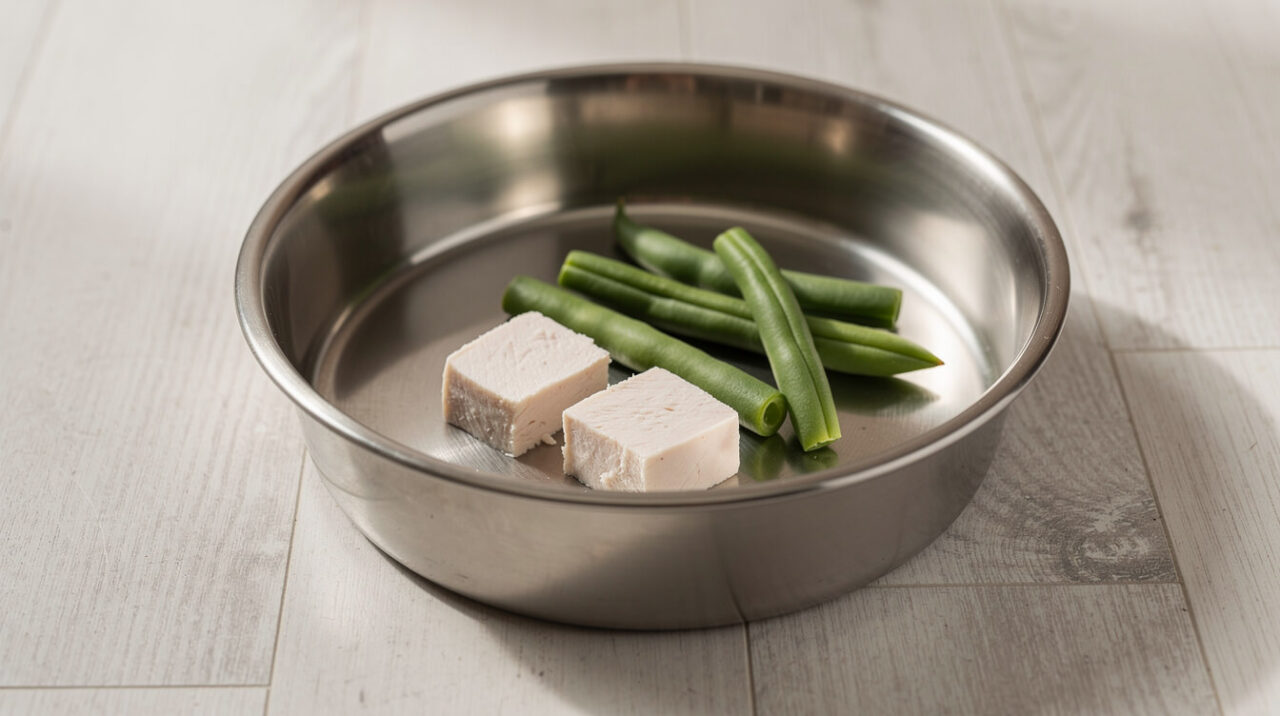
This is the fun part. Your dog doesn’t need stuffing to feel included, and there’s plenty on the Thanksgiving table they can have, as long as it’s set aside before the onion, butter, and gravy go on.
- A few small bites of plain turkey breast, white meat, no skin, no bones, no gravy. Set them aside as you carve, before anything gets seasoned.
- Plain green beans, steamed or raw, with no butter, almonds, or fried-onion topping.
- A spoonful of plain pumpkin (plain canned pumpkin, not pie filling). Our pumpkin guide for dogs has the portion sizes by weight, and our pumpkin pie guide explains why the dessert version is different.
- A bit of plain sweet potato, cooked and unseasoned. Our guide to whether dogs can eat yams explains why the candied, marshmallow-topped casserole doesn’t count.
- A single plain bread cube, if you really want to share “stuffing.” Pull one from an unseasoned bag before anything is mixed in. It’s nutritionally pointless, but it’s harmless in that amount. Once the cube has been tossed with sautéed onion and butter, it’s stuffing again.
- Their own food, served while you eat. Many dogs care more about being included than about what’s in the bowl. A stuffed lick mat or a chew toy at the edge of the room can make them feel part of the meal.
If you love getting this kind of detail right, you’re our kind of person. And if your household has a reptile keeper as well as a dog, our Bearded Dragon Crown Sunglasses King T-Shirt is a fun way to wear the obsession to the holiday table.
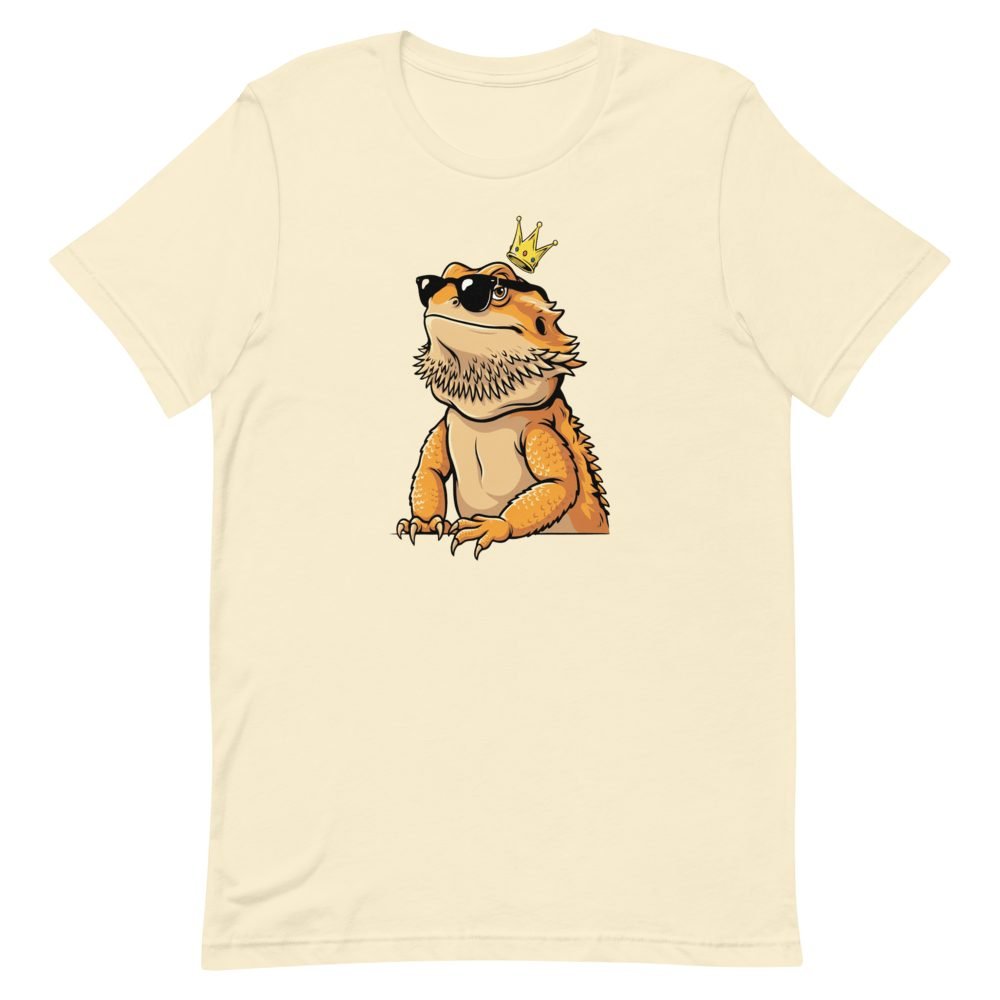
Wear the obsession
The Bearded Dragon Crown Sunglasses King T-Shirt: a crown, shades, and total basking-rock confidence. Made for keepers whose household runs on more than one species.
A simple plan for the day
Most stuffing incidents aren’t about sharing. They’re about opportunity: a dish left on a low coffee table, a guest who doesn’t know the rules, a trash bag by the back door. A few habits cover most of it:
- Tell guests, kids included, that the dog’s treats come from one person only.
- Keep the stuffing dish on the back of the counter or table, never at nose height.
- Put leftovers straight into sealed containers in the fridge.
- Take the trash, along with the string, bones, and carcass, outside to a lidded bin right after dinner.
- If your dog is a determined counter-surfer, a closed pet gate during the meal is kinder than a day of saying “no.”
My dog ate stuffing: what to do

First, take a breath. You’re reading up, which means your dog is in good hands. Here’s a calm, practical order of operations.
- Move the rest out of reach so the amount doesn’t grow while you figure things out.
- Work out roughly how much was eaten. A cube? A serving? Half the pan? Dry mix from the box?
- Work out what was in it. Onion, garlic, or leeks (almost certainly yes)? Raisins or macadamia nuts? Sausage? Was it cooked inside the bird, and is any string or bone missing?
- Call your vet or a poison line if any of these apply: your dog is small and ate a serving or more; any dog got into the pan or dry mix; there were raisins or macadamia nuts in it; string or bone may have been swallowed; or your dog has a history of pancreatitis. Have your dog’s weight and the recipe handy. ASPCA Animal Poison Control: (888) 426-4435. Pet Poison Helpline: (855) 764-7661.
- Don’t make your dog vomit at home unless a veterinarian tells you to. Whether that helps depends on what was eaten and when, and that’s your vet’s call.
- Watch for several days, not just tonight. Vomiting, diarrhea, or a sore belly within a day or two can point to stomach upset or pancreatitis. Weakness, pale gums, fast breathing, or dark urine three to five days later can point to onion or garlic effects on the blood. Either is a reason to call your vet.
If your large dog snagged one forkful of a normal homemade stuffing, the most likely outcome is nothing at all, or a slightly unsettled stomach. Keep an eye on them, and call if anything changes. You haven’t done anything wrong. Dogs are very good at finding the one dropped bite.
If you meant toy stuffing: the fluff from inside a plush toy
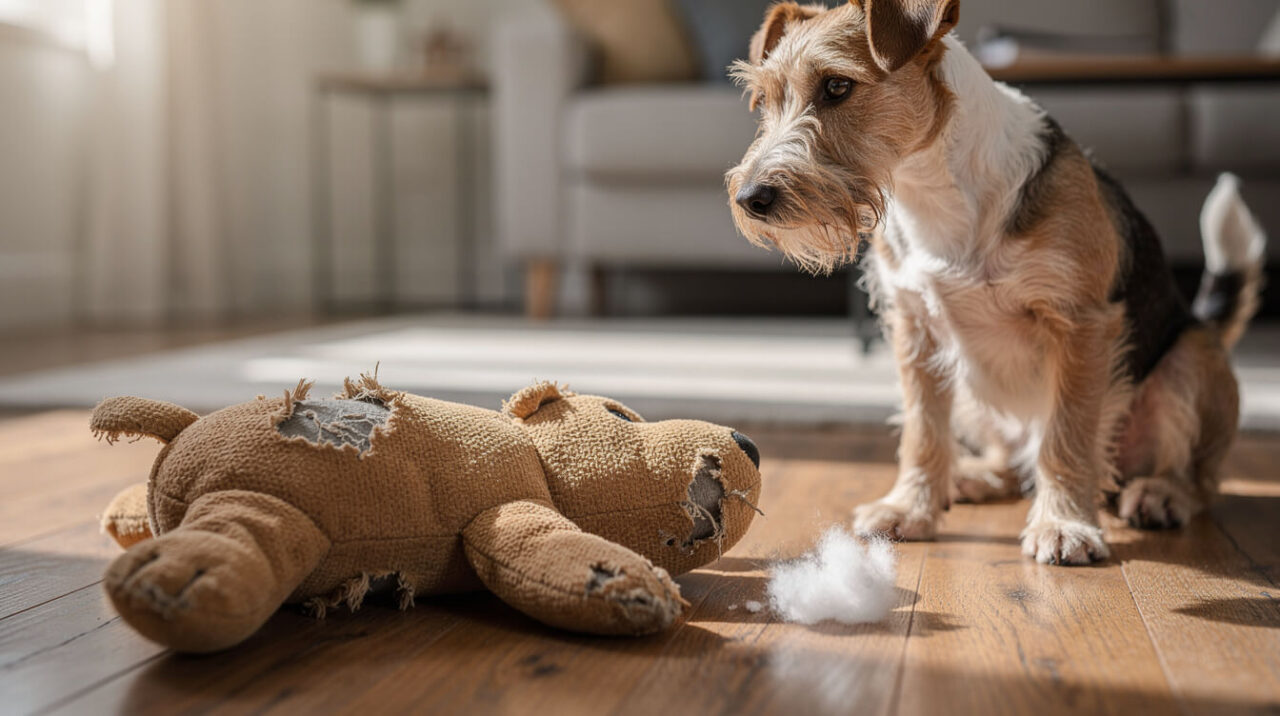
A lot of people searching “can dogs eat stuffing” mean the fiberfill inside a squeaky toy, not the Thanksgiving side dish. That’s a different problem: it’s not about toxins, it’s about whether the material can pass through the gut.
Toy stuffing isn’t digestible. Merck’s chapter on GI obstruction in small animals explains that blockages inside the gut in dogs most often come from a swallowed foreign body, meaning objects that can’t be digested or are too large to pass. Merck also notes that “young large-breed dogs are more likely to develop foreign body obstruction” than older animals. A small wisp often passes, but nobody can promise which piece will and which won’t, and a squeaker, plastic eye, or rope strand raises the stakes.
- Collect the toy and lay out what’s left, so you can see what’s missing: fluff, squeaker, eyes, or strands.
- Call your vet, especially if more than a small tuft is gone, if any hard or plastic part is missing, if your dog is small, or if you’re simply not sure. Bring the toy or a photo.
- Don’t make your dog vomit at home unless your vet tells you to.
- Watch for the signs Merck lists for GI obstruction, especially vomiting and not eating, as well as lethargy or diarrhea. Any of those after your dog swallowed toy parts is a reason to be seen promptly.
For the future, choose toys sized for your dog’s jaw and chewing style, check them often, and take them away once the seams start to give.
Can dogs eat stuffing? Frequently asked questions
Can dogs eat stuffing without onions?
An onion- and garlic-free stuffing removes the biggest concern, but it’s still a rich, buttery, salty food that’s high in calories for a dog. A cube or two of a genuinely plain version is unlikely to cause trouble for most healthy adult dogs. If you’re cooking a dog-safe batch on purpose, keep it to plain bread, a little plain low-sodium broth, and celery, and treat it as part of the day’s treat allowance.
Can dogs eat Stove Top or other boxed stuffing?
Not as a treat. All 10 Stove Top mixes in the USDA database list onion, including the “traditional sage” one. Across the wider label check, 139 of 146 seasoned stuffing mixes and ready-made stuffings listed onion and/or garlic, often as dried or powdered forms, which Merck flags as the concentrated kind. If your dog ate dry mix straight from the box, call your vet.
Is sage safe for dogs?
Yes. The ASPCA lists garden sage as non-toxic to dogs. The problem in stuffing is the onion and garlic it’s cooked with, not the sage.
How long after eating stuffing would my dog show signs?
Stomach upset from fat usually shows within a day or two. Onion and garlic effects on the blood are delayed: Merck notes red blood cell breakdown typically happens 3–5 days after exposure. That’s why “he seems fine tonight” isn’t the all-clear, and why it’s worth calling your vet if your dog ate more than a bite.
Can puppies eat stuffing?
No. Puppies are small, so the per-kilogram math works against them, and their stomachs are often more sensitive to rich food. Stick to their own food and puppy-appropriate treats.
The bottom line: stuffing is a skip, not because bread is bad, but because onion, garlic, and butter are almost always part of it. Set your dog’s share aside before the seasoning goes in, keep the pan out of reach, and you’ll both enjoy the holiday. Your dog will be just as happy with a few bites of plain turkey and a spot near the table.
Before you go
Keep learning your animal
We publish a new guide every day. The best of them land in one short weekly email, so you never miss the one about your species.

Meet Jake Harrington, your go-to guru for all things canine. With over 15 years of professional dog training experience, Jake has transformed the lives of thousands of dogs and their owners. His journey began in the bustling streets of a major city, where he discovered his natural affinity for understanding canine behaviors and communication.