
Can Dogs Eat Candy Canes? What 301 Store Labels Show, and When a Stolen One Needs a Call
Can dogs eat candy canes? No. They’re not a treat to share. But if your dog just crunched up a regular peppermint candy cane, take a breath: a plain sugar cane is very unlikely to poison them. What matters is what the cane is made of, whether the wrapper went down too, and how big your dog is. The one version that turns this into an emergency is sugar-free, because some sugar-free candy contains xylitol.
We read the ingredient lists on 301 candy cane labels in the USDA’s branded-foods database, did the sugar math by dog size, and checked the sugar-free canes and candy-cane-flavored gum that most guides skip. Here’s what’s actually true, and what to do if a cane has already gone missing off the tree. If your dog already ate one, jump to what to do right now.
Can dogs eat candy canes? The short answer
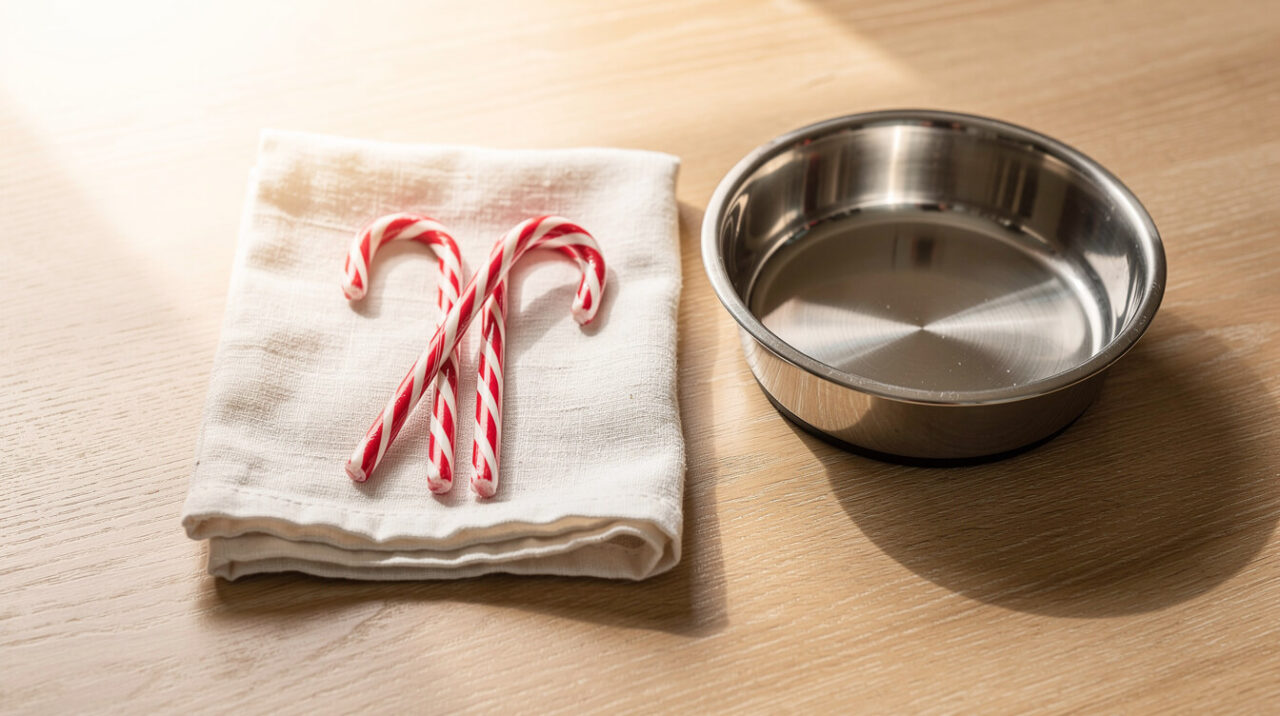
A candy cane is almost pure sugar, poured into a shape that’s hard to crunch and wrapped in plastic. Nothing in it does your dog any good. “Not a treat” is a different answer from “poisonous,” though, and much of what’s online blurs the two. Here’s the answer by the kind of candy cane in your house:
- Regular peppermint candy cane (sugar and corn syrup): not toxic, but not food for dogs. A lick or a small piece is unlikely to do more than upset a stomach. A whole cane is a lot of sugar for a small dog, and the sharp shards and wrapper are their own problems.
- Sugar-free candy cane: read the label now. If it lists xylitol (also sold as birch sugar or wood sugar), or you can’t find the label, call your vet or a pet poison line right away. Don’t wait for signs.
- Chocolate-dipped canes, peppermint bark, and candy cane cookies: the chocolate, not the cane, is the part to worry about. Call with the package in hand.
- Candy-cane-flavored sugar-free gum or mints: treat these like any sugar-free gum. Check for xylitol and call if it’s there.
- A swallowed wrapper, ornament hook, or ribbon: call your vet the same day, even if your dog seems fine.
The peppermint itself is the least of it. A candy cane gets its flavor from a small amount of peppermint oil or flavoring cooked into a lot of sugar. That’s a very different exposure from a bottle of concentrated essential oil. Our guide to whether dogs can eat peppermint covers the plant, the oil, and the one mint that truly is dangerous.
Several popular pages say candy canes contain “large amounts of xylitol” or call all candy canes “toxic.” The labels don’t back that up, and the next sections show what they do say. Getting this right matters. An owner told that every candy cane is poison may rush a dog who ate a sugar cane to the ER for nothing. Worse, an owner told it’s “just sugar” may sit on a sugar-free one that really is dangerous.
My dog ate a candy cane: what to do right now

Most candy cane thefts end with nothing worse than a sticky dog and a messy rug. Work through these steps in order. They take about two minutes.
1. Pick up what’s left and find the package
Get the dog away from any remaining canes, then find the box, bag, or wrapper. The ingredient list is the single most useful thing you can have, for you and for anyone you call. If the canes came loose in a gift bag or a jar with no label, assume you don’t know what’s in them.
2. Look for xylitol before anything else
Read the ingredients for xylitol. The FDA notes that it may also be listed as birch sugar or wood sugar. If you see any of those, or the cane is sugar-free and you can’t read the full label, call now:
- Your regular vet or the nearest emergency vet
- ASPCA Animal Poison Control Center: (888) 426-4435
- Pet Poison Helpline: (855) 764-7661
Both poison lines charge a consultation fee. They’re staffed around the clock, and they’ll want your dog’s weight, what was eaten, roughly how much, and when.
Why the urgency? The Merck Veterinary Manual explains that in dogs, xylitol triggers a rapid insulin release that can drop blood sugar sharply. Signs can start within 30 minutes, or be delayed up to 12 to 18 hours depending on the product. Liver injury, which is less common, may not show for 24 to 48 hours. A dog who looks perfectly normal right now isn’t in the clear. That’s why this is a call-first situation, not a wait-and-see one.
3. Count canes and wrappers separately
Work out how many canes are missing and how many wrappers you can find. Cellophane that’s missing and nowhere on the floor may be inside your dog. A swallowed wrapper is a same-day call to your vet even when the candy itself was ordinary sugar.
4. Don’t make your dog vomit unless a vet tells you to
It’s tempting to reach for hydrogen peroxide, but don’t. Merck advises that with xylitol, vomiting should ideally be induced only under veterinary supervision, because blood sugar can fall quickly. Sharp candy shards and plastic can also do damage on the way back up. Let the person on the phone make that call.
5. If it was a regular sugar cane, watch for a day
If the label shows sugar and corn syrup, your dog ate a small amount, and every wrapper is accounted for, you can usually watch at home. Offer fresh water and keep meals normal. Over the next 24 hours, call your vet if you see:
- Repeated vomiting, or vomiting with no food coming up
- Diarrhea that lasts more than a day or has blood in it
- Drooling, pawing at the mouth, or reluctance to eat (a shard can cut the mouth or throat)
- A tight, painful belly, lethargy, or straining with nothing passing
- Any weakness, wobbling, trembling, or collapse, whatever the label said
When in doubt, call. “Is this normal?” is a perfectly good reason to phone your vet, and no good vet will mind.
What’s actually in a candy cane? What 301 labels show

We pulled every candy cane in the USDA’s FoodData Central branded-foods database, which collects the nutrition panels and ingredient lists manufacturers submit. We set aside candy cane ice cream, cookies, bark, and gum, which left 301 candy cane labels from 66 brand owners.
Regular canes: sugar, corn syrup, flavor, color
300 of the 301 are sweetened with sugar, corn syrup, or glucose syrup. A typical ingredient list is short: sugar, corn syrup, peppermint oil or natural flavor, and a food coloring such as Red 40. Fruit flavors add citric acid. None of these is known to be toxic to dogs in candy amounts. Sugar and corn syrup are a problem of dose and habit, not poison.
The one label that listed xylitol
The single exception was a “Candy Cane” flavor from Ice Chips, a brand that makes xylitol-sweetened candy. Its ingredients are xylitol, peppermint oil, cream of tartar, and calcium stearate. It’s a reminder that “candy cane” on a label can describe a flavor, not just the hooked stick on your tree.
Sugar-free canes: usually isomalt, but you can’t tell by looking
The database had no sugar-free hard candy canes, so we checked retail labels directly. The sugar-free peppermint canes and hard candies we found were sweetened with isomalt and sucralose, not xylitol. That includes small-batch sugar-free canes and Brach’s sugar-free peppermint hard candy. Isomalt is a sugar alcohol that behaves like sugar when it’s cooked into hard candy, and makers warn that eating a lot of it can have a laxative effect.
The UK’s Veterinary Poisons Information Service says sweeteners such as maltitol, sorbitol, and sucralose are not hazardous to pets and are well tolerated even in overdose, though some can cause vomiting and diarrhea. It names xylitol as the only sweetener of concern. Isomalt isn’t on that list by name, and we didn’t find a dog study of it. So the honest version is this: it isn’t known to act like xylitol, but loose stools are possible, and your vet should hear about it.
None of that changes the rule in the short answer above. A sugar-free cane with no readable label is a phone call, because xylitol and isomalt canes look identical. A few years ago, a Texas news station reported that a 7-month-old Chihuahua mix died the day after eating sugar-free candy canes. Her vet attributed it to xylitol poisoning. The report didn’t name the brand, which is exactly the problem: once the package is gone, nobody can check.
The real hiding place: candy-cane-flavored gum
Every December, “candy cane” turns up as a flavor on sugar-free gum and mints. We found eight candy-cane-flavored sugar-free gum labels in the database, and three listed xylitol: two entries for Ice Breakers Ice Cubes Candy Cane gum and one gourmet novelty gum. The others used sorbitol and maltitol. Ice Breakers’ sugar-free Candy Cane mints listed sorbitol, not xylitol. Gum lives in coat pockets, purses, and stockings, which is exactly where a nosy dog finds it. If your dog got into anything sugar-free and candy-cane-flavored, treat it like any sugar-free gum and check for xylitol.
Why you can’t do the xylitol math at home
With regular canes, you can work out sugar and calories from the label, and we do that in the next section. With xylitol, you can’t. Ingredient lists name xylitol but almost never say how many grams are in each piece, and the amount varies widely between products. That’s why every reputable source says the same thing: if xylitol is on the label, call. Leave the “is it enough to matter” question to a vet or poison specialist who has product data.
How much sugar is one candy cane for your dog’s size?

Across the 149 labels that list a serving as one candy cane, a standard cane weighs a median of 13 grams (most fall between 12 and 14). It carries about 50 calories and 9 grams of sugar. The mini canes we found run about half that, around 25 calories. The jumbo and character canes, the ones attached to a plush toy or sold as a stocking stuffer, are 50 to 60 grams and 180 to 240 calories each.
To show what that means for different dogs, we compared one cane with the daily calories a typical healthy, neutered adult dog needs. We used the standard veterinary resting-energy formula (70 × body weight in kg0.75) and multiplied it by 1.6. Your own dog’s needs may be higher or lower, so treat these as ballpark figures:
| Dog’s weight | Approx. daily calories | One standard cane (50 kcal) | One mini cane (25 kcal) | One jumbo cane (240 kcal) |
|---|---|---|---|---|
| 5 lb | ~210 | about 24% of the day | about 12% | more than a full day |
| 10 lb | ~350 | about 14% | about 7% | about 69% |
| 20 lb | ~585 | about 9% | about 4% | about 41% |
| 30 lb | ~795 | about 6% | about 3% | about 30% |
| 50 lb | ~1,165 | about 4% | about 2% | about 21% |
| 70 lb | ~1,500 | about 3% | about 2% | about 16% |
Many vets suggest keeping all treats under about 10% of a dog’s daily calories. One standard candy cane blows past that for any dog under about 15 pounds. One jumbo cane is a meal’s worth of straight sugar for a medium dog. For a big Lab, one stolen mini cane barely registers in calories, and the shards and wrapper are the bigger concern.
What a sugar binge usually looks like
A dog who wolfs down a lot of sugar at once often gets an upset stomach: vomiting, loose stool, or both, usually within a day. It’s unpleasant, and in most healthy dogs it passes on its own. Call your vet if it doesn’t settle within a day, if your dog can’t keep water down, or if they seem weak or painful. Call before you wait it out if your dog has diabetes, or if a small dog ate several canes. Those dogs deserve a professional opinion sooner.
Sugar adds up over the season
The bigger issue with sugar isn’t one stolen cane. It’s a December of small handouts: a lick of a cane here, a corner of a cookie there. Regular sweets add empty calories, and a dog who learns that the tree and the coffee table produce candy will keep checking them. If you’d like to share something seasonal, there are much better options, and we cover them below.
The weekly care guide
Get it right for your animal, every week
One email a week: new care guides, species deep-dives, and the safety answers keepers search for, written by our specialists. No spam. Unsubscribe anytime.
Wrappers, shards, and the candy canes on your tree

For a lot of dogs, the most dangerous part of a candy cane isn’t the candy.
Wrappers
Cellophane and plastic don’t digest. The AKC notes that candy wrappers can lodge in a dog’s throat or intestines and may need surgery to remove. The Merck Veterinary Manual lists plastic among the classic causes of gastrointestinal obstruction in dogs and calls obstruction an emergency. Watch for vomiting, especially repeated or unproductive vomiting, loss of appetite, a painful belly, lethargy, or straining. Dogs who steal from a candy dish rarely stop to unwrap. If wrappers are missing, call your vet that day, even if the candy was ordinary sugar.
Shards
Hard candy breaks into sharp, glassy pieces. A dog who crunches a cane can get small cuts in the mouth, and a dog who gulps a large chunk can choke on it. Watch for gagging, pawing at the mouth, drooling, or blood-tinged saliva. Choking is an emergency: if your dog is struggling to breathe, head to the nearest vet immediately.
Hooks, ribbon, and the tree itself
Candy canes on a tree come with extras: wire ornament hooks, ribbon, and sometimes tinsel. A dog who pulls a cane off a branch can swallow the hook along with it. Ribbon and string are linear foreign bodies, which Merck flags as especially risky because they can bunch up the intestines. If you hang candy canes, hang them high:
- Top half only. Keep the lower branches, at least as high as your dog can reach standing on their hind legs, free of candy and anything edible.
- Skip the metal hooks. The cane’s own crook holds it on a branch fine.
- Count them. Knowing you hung twelve makes it easy to tell when one goes missing, wrapper and all.
- Use a pen or gate for the tree if your dog is a determined climber or a young chewer.
Cats have their own tree hazards, from tinsel to tree water. If you share your home with both, our guide to whether a Christmas tree is safe for cats covers the feline side.
Candy cane cousins: bark, dipped canes, and crushed-cane cookies
Peppermint bark, chocolate-dipped canes, and cookies rolled in crushed candy canes are a different question, because they contain chocolate. Chocolate toxicity depends on the type of chocolate and your dog’s weight. Dark and baking chocolate are far more concentrated than milk chocolate. Call your vet or a poison line with the package and an estimate of how much is gone. The same goes for any candy cane treat baked with raisins or macadamia nuts. For more on spiced holiday baking, see our guide to whether dogs can eat gingerbread.
A dog-safe December: keeping canes out of reach, and what to share instead
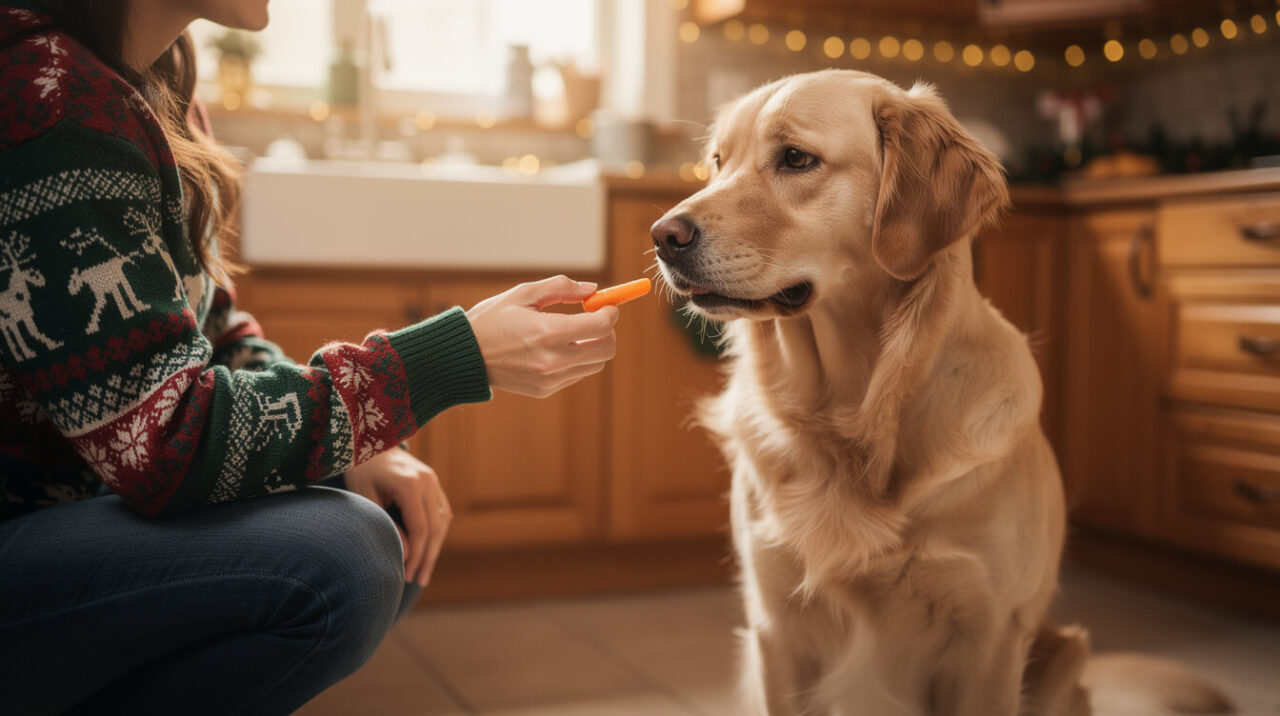
Keeping candy canes away from your dog in December doesn’t require a fortress. A few habits cover almost every way a dog gets to them:
- Give candy a high home. Bowls of canes go on a mantel or a high shelf, not a coffee table. Better still, use a lidded jar.
- Brief your guests. Visitors bring gum, mints, and candy in coat pockets and handbags. Hang coats and bags out of reach, and ask guests not to slip the dog anything sweet.
- Watch the stockings. A stocking full of candy hanging at nose height is an open invitation. Fill them on Christmas morning, or hang them high.
- Clean up after crafts and baking. Crushed candy cane dust, broken pieces, and wrappers end up on the floor more often than you’d think.
- Know where your sugar-free products are. If anyone in your home uses xylitol gum or mints, keep them somewhere your dog truly can’t reach. That includes the purse on the floor.
What to share instead
Your dog doesn’t care whether a treat is red and white. They care that it came from you. A few seasonal swaps that are safe for most healthy dogs in small amounts:
- A baby carrot or a few green beans, plain and crunchy, with almost no calories
- A spoonful of plain canned pumpkin (not pie filling). Here’s why pumpkin pie is a different story.
- A small piece of plain, cooked turkey or chicken, no skin, no bones, and no seasoning
- A few pieces of their own kibble in a snuffle mat or treat puzzle, which turns snack time into a game
Keep all treats inside that 10% guideline, and check with your vet first if your dog has diabetes, pancreatitis, a sensitive stomach, or a prescription diet. If you’re working through the holiday table one dish at a time, our guides to cranberry sauce and cornbread walk through the add-ins that change the answer.

A gift no dog can steal off the tree
The Bearded Dragon Crown Sunglasses King T-Shirt: a crown, shades, and the calm confidence of a reptile who claimed the warmest spot in the house. For the keeper on your list, zero calories, and nothing for the dog to unwrap.
Shopping for the animal person in your life? Plenty of dog homes also have a reptile, and our Bearded Dragon Crown Sunglasses King T-Shirt is a stocking stuffer your dog can sniff all they like. For a calmer house all season, our guide to how cold is too cold for dogs covers the outdoor side of a December with your dog.
Can dogs eat candy canes? Quick answers to common questions
Is one candy cane going to hurt my dog?
If it was a regular sugar candy cane and the wrapper isn’t missing, one cane is unlikely to poison a dog. A small dog may get an upset stomach, and any dog can cut their mouth on the shards. Check the label for xylitol first. If it’s sugar-free and you can’t confirm what’s in it, call your vet or a poison line right away.
Do all sugar-free candy canes contain xylitol?
No. The sugar-free canes and peppermint hard candies we checked used isomalt and sucralose. But xylitol versions of candy-cane-flavored candy and gum do exist, and the two look identical. The label is the only way to know, and if you don’t have the label, treat it as a possible xylitol exposure and call.
Is peppermint bad for dogs?
The small amount of peppermint flavoring in a candy cane isn’t the concern. Concentrated peppermint essential oil and pennyroyal are much bigger risks. Our peppermint guide covers the details.
Can dogs have candy-cane-flavored dog treats?
Treats made for dogs and labeled “candy cane” or “peppermint” are usually just colored and flavored dog biscuits. Read the ingredients as you would for any treat, count them toward the 10% guideline, and skip anything with xylitol or chocolate. Some are also high in calories, so check the calories per treat.
My dog ate a candy cane and is acting fine. Do I still need to call?
For a regular sugar cane with all wrappers accounted for, watching at home for 24 hours is usually reasonable. For anything sugar-free with xylitol, or with no label, yes, call now. Xylitol signs can be delayed for hours, and a dog who’s acting fine isn’t proof of anything yet. For a missing wrapper or hook, call the same day.
Are candy canes toxic to cats?
Cats are a different case. Merck notes that cats are not at risk of the low blood sugar or liver injury xylitol causes in dogs. Cats also can’t taste sweetness, so most ignore candy. Wrappers, ribbon, and tinsel are still serious hazards for a playful cat. Call your vet if your cat swallowed any string-like decoration, and never pull on a strand you see in their mouth.
What about peppermint ice cream or a peppermint latte?
Both bring dairy, fat, and sugar, and sometimes chocolate. A lick is unlikely to cause harm in a healthy dog. A bowl or a cup is an upset stomach waiting to happen. Skip anything labeled sugar-free or “skinny” until you’ve checked for xylitol.
The bottom line
A regular candy cane is mostly sugar in a hard, sharp, wrapped package. It’s not a treat for dogs, and a stolen one is usually a messy afternoon rather than an emergency. Two things change that. A sugar-free cane, or candy-cane gum, that might contain xylitol is a phone call right now. A swallowed wrapper or hook is a call to your vet the same day. Read the label, count the wrappers, hang the canes high, and keep a dog-safe treat in your pocket for when those eyes start following the tree.
Before you go
Keep learning your animal
We publish a new guide every day. The best of them land in one short weekly email, so you never miss the one about your species.

Meet Jake Harrington, your go-to guru for all things canine. With over 15 years of professional dog training experience, Jake has transformed the lives of thousands of dogs and their owners. His journey began in the bustling streets of a major city, where he discovered his natural affinity for understanding canine behaviors and communication.