Can Dogs Eat Ginger? Fresh vs. Powder, the Dose Charts, and What the Dog Studies Found
Can dogs eat ginger? Yes. Plain ginger, fresh or ground, isn’t toxic to dogs, and a small taste is generally considered safe for a healthy adult dog. There are two catches, though, and most of the advice online skips both. The first is what the ginger comes in: sushi ginger, candied ginger, ginger ale, and ginger snaps are different foods from the root. The second is that “a teaspoon of ginger” means very different things depending on whether it’s fresh or ground, and the popular dose charts treat the two as the same thing.
This guide gives you the straight answer for each kind of ginger, explains why no one can honestly give you a precise dose, and reports what the small number of dog studies actually found (including the parts that usually get left out). It also covers which dogs should skip ginger altogether. Ginger is a nice little extra for most dogs. It’s just a small one.
Can dogs eat ginger? The short answer
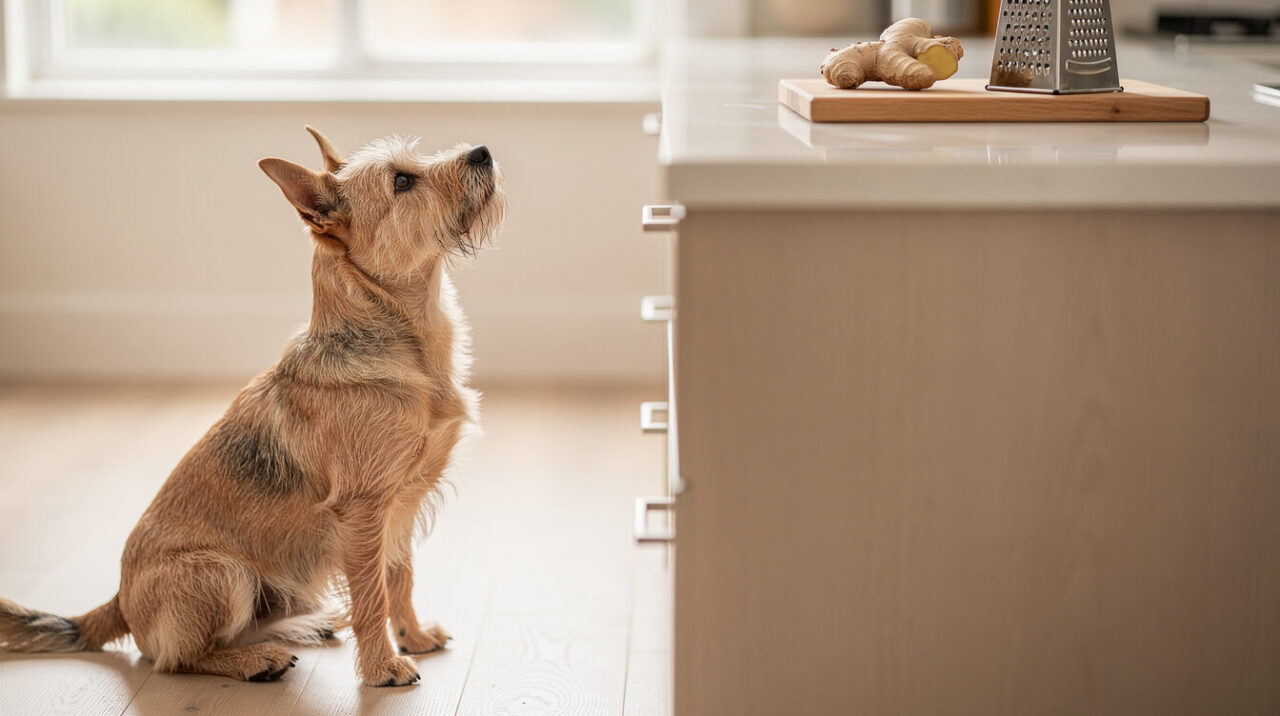
Plain ginger root (Zingiber officinale) is a food spice, not a poison, and nothing in the veterinary literature treats it as one. VCA Animal Hospitals’ ginger monograph covers it as a supplement with a few cautions, and PetMD, the AKC, Purina, and Rover all land on the same answer: small amounts are fine for healthy adult dogs.
One detail you’ll see misquoted: the ASPCA’s poison-control plant list doesn’t have an entry for culinary ginger at all, toxic or non-toxic. The “ginger” plants it does list are ornamental relatives. Butterfly ginger, also called white ginger or ginger lily (Hedychium coronarium), and peacock ginger (Kaempferia) are on its non-toxic to dogs list. So if you have a ginger lily in the garden, that’s reassuring. It just isn’t the same plant as the root in your fridge.
Here’s the practical version:
- Fresh ginger, finely grated: fine in a tiny amount, mixed into food.
- Ground ginger (the spice jar): fine too, but use much less than you would of fresh. More on why below.
- Ginger in human foods and drinks: judge the food, not the ginger. Sugar, salt, sweeteners, and chocolate are what matter there.
- Dogs on blood thinners or NSAIDs, dogs with bleeding disorders, and dogs heading into surgery: ask your vet first.
If your dog just grabbed a slice of ginger off the cutting board, the most likely outcome is a funny face and some drooling. A whole knob of root swallowed in a gulp is a different question, covered in the FAQ.
Fresh, ground, pickled, candied: which ginger is which
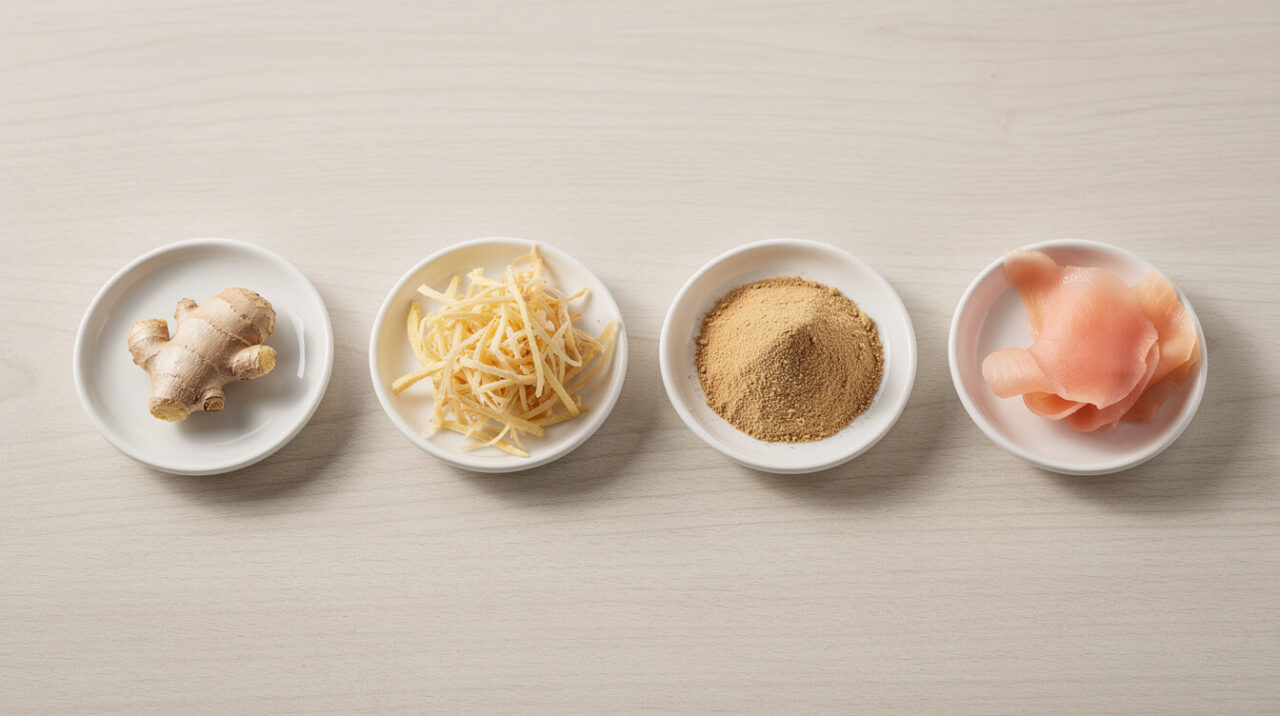
“Ginger” covers a lot of different things in a kitchen. Here’s a quick verdict on each. For the packaged ones, I checked the ingredient lists on USDA’s FoodData Central branded-foods database so these aren’t guesses.
Fresh ginger root
The best option if you want to share ginger at all. Peel it, grate it very finely, and mix a tiny amount into food. Don’t hand over chunks or slices. Ginger is fibrous, and a dog who gulps a piece can gag on it.
Ground ginger
Safe, as long as the jar contains only ginger. Some “ginger” seasoning blends contain other spices, so check that ginger is the only ingredient. Ground ginger is dried, so it’s far more concentrated by volume than fresh. Use a much smaller pinch.
Pickled sushi ginger (gari)
Don’t share it on purpose, but a dropped slice isn’t a crisis. One vet-written page warns that pickled ginger may contain xylitol. Across the 27 US pickled and sushi ginger labels I checked, none listed xylitol. What they did list: salt on 25, FD&C Red 40 on 12, and aspartame on 6. Sodium ran from 53 to 3,680 mg per 100 g, with a median of 500. So a slice or two is trivial, but a small dog who gets into a whole tub of one of the saltier brands warrants a call to your vet. Since recipes vary, it’s still worth glancing at the label if your dog eats some.
Crystallized or candied ginger
Not a dog treat. It’s essentially ginger preserved in sugar: 89 of the 90 labels I checked listed sugar, at a median of 74 grams of sugar per 100 grams. None listed xylitol, but 5 were chocolate-coated, and chocolate is the part that would need a call.
Ginger ale
Skip it. Many people reach for ginger ale when their own stomach is upset, but it doesn’t translate to dogs. Of 378 ginger ale labels, 264 didn’t list ginger in the ingredients at all (the flavor comes from “natural flavors”). 212 listed high-fructose corn syrup, and 56 listed aspartame. A dog with an upset stomach needs water and, if it doesn’t settle, a vet. Sugary soda won’t help.
Ginger snaps and gingerbread
These are cookies first and ginger second. The sugar and fat, plus raisins, chocolate, or sugar-free sweeteners in some versions, are what matter. I covered them in detail in can dogs eat gingerbread, including what to do if your dog got into a plate of them.
Ginger dog treats and supplements
Products made for dogs are the easiest way to give ginger regularly, because the amount is set for dogs. Follow the label, and tell your vet you’re using it. As VCA notes, the FDA doesn’t review supplements for safety or effectiveness before they’re sold, and the amount of ginger can vary from one product to the next. Don’t give a dog human ginger capsules, ginger “shots,” or ginger essential oil, which are concentrated far beyond a pinch of root.
How much ginger can a dog have? Why the charts don’t agree
This is the question everyone asks, and the honest answer is that no one has worked out a feeding amount for dogs. One vet-written guide on the first page of Google says so directly: there isn’t “a clear answer or any scientific guidelines surrounding ginger dosing for dogs.” VCA’s monograph gives no dose either, just “follow your veterinarian’s instructions.” The charts you’ll find are rules of thumb. That’s fine, as long as you know their limits.
Problem 1: a teaspoon of fresh isn’t a teaspoon of ground
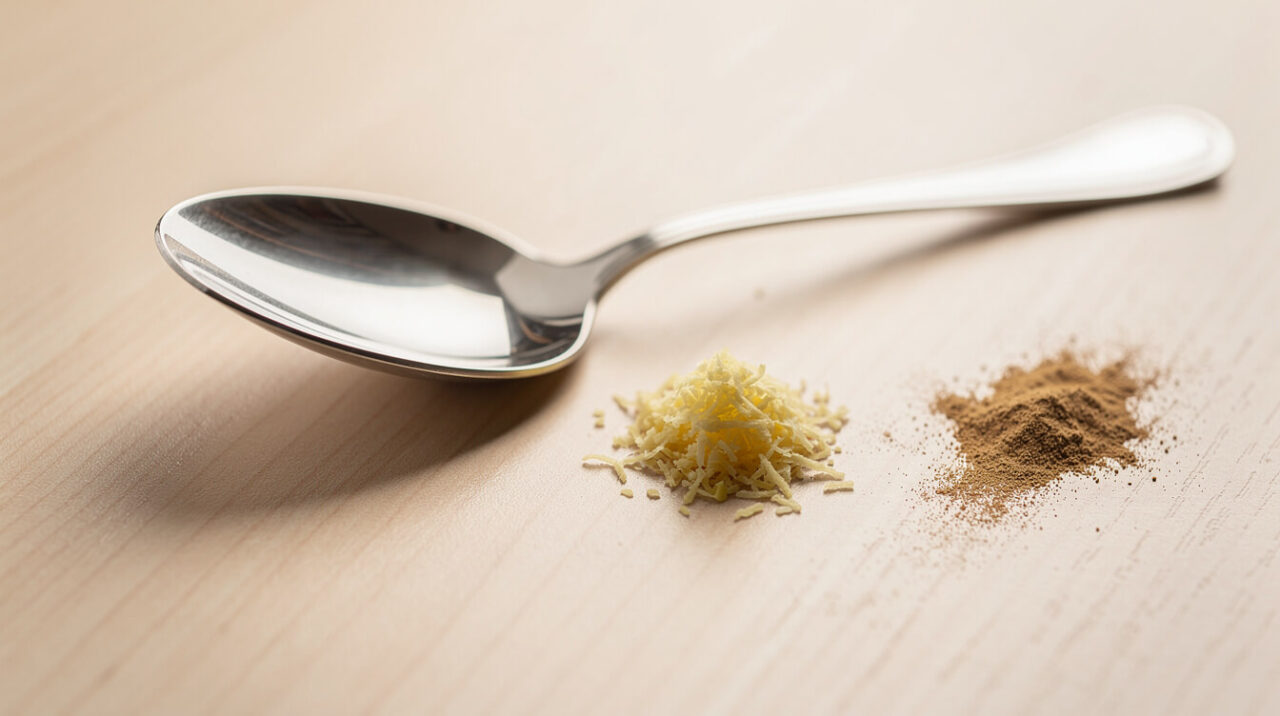
PetMD’s popular chart is written in teaspoons of raw ginger. It ranges from “less than ¼ teaspoon” for dogs from 2 to 20 pounds up to about ¾ teaspoon for dogs over 50 pounds. The same page then suggests using fresh-grated ginger or powder, and the AKC says “all forms” are safe, fresh or powdered, without changing the amount.
USDA’s data shows why that matters. A teaspoon of fresh ginger weighs about 2.0 grams, and nearly 79% of that is water. A teaspoon of ground ginger weighs about 1.8 grams, and only about 10% is water. Take out the water, and a teaspoon of ground ginger holds about 3.8 times as much actual ginger as a teaspoon of fresh (1.62 g vs 0.42 g of dry matter).
That’s a comparison by weight, not a precise potency figure. Drying changes some of ginger’s pungent compounds, so it isn’t a perfect one-to-one. But the practical takeaway holds: if a chart is written for fresh ginger, use roughly a quarter of that volume if you’re using powder. A chart’s ¾ teaspoon of fresh works out to a scant ¼ teaspoon of ground.
Problem 2: the charts aren’t really based on weight
PetMD’s chart has one amount for every dog from 2 to 20 pounds. At the top of that range, a 2-pound dog would get about ten times as much ginger per pound of body weight as a 20-pound dog in the same row. The 51-to-90-pound and 91-plus-pound rows both stop at ¾ teaspoon. The AKC’s version has the same issue from the other direction: its rule of thumb is “never more than one-sixteenth of a teaspoon per pound,” capped at ¾ teaspoon for larger dogs. One-sixteenth of a teaspoon per pound reaches ¾ teaspoon at just 12 pounds, so for most dogs the cap, not the per-pound rule, sets the amount.
None of this means the charts are dangerous. These are all small amounts. It means they’re ceilings to stay under, not targets to hit, and that small dogs deserve the smallest pinch.
Problem 3: the 10% treat rule can’t help here
The usual guideline for any treat is that it should be no more than 10% of a dog’s daily calories. With ginger, that rule never comes into play, because ginger has almost no calories at these amounts:
| Dog | Daily calories (approx.) | 10% treat budget | Chart amount of fresh ginger | Calories in that ginger |
|---|---|---|---|---|
| 10 lb | ~350 | ~35 | under ¼ tsp | under 0.5 |
| 25 lb | ~690 | ~69 | ¼ tsp | ~0.4 |
| 40 lb | ~985 | ~98 | ½ tsp | ~0.8 |
| 70 lb | ~1,500 | ~150 | ¾ tsp | ~1.2 |
Daily calories estimated for a typical neutered adult (resting energy × 1.6). Your dog’s actual needs vary with age, activity, and body condition.
So calories aren’t the limit. What actually limits ginger is your dog’s stomach, because too much causes gas, nausea, or loose stool, along with any medications your dog takes. Where ginger does add calories, it’s because of what it’s mixed into, like the sugar in crystallized ginger.
So what should you actually do?
- Start with a taste-sized amount: a few flecks of grated fresh ginger, or a tiny pinch of ground, mixed into a meal.
- Treat the charts as a maximum for fresh ginger, and cut the volume to about a quarter if you’re using ground.
- Go smallest for small dogs.
- If you’re thinking about giving ginger every day, or for a health reason, ask your vet first. Regular use is a supplement decision, not a treat decision.
Does ginger help a dog’s upset stomach? What the dog studies actually found

Ginger’s reputation for settling stomachs comes mostly from human research, and even there the evidence is mixed. A 2019 overview of systematic reviews called ginger “promising” for nausea and vomiting in people, while noting the “limited quality” of the evidence behind it. The dog research is much thinner than most pages suggest. Here’s all of it that’s relevant to a pet owner.
The dog vomiting study, reported in full
Many articles cite a 1997 study showing ginger reduced vomiting in dogs. That’s true, but only part of the story. In that lab study, published in the Journal of Ethnopharmacology, dogs were given the chemotherapy drug cisplatin to trigger vomiting, then ginger extracts at 25 to 200 mg per kilogram. The full abstract reports four results:
- Extracts made with acetone or alcohol significantly reduced the vomiting.
- The water-based extract didn’t work at any dose tested. That’s the form closest to a home ginger tea.
- Both working extracts were less effective than granisetron, a standard anti-nausea drug.
- Neither extract helped against vomiting caused by a different drug, apomorphine. So ginger didn’t block every kind of vomiting.
That’s a useful scientific finding. But it was a lab model with concentrated extracts, not a trial in pet dogs with upset stomachs, and its results can’t be converted into “teaspoons of root.”
The other dog studies
A 2021 pilot study gave five puppies a ginger-powder capsule before their spay surgery and daily for ten days afterward, and compared them with five puppies who didn’t get it. The ginger group had lower blood markers of inflammation. It’s an interesting early result, but with ten dogs it’s far too small to base advice on. And it wasn’t designed to look at bleeding, so it doesn’t settle whether ginger is fine around surgery.
There’s no dog study on ginger for car sickness. You’ll see it recommended for travel nausea, and Purina UK is one of the few to say plainly that there’s little scientific evidence for it. If your dog gets carsick, your vet has proven options, including medications made for exactly this.
When an upset stomach needs a vet, not ginger
Ginger isn’t a treatment, and it’s not something to try in place of a vet visit. Call your veterinarian if your dog:
- vomits more than once or twice, or keeps trying to vomit without bringing anything up
- has vomiting and diarrhea, blood in either, or a painful or swollen belly
- is lethargic, won’t eat, or won’t drink
- is a puppy, a senior, or has an existing health condition
- might have eaten something toxic
If you think your dog ate something poisonous, call your vet, the Pet Poison Helpline (855-764-7661), or the ASPCA Animal Poison Control Center (888-426-4435). Both charge a consultation fee.
The weekly care guide
Get it right for your animal, every week
One email a week: new care guides, species deep-dives, and the safety answers keepers search for, written by our specialists. No spam. Unsubscribe anytime.
Who should skip ginger: medications, surgery, and a few health conditions

VCA’s veterinary monograph is the clearest source here. It says not to use ginger in pets with known bleeding disorders, and to use it with caution in:
- pets that are pregnant or nursing
- pets with gallbladder disease
- pets taking anticoagulants such as warfarin
- pets taking NSAIDs (non-steroidal anti-inflammatory drugs) such as carprofen, meloxicam, or robenacoxib
Several other vet-written pages also suggest checking with your vet first if your dog has diabetes or heart disease.
The “blood thinner” question, stated accurately
You’ll read that ginger “acts as a blood thinner” as if it’s settled fact. The real picture is less certain. A 2015 systematic review of human research found eight clinical trials: four reported that ginger reduced platelet clumping, and four found no effect. The authors called the evidence “equivocal.” That’s in people, and there’s no equivalent research in dogs.
That uncertainty is exactly why the caution stays. When the effect is unpredictable, the sensible move is to keep ginger out of the picture where bleeding matters. Reviews of human surgery take the same line, describing it as “prudent” to stop supplements like ginger before an operation.
Why this matters for arthritis dogs
Many people look into ginger because they’ve read it helps joints. The trial PetMD links for joint pain was in people with knee arthritis, using a concentrated extract of two ginger species, not dogs eating ginger root. Meanwhile, many dogs with arthritis already take an NSAID like carprofen or meloxicam, which is exactly the combination VCA flags. Arthritis is also common in older dogs (here’s when a dog is considered a senior). If your dog is on pain medication, talk to your vet before adding ginger, even in food amounts.
The same goes for surgery and dental cleanings. If your dog gets ginger regularly, whether in food or in a supplement, tell your vet when the procedure is booked. They may ask you to pause it beforehand.
Puppies are a “check first” too. There’s no research on ginger for young puppies specifically, and a growing puppy’s stomach is easily upset, so ask your vet before offering any.
How to share ginger with your dog the careful way
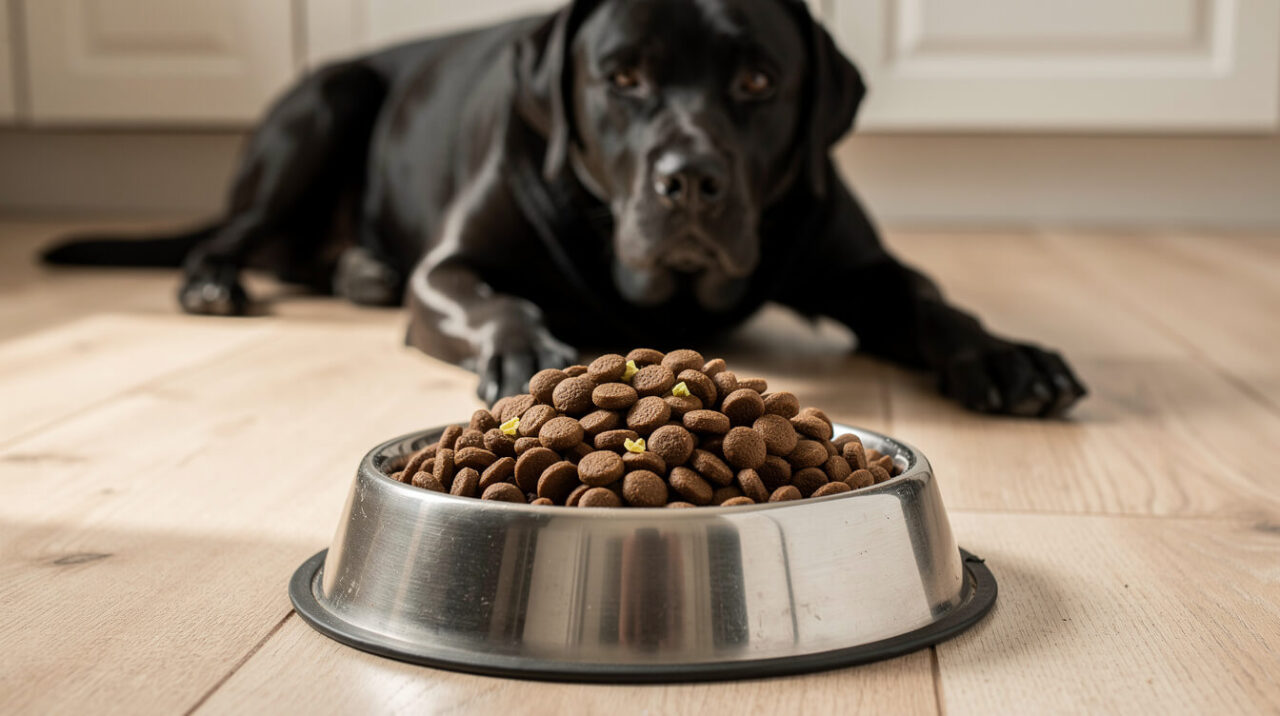
If your dog is healthy, isn’t on any of the medications above, and you’d like to share a little ginger, here’s the easy way to do it.
- Use plain ginger. Peeled fresh root, or a jar of ground ginger with ginger as the only ingredient.
- Grate it very finely, or use a pinch of powder. No slices, no chunks.
- Start with a few flecks mixed into a normal meal. Ginger with food is gentler on the stomach than ginger alone.
- Watch for the next day. A little gas or one soft stool means that was too much for this dog, so stop or use less. Vomiting, diarrhea, itchiness, or facial swelling means stop and call your vet.
- Keep it occasional. If you want to give ginger daily, that’s a conversation for your vet.
If you like making treats, the classic frozen option is a tiny bit of grated ginger stirred into plain canned pumpkin or mashed, cooked sweet potato, frozen in small portions. See our guides on pumpkin for dogs and sweet potato for dogs for the safe amounts of those. Keep each portion small, because the pumpkin or sweet potato counts toward your dog’s treat calories even though the ginger barely does.
And while you’re grating a fleck of ginger for the dog, the reptile people in your life might appreciate the Bearded Dragon Crown Sunglasses King T-Shirt, our keeper merch for whoever in the house is a little obsessed with their animal.

For the keeper who reads the label twice
The Bearded Dragon Crown Sunglasses King T-Shirt is our nod to the people who do their homework for their animals, whether that animal has fur or scales. A soft everyday tee for the household’s resident animal nerd.
Why your dog might pull a face (and drool)
Don’t be surprised if your dog smacks its lips, chews at the air, or drools after a taste of ginger. Ginger is a strong saliva stimulant. In a 2021 study of 16 healthy Beagles, a cotton swab dipped in ginger powder produced a median of about 1,200 microliters of saliva, three times the 400 microliters from a plain swab. The ginger dogs also chewed more and were more excited. The researchers suggested it as a simple way for owners to collect saliva samples at home for lab tests, so it’s not considered harmful.
So lip-smacking and drooling right after ginger are an expected taste reaction, not poisoning. Some dogs love the zing. Others will make it very clear they’d rather not, and that’s fine too. There’s no need to give ginger to a dog who doesn’t enjoy it.
Can dogs eat ginger? Your other questions, answered

Is ginger toxic to dogs?
No. Ginger root isn’t considered toxic to dogs. The risks come from amount (stomach upset), from what it’s mixed with, and from interactions with certain medications.
Can dogs eat raw ginger root?
Yes, in a tiny amount, peeled and finely grated. Don’t offer slices or chunks, which a dog can swallow whole.
My dog ate a whole piece of ginger root. What should I do?
Stay calm. Ginger itself isn’t the worry. A big bite of ginger is likely to cause drooling and maybe an upset stomach. The bigger concern with a whole knob is that it’s fibrous and could cause choking or, in a small dog, a blockage. Call your vet if your dog is gagging, retching, vomiting repeatedly, has a painful belly, or isn’t passing stool.
Can dogs have ginger for car sickness?
There’s no research showing it works in dogs, and the one dog vomiting study didn’t look at motion sickness. If your dog gets carsick, ask your vet. There are effective medications made for exactly this.
Can dogs eat pickled ginger from sushi?
A dropped slice is fine. Don’t share it on purpose: most labels list salt, and some list artificial sweeteners or food dyes. If a small dog ate a large amount, call your vet with the label in hand.
Can dogs drink ginger ale?
No. Most ginger ale contains little or no real ginger, plus sugar or artificial sweeteners and carbonation. Offer water instead.
Can dogs have ginger tea?
Plain ginger steeped in water, cooled, and unsweetened is safe in small amounts. Don’t share a blend made with black or green tea (caffeine), honey and lemon, or other spices. Keep in mind that the water-based ginger extract was the one that didn’t work in the dog vomiting study, so don’t count on tea as a remedy.
Can puppies have ginger?
There’s no research on ginger for puppies, so ask your vet first. The same goes for pregnant or nursing dogs.
Can dogs eat other holiday spices?
It depends on the spice and the amount. See our guides to peppermint and cinnamon rolls. For seasonal sweets, see candy canes and pumpkin pie.
The bottom line
So, can dogs eat ginger? Yes. A little plain ginger is safe for most healthy adult dogs, and some will enjoy it. Use a few flecks of fresh or an even smaller pinch of ground, mixed into food. Treat the online charts as an upper limit, not a goal. Skip the sushi ginger, candied ginger, and ginger ale. If your dog is on blood thinners or NSAIDs, has a bleeding problem, is pregnant, or has surgery coming up, ask your vet before ginger goes anywhere near the bowl. And if your dog’s stomach is truly upset, that’s a call to your vet, not a job for the spice rack.
Before you go
Keep learning your animal
We publish a new guide every day. The best of them land in one short weekly email, so you never miss the one about your species.

Meet Jake Harrington, your go-to guru for all things canine. With over 15 years of professional dog training experience, Jake has transformed the lives of thousands of dogs and their owners. His journey began in the bustling streets of a major city, where he discovered his natural affinity for understanding canine behaviors and communication.