Crested Gecko Care: Temperature, Humidity, Diet, and Why the Care Sheets Disagree
Good crested gecko care comes down to five things: a tall enclosure, a temperature band most of us already live in, humidity that rises and then dries out, a complete powdered diet, and gentle handling that protects a tail that will never grow back. That’s the easy part. The hard part is that the care sheets you’ll find disagree with each other on almost every number. One says never above 80°F, another says bask at 85°F. One says no banana ever, while the most popular complete diet lists dried banana as its first ingredient.
This crested gecko care guide puts those sources side by side, explains why they disagree, and lands on ranges you can actually use. Where the research or a veterinary source settles a question, we’ll say so. Where it doesn’t, we’ll say that too.
Crested gecko care at a glance

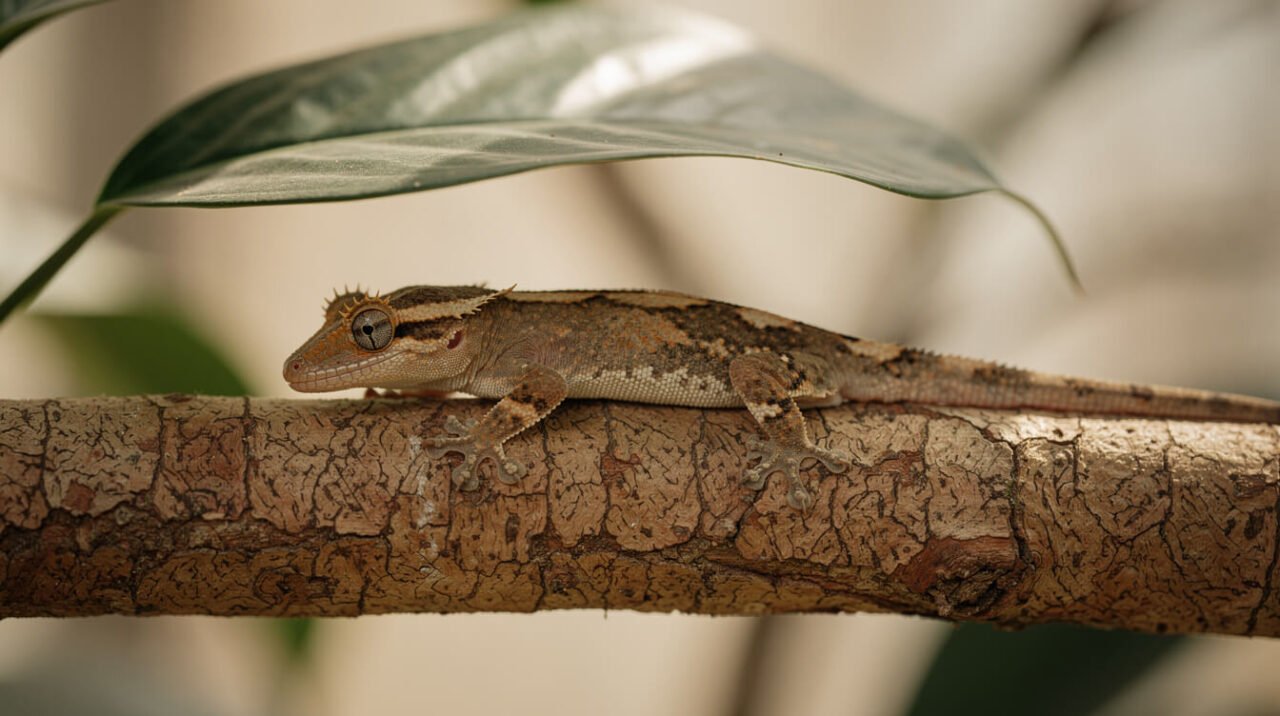
First, the commitment. Crested geckos (Correlophus ciliatus) commonly live 15 to 20 years with good care, according to PetMD and the RSPCA, and some exceed 20. A hatchling bought for a ten-year-old can still be around when that child finishes college. They’re nocturnal, so most of their life happens after you’ve turned the lights off. They’re also a species that was thought to be extinct until it was rediscovered in New Caledonia in 1994. Today they’re widely bred in captivity, so there’s no reason to buy anything but a captive-bred gecko.
Here’s how four respected sources set up the basics. Read across a row and you’ll see the problem.
| Spec | PetMD (DVM, 2025) | ReptiFiles | RSPCA sheet (2015) | Royal Veterinary College (2022) |
|---|---|---|---|---|
| Warm zone | Warm end 72–75°F; never over 80°F for long | Basking 82–85°F at the top | Basking 79–82°F (26–28°C) | Basking about 82°F (28°C) |
| Cool zone | 68–75°F | 70–75°F at the bottom | 72–77°F (22–25°C) | About 77°F (25°C) |
| Night | Not specified | 65–72°F | 64–68°F (18–20°C) | Not below about 68°F (20°C) |
| Humidity | 70–80%, mist daily | 60–80%, dry to about 40–50% between mistings | Boosts to 60–80%, dry out between | 50–70% |
| Minimum enclosure (adult) | 20 gallons, tall | 18″ × 18″ × 36″ | 45 × 45 × 60 cm (about 18″ × 18″ × 24″) | 45 × 45 × 60 cm |
| Staple food | Complete powdered diet daily | Complete powdered diet; adults every 2–3 days | Mashed fruit, insects, and powdered diet on rotation | Typically a complete formulated diet |
The short version: keep most of the enclosure in the low-to-mid 70s °F, let one high spot reach about 80–82°F, never let the whole thing sit in the mid-80s, mist so the humidity rises and then falls, and feed a proven complete diet.
Crested gecko enclosure: size, height, and setup
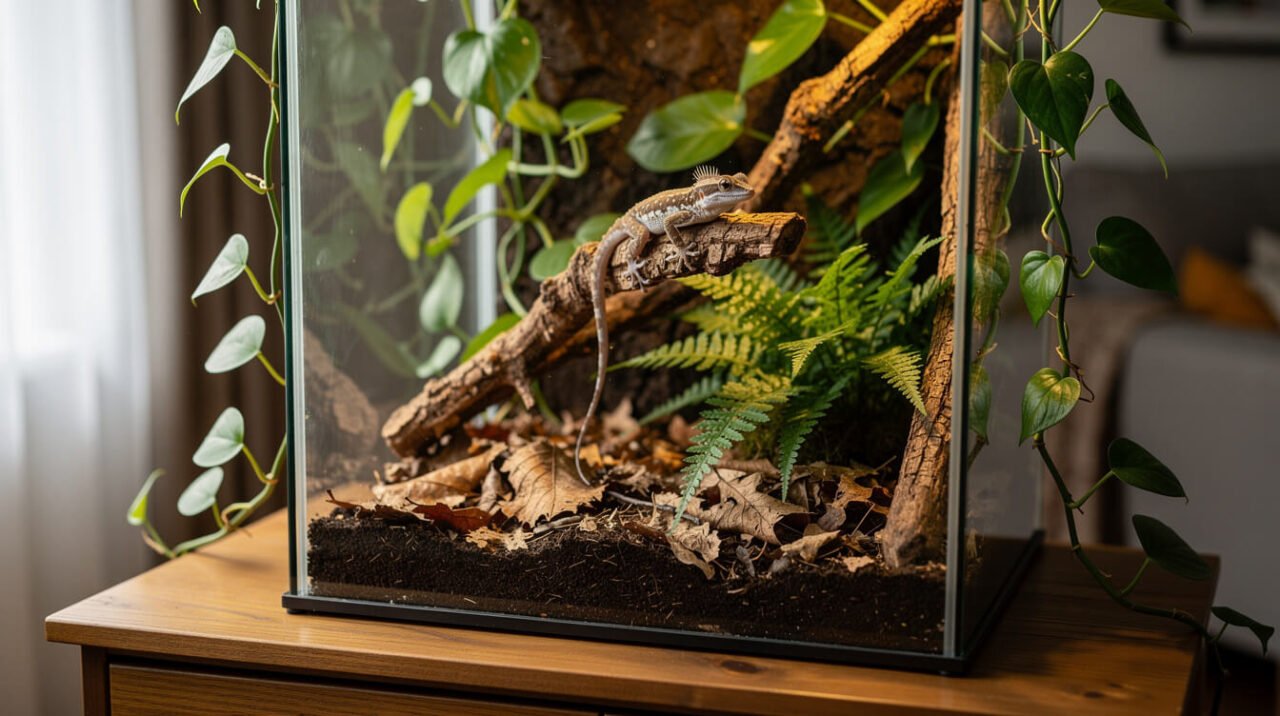
Crested geckos are arboreal. In the wild they live in trees, and they use height, leaves, and branches the way a cat uses shelves. So the shape of the enclosure matters as much as its volume.
Why the size numbers disagree
PetMD’s “20 gallons” is the older pet-trade standard. The two UK veterinary and welfare sources both use 45 × 45 × 60 cm, which works out to roughly 18″ × 18″ × 24″, or about 34 US gallons. That’s already well above 20. ReptiFiles has since raised its own minimum for juveniles and adults to 18″ × 18″ × 36″ (about 50 gallons), and it treats 24″ × 24″ × 24″ as the starting point for its recommended models.
Our reading: 18″ × 18″ × 24″ is the floor every modern source accepts, and taller is better. If you can fit an 18″ × 18″ × 36″ or a 2′ × 2′ × 3′, your gecko will use all of it. A 20-gallon aquarium stood upright is a starting point from an older era, not the goal.
What goes inside
- A front-opening glass or PVC enclosure with a mesh top for ventilation.
- Branches in every direction. Include vertical climbs and also horizontal perches near the top, so the gecko has somewhere to sleep that isn’t the glass.
- Dense foliage. Live pothos or similar safe plants, or good artificial plants, give daytime cover. The RSPCA suggests cork bark tubes or half coconut shells for hides.
- A moisture-holding substrate such as coco fiber or a soil mix topped with leaf litter. The RSPCA and RVC both warn against feeding on loose substrate where it can be swallowed, which is one reason most keepers feed from a wall-mounted ledge.
Hatchlings under about 12 grams are the exception. ReptiFiles’ minimum for them is a 12″ cube, and they move up as they grow. If you’re setting up for a leopard gecko as well, note that the two species need opposite shapes: leopard geckos live on the ground, cresties live up high.
One gecko per enclosure. The RSPCA and the RVC both recommend keeping them singly, and every source agrees that males must never share. Females sometimes coexist in a much larger space, but cohoused geckos are more likely to lose tails in scuffles, and a lost tail is permanent.
Temperature: what a crested gecko actually prefers
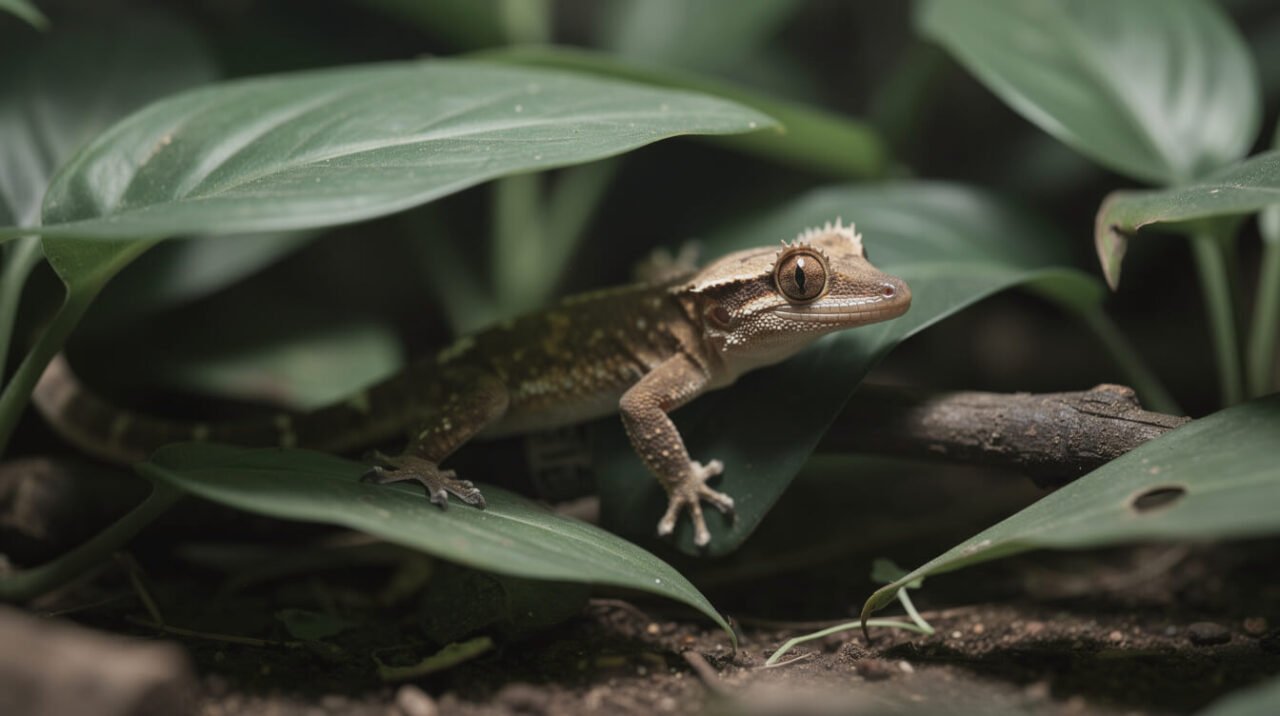
This is the row where the care sheets disagree most. Here’s the full spread from reputable sources:
- A vet-written care sheet from Swiftail Vet: ambient 72–78°F, and avoid temperatures above 82°F.
- PetMD: warm end 72–75°F, never over 80°F for extended periods.
- ReptiFiles: a basking area of 82–85°F at the top, and sustained temperatures above 85°F risk heat stroke.
- PetSmart: basking 85–87°F, the hottest figure we found on page one.
The study that settles most of it
None of the top-ranking guides cite the one study that measured what crested geckos choose for themselves. In a study published in 2020, researchers at California State University, Fresno tested adult and juvenile crested geckos on a thermal gradient. The geckos held their body temperature within a narrow set-point range of 24–28°C, about 75–82°F, and adults and juveniles behaved the same. Their running performance peaked at about 32°C (around 90°F), and the warmest temperature they voluntarily experienced averaged about 33°C. That means they’ll briefly visit a hotter spot, but they choose to spend their time in the mid-70s to low 80s.
That matches the RSPCA and RVC figures and the low end of ReptiFiles’ basking range. It also shows why both camps are partly right: a gecko that can move between a warmer spot and a cooler one is regulating the way the study describes. A gecko in a room that’s 84°F all day has nowhere to go.
A working range
- Most of the enclosure: about 72–78°F during the day.
- Warmest spot, near the top: about 80–82°F. Any heat bulb goes on a thermostat. The measured preference tops out around 82°F, so there’s little to gain by going higher.
- Night: a drop into the mid-to-high 60s °F is natural and fine. ReptiFiles goes as low as 65°F, the RSPCA as low as 64°F.
- Sustained mid-80s with no cooler zone: every source treats this as dangerous. Avoid it.
The real risk is the room, not the lamp
Many keepers need little heat at all. The bigger danger is a hot room: a heatwave, a sunny window, or a power cut that takes the air conditioning with it. An enclosure can’t be cooler than its room, and Chicago Exotics Animal Hospital warns that above 85°F crested geckos are at risk of overheating. Here’s a summer plan:
- Put a digital max/min thermometer at the bottom and the top so you know the actual peak temperature, not just the reading when you check.
- Turn off any heat source on hot days. Thermostats don’t cool.
- Know which room in your home stays coolest (often a basement or an interior room on the lowest floor) and be ready to move the enclosure there.
- Keep it out of direct sun at every hour of the day.
- If your gecko seems limp, unusually lethargic, or unresponsive after a heat spike, treat it as an emergency and call a reptile veterinarian right away.
Humidity and misting: the wet-dry cycle

Humidity looks like another disagreement, but most of it is a difference in emphasis. PetMD gives 70–80% and says to mist daily. ReptiFiles gives 60–80% but says to let it dry out to around 50% or even 40% before misting again, because constant moisture encourages mold. The RSPCA calls them “humidity boosts” to 60–80% and says the enclosure should dry out between mistings. The RVC gives 50–70%.
Three of those four describe a cycle rather than a constant, and that’s the rule we’d follow: spike, then let it dry. In practice:
- Mist in the evening, as your gecko wakes up. Cresties prefer to lick droplets off leaves and glass, so misting doubles as their main drink.
- Mist again in the morning if your enclosure dries out fast. Many screen-topped setups need two mistings, and many glass enclosures with live plants need only one.
- Let it fall back toward 50% during the day. If the hygrometer never drops below 80% and the glass is always fogged, you’re heading toward mold and the soggy substrate that the RSPCA links to skin and respiratory infections.
- Also give them a water dish. ReptiFiles notes that crested geckos do recognize and drink from a dish. The RSPCA calls fresh water at all times a must. Use fresh water. ReptiFiles specifically advises against distilled or reverse-osmosis water for the dish.
Humidity also affects shedding. Stuck shed around the toes is one of the most common problems in crested geckos, and the RSPCA warns that it can cost toes. Persistent stuck shed is worth a reptile vet visit.
The weekly care guide
Get it right for your animal, every week
One email a week: new care guides, species deep-dives, and the safety answers keepers search for, written by our specialists. No spam. Unsubscribe anytime.
Crested gecko diet: complete powder, insects, and the banana question
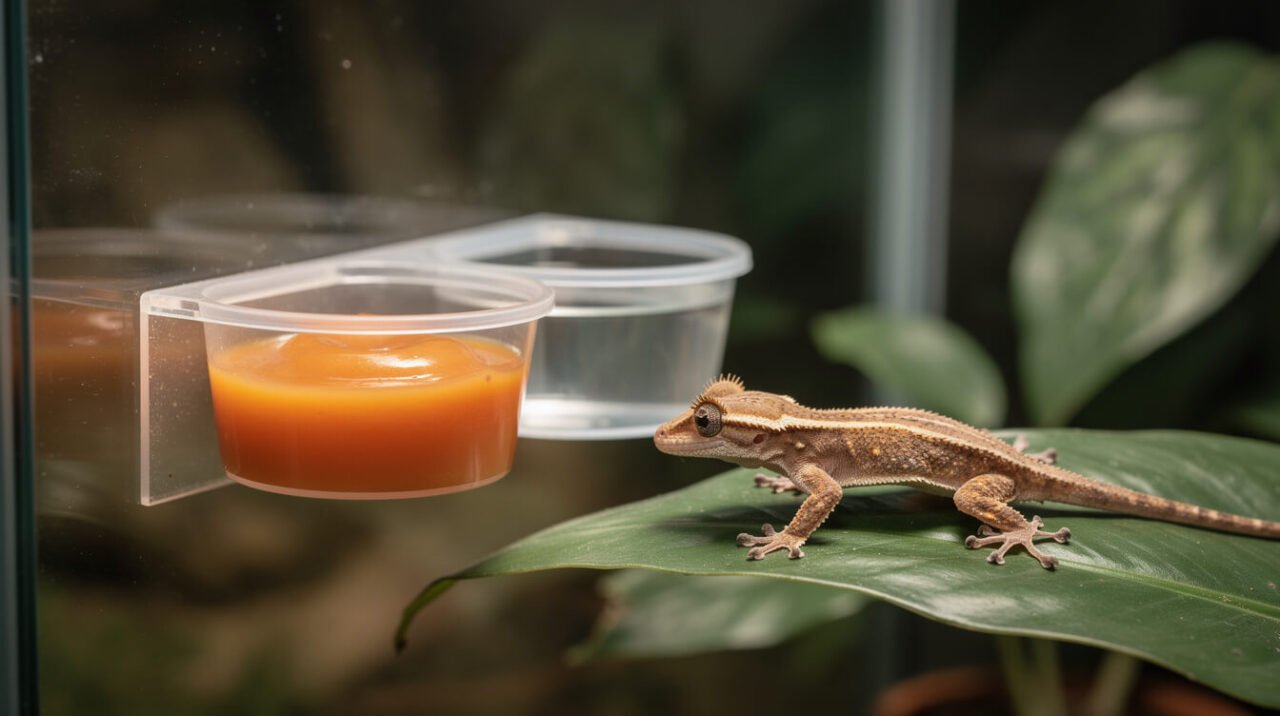
Crested geckos are omnivores. In the wild they eat fruit and other plant matter, insects, and, according to the RVC, even other small lizards. The thing that changed crestie keeping is the complete powdered crested gecko diet, or CGD, which you mix with water to about the consistency of ketchup and serve in a small cup on a ledge.
The staple
Modern sources agree that a good CGD is the base of the diet. ReptiFiles keeps a short list of brands it considers proven (Pangea, Repashy, Arcadia, Black Panther Zoological, Leapin’ Leachie, Lugarti, Blue River, and Zoo Med’s newer formula) and advises leaving others on the shelf. They disagree on frequency. PetMD says every day, while ReptiFiles says daily for juveniles and every two to three days for adults, because a lot of captive cresties are overweight. Our view: daily for growing geckos, and for adults let the scale decide. Remove old CGD within about a day, since the RSPCA notes it sours quickly.
The 2015 RSPCA sheet calls CGD “supplementary,” but the newer Royal Veterinary College guidance (2022) says crested geckos are “typically fed a complete formulated diet.” We’d go with the newer veterinary guidance.
Insects
- How often: one to two times a week for juveniles, about once a week or less for adults (ReptiFiles).
- What: crickets, dubia or discoid roaches, black soldier fly larvae, silkworms, and the occasional waxworm. ReptiFiles avoids mealworms and superworms, while the RVC allows mealworms in moderation.
- Size: no wider than the space between your gecko’s eyes.
- Prep: gut-load and dust with calcium (which kind is covered below).
- Remove any insects the gecko doesn’t eat. The RSPCA warns that leftover bugs can bite a sleeping gecko.
The banana question
The RSPCA says “never feed citrus fruits or banana, as they prevent the uptake of calcium.” PetMD and ReptiFiles both list banana as an acceptable treat. And Repashy’s classic crested gecko diet lists dried banana as its first ingredient. So who’s right?
The answer is the calcium-to-phosphorus ratio. The Merck Veterinary Manual says a reptile’s food should have at least as much calcium as phosphorus (1:1), and preferably twice as much (2:1). Here are the numbers for common fruits, from USDA FoodData Central:
| Fruit (raw, per 100 g) | Calcium | Phosphorus | Ca:P |
|---|---|---|---|
| Banana | 5 mg | 22 mg | 0.23 : 1 |
| Blueberries | 6 mg | 12 mg | 0.5 : 1 |
| Apricot | 13 mg | 23 mg | 0.57 : 1 |
| Mango | 11 mg | 14 mg | 0.79 : 1 |
| Papaya | 20 mg | 10 mg | 2 : 1 |
| Fig | 35 mg | 14 mg | 2.5 : 1 |
Banana doesn’t block calcium. It just has the most lopsided ratio of these common fruits. Blueberries and mango, which the RSPCA lists as safe, also fall below 1:1. That’s why the complete diets add calcium carbonate: inside a formula, the banana is balanced out. In a dish on its own, it isn’t. (Citrus is different. By the same USDA data, oranges carry more calcium than phosphorus, so the calcium explanation doesn’t fit them. There’s just no good reason to offer citrus.)
The practical rule: fresh fruit is an occasional treat, not a meal. If you offer it, papaya and fig are the better picks by these numbers. Too much fruit can also make a gecko refuse its complete diet (ReptiFiles). Skip baby food. ReptiFiles advises against it, and it adds nothing a good CGD doesn’t already provide.
UVB, calcium, and D3: how to avoid doubling up
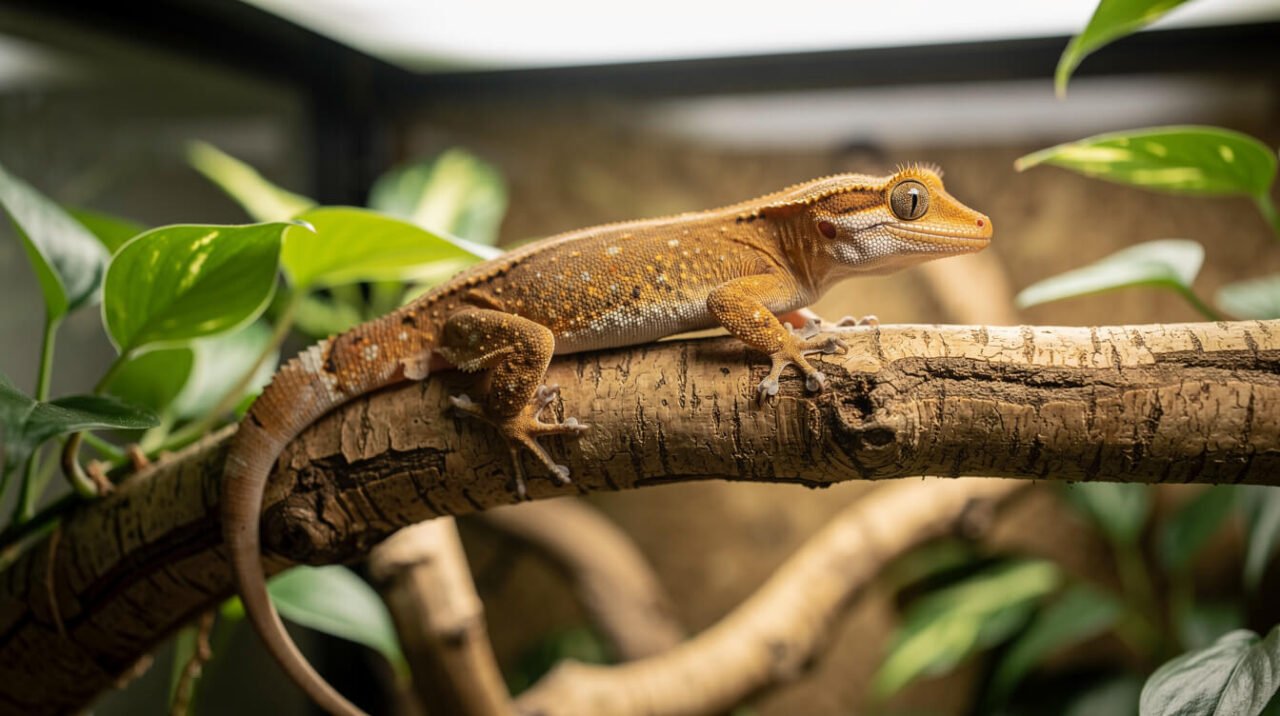
Older care sheets said nocturnal geckos don’t need UVB. The guidance has shifted. ReptiFiles recommends UVB for all reptiles. The RVC says cresties “appear to benefit” from a low-output lamp. The RSPCA specifies a 5–7% UVB tube. The common thread is low output, because cresties are shade dwellers. ReptiFiles’ target is a UV index of 1.0–2.0 at the basking branch, measured with a UV meter, using a shade-dweller-strength T5 tube mounted above the mesh. Hatchlings in small tubs need special care: a strong tube over a tiny enclosure can overexpose them.
Where the D3 confusion comes from
Vitamin D3 lets a reptile use the calcium it eats. Your gecko can get D3 from three places, and many setups use all three:
- UVB light. The skin makes D3 from UVB exposure.
- The complete diet. Repashy’s label, for example, lists “Vitamin D3 Supplement” among its vitamins, and complete diets are formulated to include it.
- Calcium powder with D3, dusted on insects. PetMD’s sheet calls for this “before each feeding session.”
The Merck Veterinary Manual says vitamin D is needed in the diet only when the body can’t make enough on its own, as when an animal gets no suitable UV light. Merck also notes that vitamin D toxicity can cause soft-tissue calcification, which has been documented in green iguanas. The RSPCA says with a well-set-up UV system “you will not need to add vitamin D3 to the diet,” and warns that supplements can be overdone.
So the reconciled rule, which ReptiFiles and a vet-clinic care guide from Long Island Bird & Exotics both follow:
- Using UVB? Dust insects with plain calcium, without D3.
- No UVB? Use calcium with D3 on insects, and feed a proven complete diet. ReptiFiles stresses that without UVB, diet quality matters even more.
- Either way, ask your reptile vet to review your supplements at the annual check. Bring photos of every label.
Run lights about 12 hours a day (ReptiFiles suggests 14 in summer and 10 in winter), and turn them fully off at night. Your gecko sees well in the dark and doesn’t need a red or blue “night bulb.”
Handling, tail loss, and enrichment
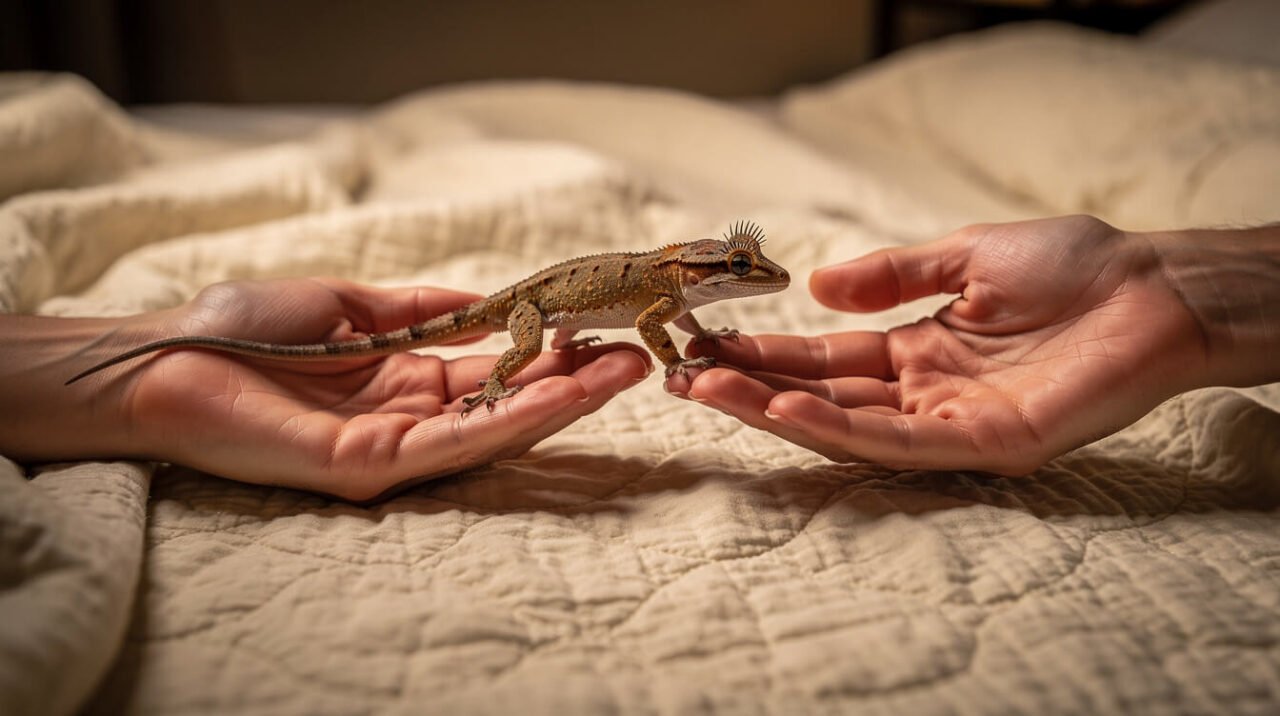
Many cresties tolerate gentle handling well once they’ve settled. The goal is to enjoy that without costing them their tail.
The tail doesn’t grow back, and it’s more than decoration
Most geckos can regrow a dropped tail. Crested geckos can’t. A 2024 genome study names Correlophus among only a few gecko genera that have lost the ability. And the tail is a working tool: the pad on its underside is adhesive, and a 2021 study estimated it could hold up to five times the gecko’s own body mass. The RSPCA adds that dropping it is stressful and costs the gecko fat reserves.
That said, a tailless crestie, which keepers call a “frogbutt,” isn’t a ruined animal. A vet-written care sheet from Swiftail Vet notes that frogbutts live perfectly healthy lives with a little extra attention to weight and hydration. Chicago Exotics notes that most wild adults have lost their tails. If it happens, don’t blame yourself.
Handling that protects the tail
- Give a new gecko time to settle. ReptiFiles suggests about two weeks before handling.
- Never grab or restrain by the tail. Let the gecko walk onto your hand.
- Stay low, over something soft. Cresties leap without warning. A 2021 jumping study found that landings on flat surfaces produce the highest impact forces, so sit on a bed or the floor.
- “Treadmill” a jumpy gecko. Hold one hand a few inches in front of the other and let it walk or hop from hand to hand.
- Keep sessions short. ReptiFiles starts at about five minutes every other day and builds to 15. The RSPCA suggests about 10 minutes so the gecko doesn’t get chilled.
- Wash your hands afterward. All reptiles can carry Salmonella (RVC).
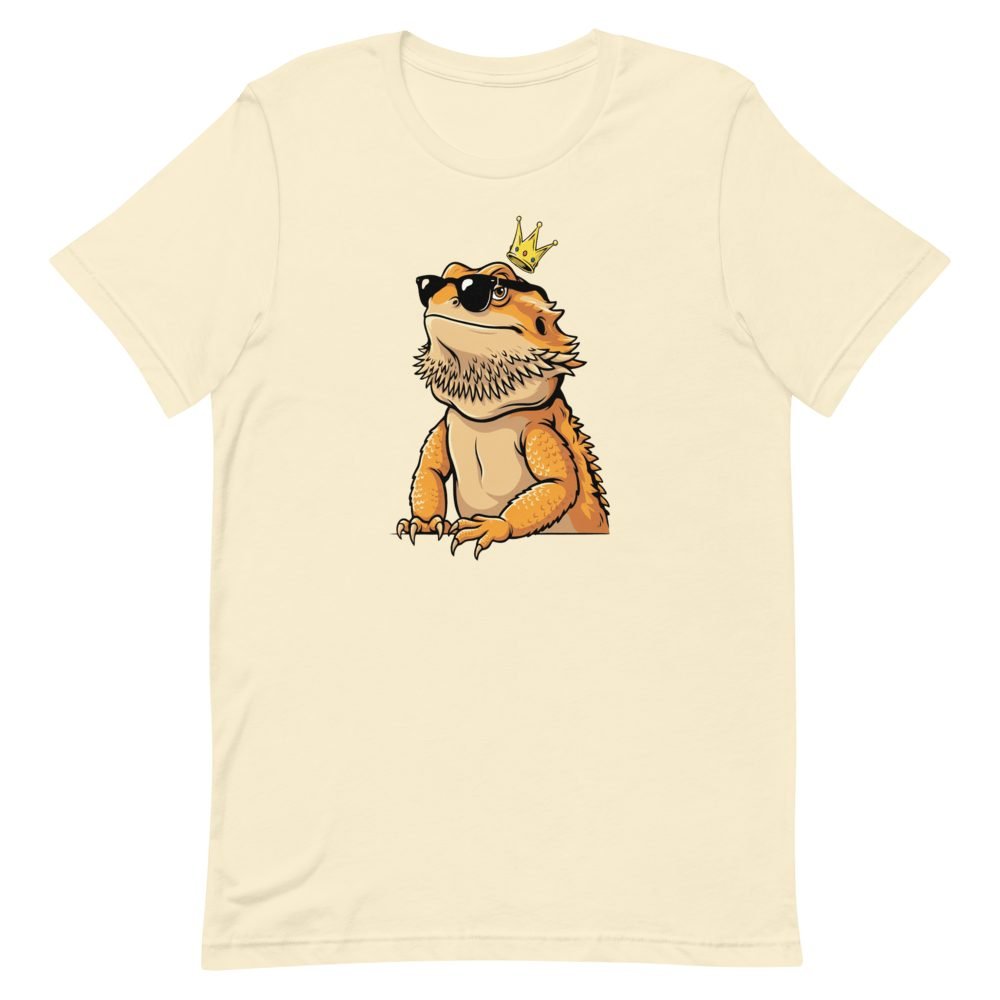
If you’re shopping for keeper gear, GeoZoo’s shop is small and reptile-first, and right now its one design is the Bearded Dragon Crown Sunglasses King T-Shirt. It’s a bearded dragon rather than a crestie, but it’s a fit for any multi-reptile household.
Wear the obsession
A crowned, shades-wearing bearded dragon for the reptile keeper whose shelves hold more than one enclosure. Soft, everyday, and an easy conversation starter at the reptile expo.
Enrichment and floppy tail syndrome
Rearrange a few branches or plants now and then, and offer insects occasionally so your gecko gets to hunt. A 2023 study of crested and leopard geckos found that individuals that approached and explored new objects sooner had lower baseline stress-hormone levels. The responses were highly individual, and the authors say more research is needed.
The setup also protects against floppy tail syndrome, in which the tail bends over the body when the gecko hangs head-down. The RSPCA links it to inadequate climbing space and geckos sleeping upside down on the glass. That’s welfare-organization and keeper consensus rather than settled research: we found no peer-reviewed study of its cause. But the fix it implies is cheap. Add plenty of horizontal perches and leaves near the top, so your gecko has better places to sleep than a bare pane of glass. If you notice the tail flopping or kinking, mention it to your reptile vet.
Crested gecko health: what normal looks like, and when to see a vet
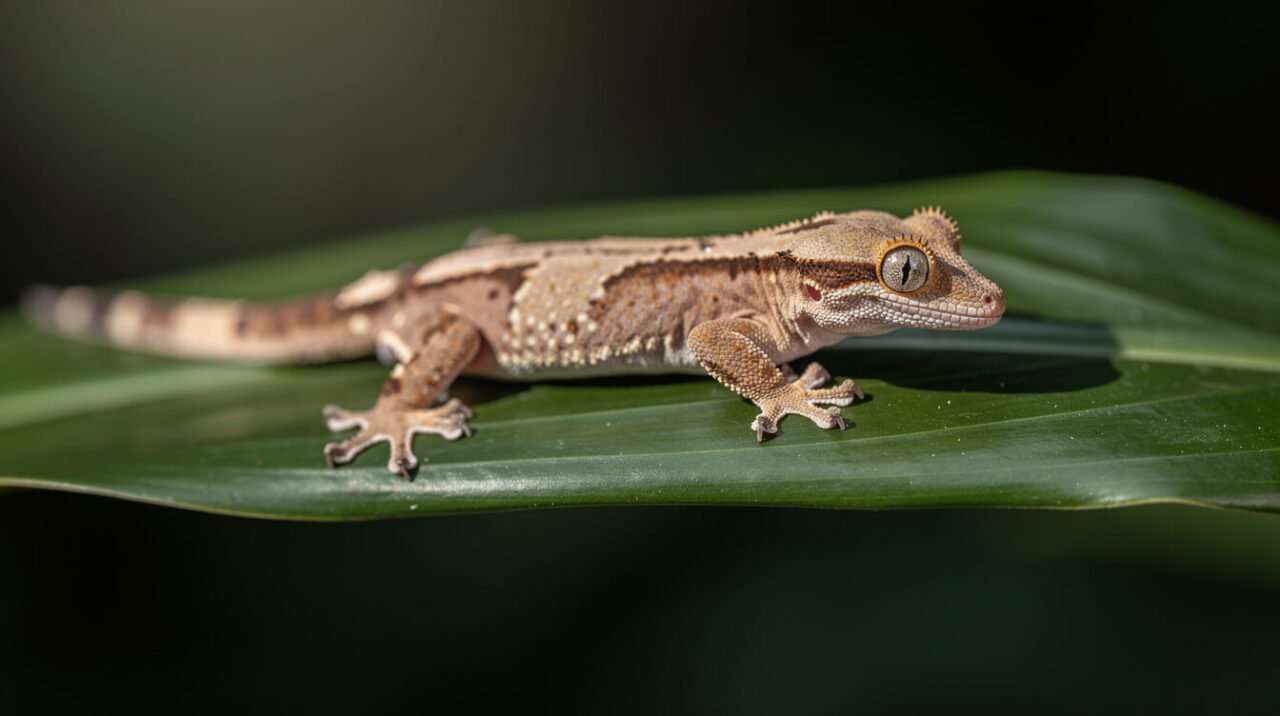
Reptiles hide illness well, so the best crested gecko care tool you own is a routine. ReptiFiles recommends weighing your gecko weekly on a gram scale and keeping a simple log of weight, appetite, and sheds. Unexplained weight loss is often the first sign of illness.
Signs of a healthy crestie
Drawing on PetMD’s vet-reviewed list and the RSPCA sheet:
- Clear, bright eyes with no discharge
- Smooth, intact skin with no stuck shed, especially on the toes
- A straight spine and tail with no kinks
- A good appetite and a steady weight
- Active, exploring, and climbing at night
- A clean vent
When to call a reptile veterinarian
PetMD lists these as reasons to see a vet: swollen, sunken, or crusted eyes, swelling around the ears, sores on the skin or nose, refusing food, lethargy, discharge from the vent, lumps, trouble moving, a sunken belly, stuck shed with swollen toes, and rapid muscle loss along the back and tail.
Pay particular attention to metabolic bone disease. The RSPCA describes it as swellings or a misshapen leg, jaw, or spine, and says it needs urgent veterinary attention. Untreated, the deformities can be permanent. If anything on these lists matches what you’re seeing, don’t wait to see if it passes. We’re not vets, and these are not things to treat at home.
PetMD and the RVC both recommend a yearly checkup with a reptile vet, even for a healthy gecko. PetMD suggests bringing photos of the enclosure, food, and the labels on your lights and supplements, so the vet can review your setup too. The Association of Reptile and Amphibian Veterinarians has a directory to help you find one. Find a vet before you need one.
Crested gecko care FAQ
How long do crested geckos live?
Usually 15–20 years with good care, according to PetMD and the RSPCA. A Tree of Life Exotics care sheet notes some exceed 20. You may see a shorter figure on some clinic pages, but most sources agree on the 15–20 range. Plan for two decades.
Do crested geckos need misting every day?
In most homes, yes, usually once in the evening. That’s when they drink. Add a morning misting if the enclosure dries out fast. Misting should cause a spike that then dries out, not keep the enclosure constantly wet.
Are crested geckos easy to care for?
They’re among the more forgiving reptiles. They don’t need hot basking spots, and their main food comes as a powder. But “easy” isn’t “low commitment.” They need humidity cycling, a tall enclosure, and weekly weigh-ins, and they live for decades. The downsides: they’re nocturnal, jumpy, sensitive to heat waves, and their tail drops for good. They’re a great fit for patient beginners who’ve done their homework. Our guide to the best reptiles for beginners compares them with other species.
How can I tell if my crested gecko is happy?
Reptiles don’t show contentment the way a dog does. Look instead for normal behavior: exploring and climbing at night, eating its diet, shedding cleanly, holding a steady weight, and resting calmly during the day instead of pacing the glass. Those are the signs of a gecko whose needs are being met.
Final thoughts
Crested gecko care isn’t hard once you see past the conflicting numbers. Most of the disagreement comes from sources written in different years and countries, describing different parts of the enclosure. The research that does exist points to a gecko that prefers about 75–82°F, needs humidity that rises and falls, does well on a proven complete diet with the right calcium, and depends on a tail it can’t replace.
Get those right, keep an eye on the scale, and you’ll have a decades-long companion that greets the evening with its eyelashes up and its toes sticking to everything. If cresties have you curious about their colors and patterns, our guide to crested gecko morphs is a good next read. The Chinese cave gecko is another cool-loving, nocturnal gecko worth meeting. For the bigger picture, see our complete reptile care guide and our leopard gecko care guide.
Before you go
Keep learning your animal
We publish a new guide every day. The best of them land in one short weekly email, so you never miss the one about your species.

Dr. Zoe Santos is a distinguished herpetologist and a revered expert in the care, conservation, and study of reptiles and amphibians. With a PhD in herpetology and over 18 years of field and academic experience, Zoe brings a depth of knowledge to her readers that is both rare and invaluable.