The Complete Parrot Toy Guide: Safe, Species-Right Toys (and What They Really Cost)
Walk into any pet store’s bird aisle and you’ll see wall after wall of parrot toys — bright, cheap, and almost entirely undifferentiated by species or size. A cockatiel and a hyacinth macaw get sold from the same rack, which is a little like handing a toddler and a linebacker the same pair of shoes. Parrot toys aren’t one-size-fits-all, and getting the match wrong isn’t just a wasted purchase — it can mean a bored bird, a destroyed toy in ten minutes, or, worse, a genuine safety hazard.
This guide covers what the toy aisle won’t tell you: how to match toys to your bird’s beak strength and species, which materials and hardware to avoid, how to build a safety-checked rotation, and what you should actually expect to spend. No fear-mongering, no vague “always supervise” hand-waving — just the specifics a devoted keeper needs to get this right.
It’s worth saying up front why this matters more than it might seem. Parrots are neurologically built for problem-solving — foraging, manipulating, and destroying objects is how a wild parrot spends a huge share of its waking day. Take that job away without replacing it, and the behaviors keepers actually worry about (screaming, feather-picking, biting, and general crankiness) tend to fill the gap. The right toys, chosen deliberately rather than grabbed off a shelf, are one of the highest-leverage things you can do for a captive parrot’s wellbeing.
One more note before the how-to: nothing here replaces watching your own bird. Species guidelines are a starting point, but the parrot in your living room has opinions, and a good toy strategy adjusts to them.
Why one-size-fits-all parrot toys don’t exist — matching toys to beak strength & species
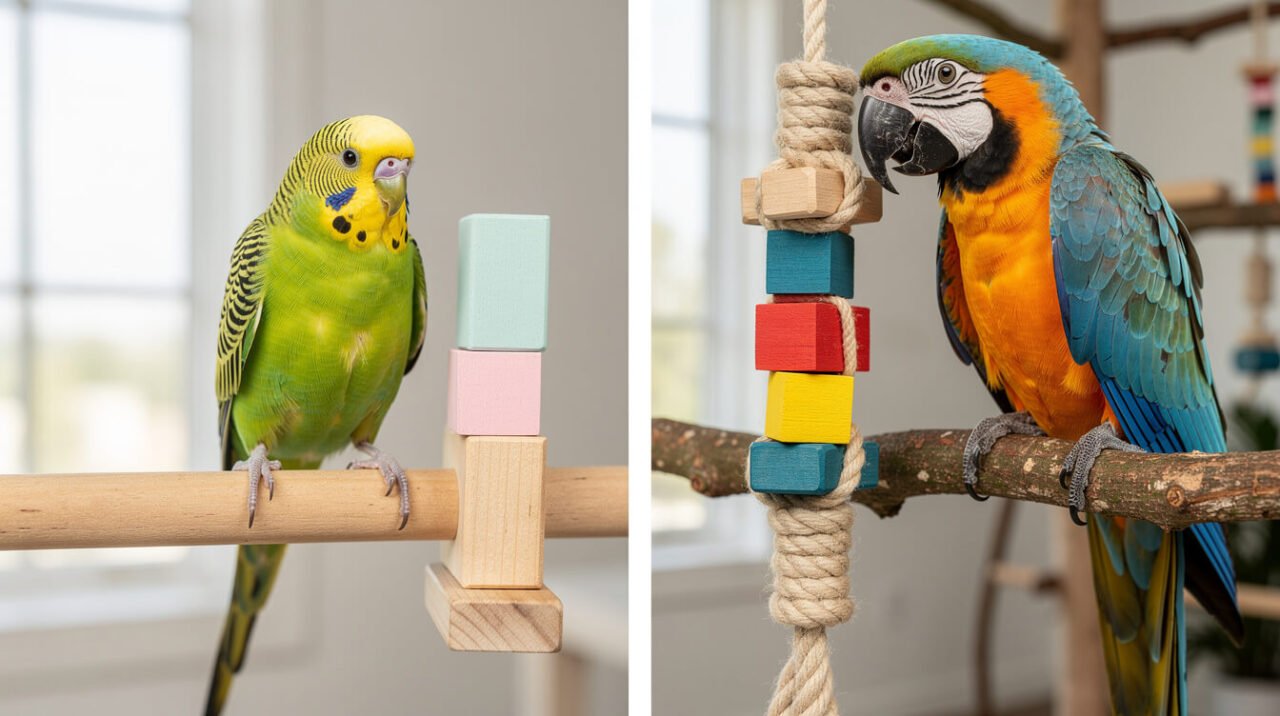
The single biggest toy-buying mistake is shopping by cage size or price point instead of beak strength. A budgie’s beak can nibble through soft balsa wood over a few days. A green-cheek conure or cockatiel needs something with a bit more resistance. And a macaw or cockatoo — birds capable of cracking Brazil nuts and hard-shelled seeds in the wild — will reduce a “small parrot” toy to splinters in minutes, which isn’t destructive behavior on their part, it’s just the toy being wrong for the bird.
Rough size classes to shop by
- X-small to small: budgies, parrotlets, lovebirds, cockatiels — softer woods (balsa, pine), thinner rope, lighter plastics.
- Medium: conures, quakers, Senegals, small cockatoos — tougher woods (yucca, vine), thicker rope, harder acrylics.
- Large: African greys, Amazons, larger cockatoos — dense wood blocks, leather, heavy-gauge rope.
- X-large: macaws, larger cockatoos — hardwoods, coconut shell, thick manila or sisal rope, substantial hardware.
These bands are a starting point, not gospel — an unusually determined cockatiel can out-chew a “medium” toy, and a gentler Amazon might do fine with something a size down. Watch how fast your individual bird works through a toy and size up or down from there rather than assuming the label is the last word.
How to tell a toy is the wrong size before you buy the next one
Two patterns tell you a lot faster than any size chart:
- Destroyed in minutes, every time: if a toy is gone before you’ve finished making coffee, size up in both material hardness and hardware gauge — this is a beak-strength mismatch, not a “tough bird” problem to solve with more toys of the same kind.
- Never touched: a toy that sits untouched for weeks, even after a rotation break, may be too hard or too intimidating for that bird’s confidence level — try something a size down or a softer material before assuming your bird just “isn’t a toy bird.”
Beak strength also isn’t purely a function of species — age, confidence, and individual temperament all play a role. A young, cautious grey may need softer starter toys before working up to what an adult grey can handle; a boldly destructive quaker may need medium-bird toys despite technically being a small parrot. Species charts get you in the right neighborhood; your bird’s actual behavior gets you the rest of the way.
Toy types explained: foraging, chewable, shreddable, puzzle, and preening
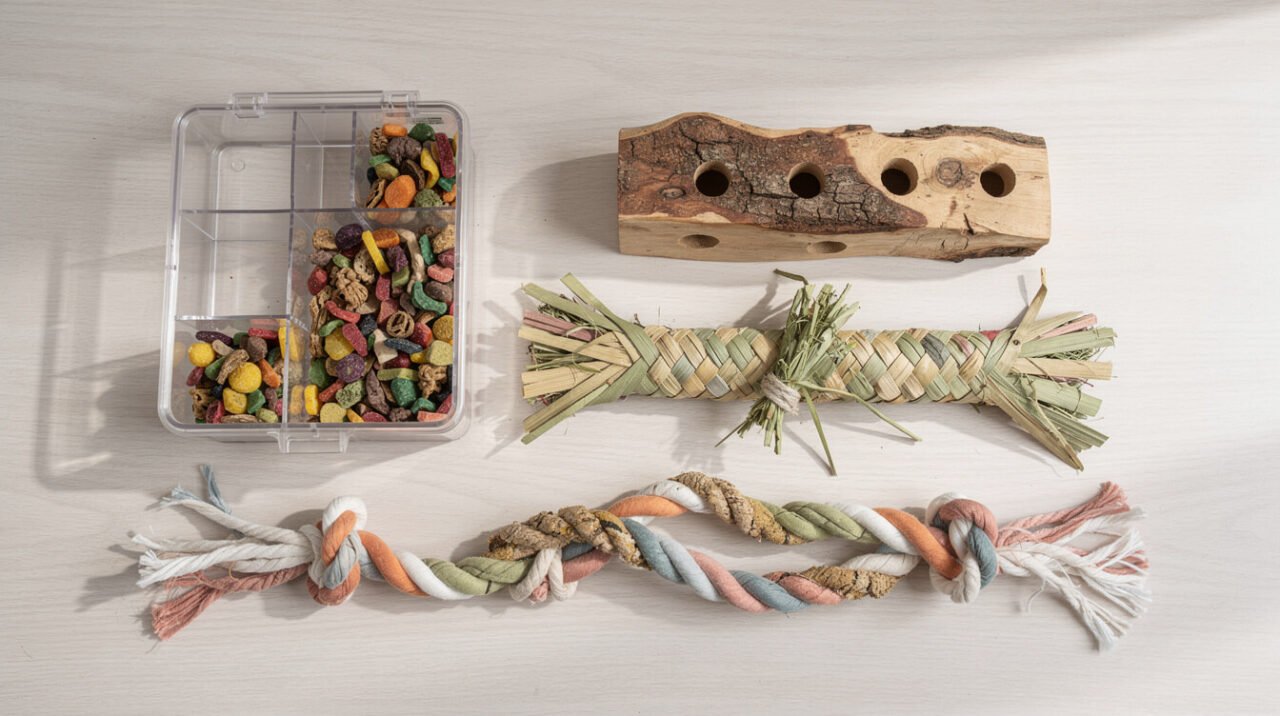
“Toy” is doing a lot of work in the pet aisle — a foraging puzzle and a preening rope solve completely different problems, and a well-enriched cage usually has more than one type in rotation.
Foraging toys
These hide food behind a barrier your bird has to work to get past — a wrapped nut, a puzzle box, a shreddable pouch. In the wild, parrots spend a huge portion of their day searching for and processing food; a bowl of pellets removes that entire job. Foraging toys give it back, and they’re consistently the highest-value enrichment category for reducing boredom-driven behaviors.
Chewable and shreddable toys
Untreated wood, palm leaf, seagrass, and paper toys exist to be destroyed — that’s the point, not a flaw. Chewing supports natural beak conditioning and gives your bird a legitimate outlet that isn’t the woodwork on your window frames.
Puzzle toys
Multi-step problem-solving toys (levers, sliding pieces, nested compartments) ask more of a bird’s problem-solving ability than simple chew toys, and are especially valuable for the more cognitively demanding species — greys, cockatoos, and macaws in particular.
Preening and comfort toys
Soft rope, fringe, and fabric toys give a bird something to preen and manipulate that isn’t their own feathers — genuinely useful for birds prone to over-preening or mild feather-picking, though persistent feather-picking itself is a conversation for your avian vet, not a toy fix.
Layering types instead of picking one
The keepers who see the biggest behavior improvements usually aren’t buying more toys overall — they’re making sure at least one toy from each category is present at once. A cage with three chew toys and nothing to forage in is still an under-enriched cage, even if it looks full. Aim for coverage across categories before you add volume within one.
Materials matter: zinc, lead, and unsafe hardware to avoid
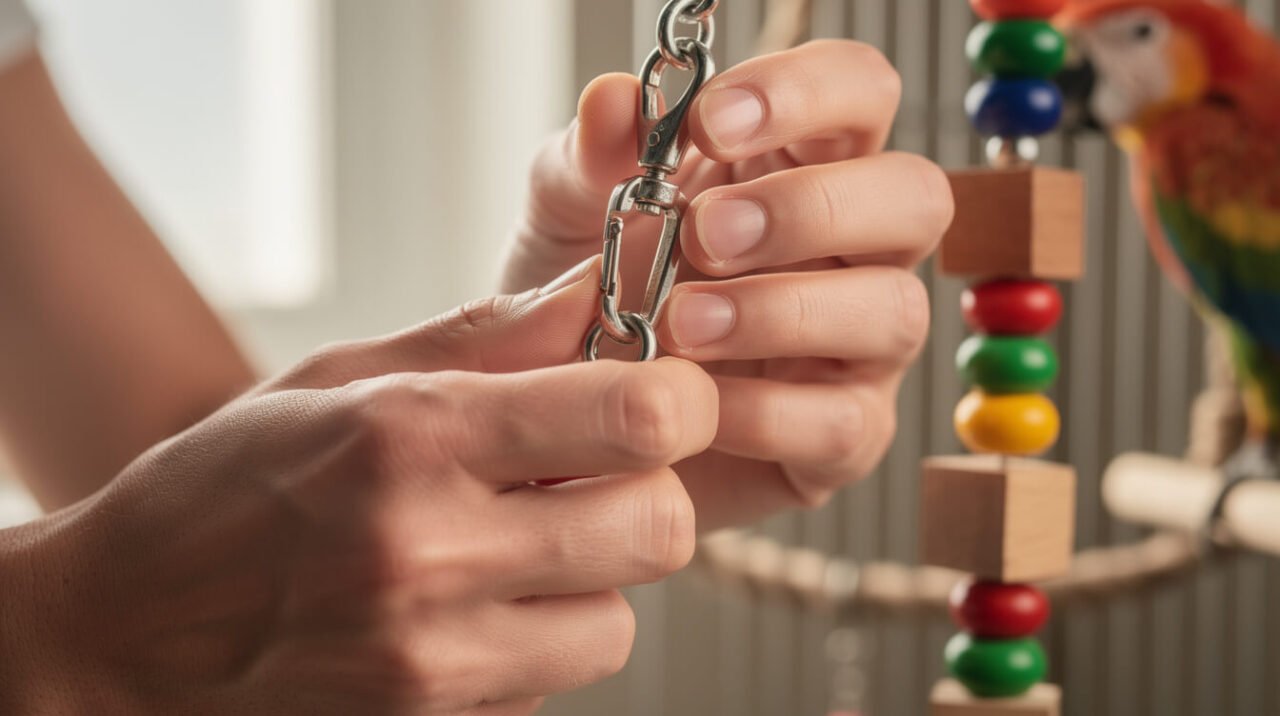
This is the section that separates a genuinely safe toy from one that just looks safe on a store shelf, and it’s the part the big e-commerce toy pages consistently skip.
Metal hardware
Cheap chain, clips, and bells are the most common source of heavy-metal exposure in pet birds. Look for hardware explicitly marked stainless steel, nickel-plated, or zinc-free. Galvanized or plated metal that isn’t labeled can carry zinc or lead content, and a parrot’s beak is more than capable of scraping enough metal off a cheap clasp to matter over time. If a toy’s hardware isn’t labeled, treat that as a reason to skip it rather than assume it’s fine.
Dyes and paints
Stick to toys labeled with non-toxic, bird-safe dyes. Reputable toy makers state this on the packaging; if a colorful toy doesn’t say so anywhere, that’s worth a pause.
Rope and fiber
Natural, untreated cotton, sisal, or seagrass rope is the standard. Avoid rope with a plastic or synthetic core, since fraying synthetic fibers don’t break down the way natural fiber does and are more likely to tangle around a toe or wing.
The rule of thumb worth remembering: if you can’t identify what a toy’s hardware or coating is made of, don’t hang it in the cage. A missing material label isn’t a small oversight — it’s the whole point of checking.
A word on secondhand and marketplace toys
Secondhand toy bundles show up often in local pet groups and marketplace listings, and the savings can be tempting. The problem is material traceability — a used toy rarely comes with its original packaging or hardware labeling, which means you’re back to guessing about metal content and dye safety. If you do buy secondhand, treat it as raw material rather than a finished toy: keep the wood or natural-fiber pieces if they look sound, and replace any metal hardware, clips, or bells with new, labeled, bird-safe versions before it goes anywhere near the cage.
Toy safety checklist: rope fraying, quick-links, and entrapment risks
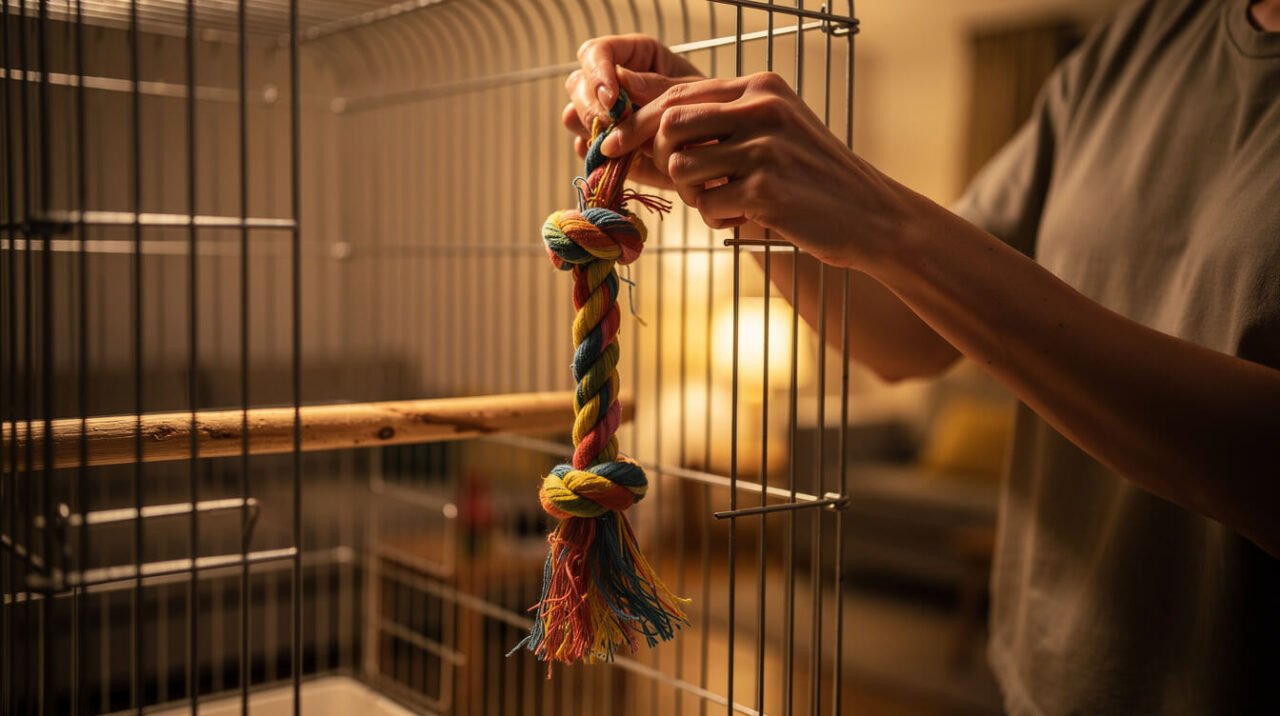
Even a well-made toy becomes a hazard as it wears down. Build a quick weekly check into your routine — it takes under a minute per toy.
- Rope fraying: Loose fiber strands can wrap around a toe or leg. Trim or retire a rope toy the moment you see fraying start.
- Open or C-shaped links: Quick-links should be fully closed and screwed tight — an open C-link is a classic beak or toenail entrapment point. Check that they haven’t loosened with use.
- Small, swallowable pieces: Bells, beads, and plastic components should be too large to swallow and securely fastened, not just resting loosely on a string.
- Cracked or splintering hard plastic: Sharp plastic edges can injure a beak or tongue; retire the toy rather than trying to sand it down.
- Chain link gaps: Wide-gauge chain can catch a toe between links, especially on smaller birds. Match chain gauge to bird size, not just toy size.
- Toy placement: Even a perfectly safe toy hung where it swings into a food bowl or blocks a flight path can cause its own problems — leave room to move.
None of this means enrichment is inherently risky — it means enrichment deserves the same routine attention you’d give any other part of the cage setup. A five-minute Sunday toy check is enough to catch nearly everything on this list before it becomes a problem.
How many toys does your parrot need? A rotation schedule
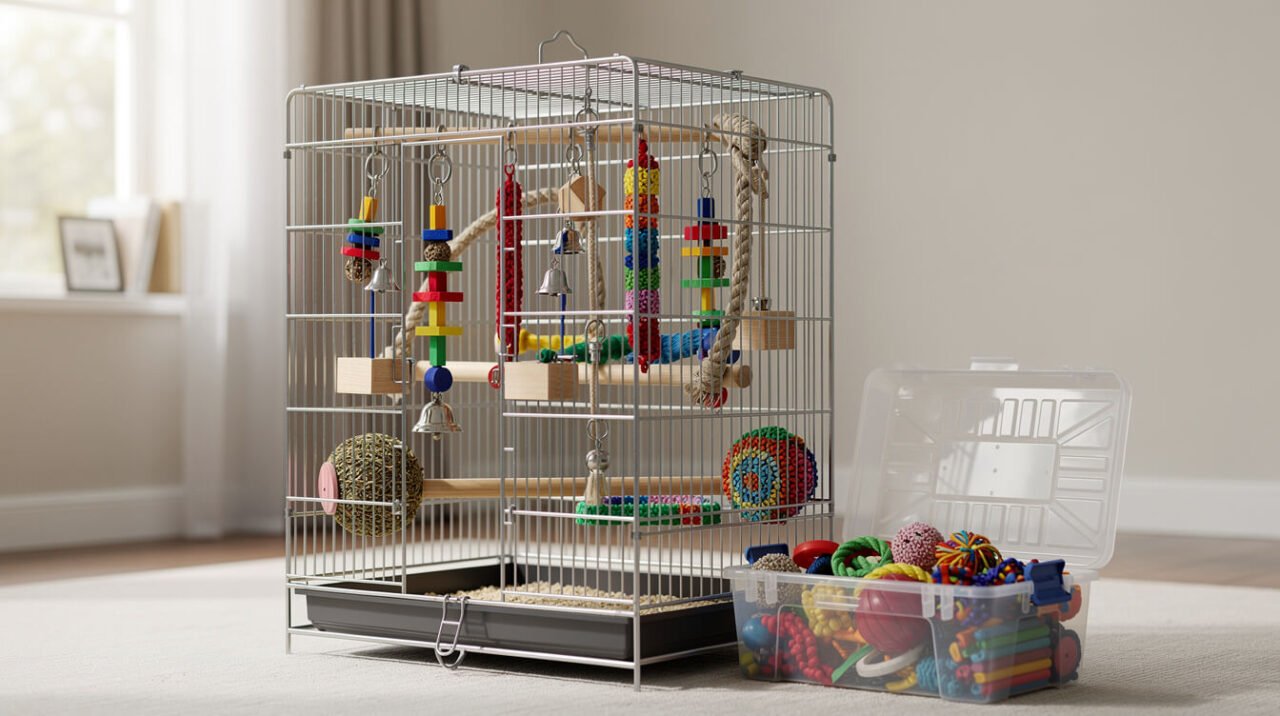
More toys crammed into a cage at once isn’t automatically better — a cage so full of toys that a bird can’t move freely, or so visually cluttered that nothing stands out, tends to reduce engagement rather than increase it. Rotation beats volume.
A workable starting rotation
- 2–4 toys visible in the cage at a time, mixing at least one foraging toy with one chew or shred toy and one preening or comfort toy.
- Swap one or two toys weekly, keeping the rest in reserve rather than buying new toys constantly — novelty, not sheer quantity, is what re-engages a bird.
- Reintroduce “retired” toys after a few weeks off; birds often respond to a toy’s return the same way they responded when it was new.
Watch your individual bird’s response — a parrot that ignores a toy entirely after a day or two is telling you something useful, and a parrot that’s still engaged with the same toy after weeks doesn’t need it swapped just because a schedule says so. Treat the rotation as a framework, not a rule to force.
Signs your rotation needs adjusting
- Toys pile up untouched: if your “reserve” bin keeps growing and nothing gets used even after a rest period, the toys themselves — not the rotation cadence — may be the wrong type or size for this bird.
- Everything gets destroyed on day one: a weekly swap is pointless if the toy doesn’t survive the first day; either size up the material or accept a faster, cheaper replacement cycle for that particular toy category.
- Your bird seems anxious about change: some individual parrots, particularly more cautious or older birds, do better with slower rotation and more advance exposure to a new toy (placed nearby before it goes in the cage) rather than a strict weekly swap.
A rotation schedule should serve your bird’s actual engagement, not the other way around — use the 2–4 toy, weekly-swap framework as a starting point and adjust based on what you observe over the first month.
What parrot toys really cost: a realistic budget by bird size
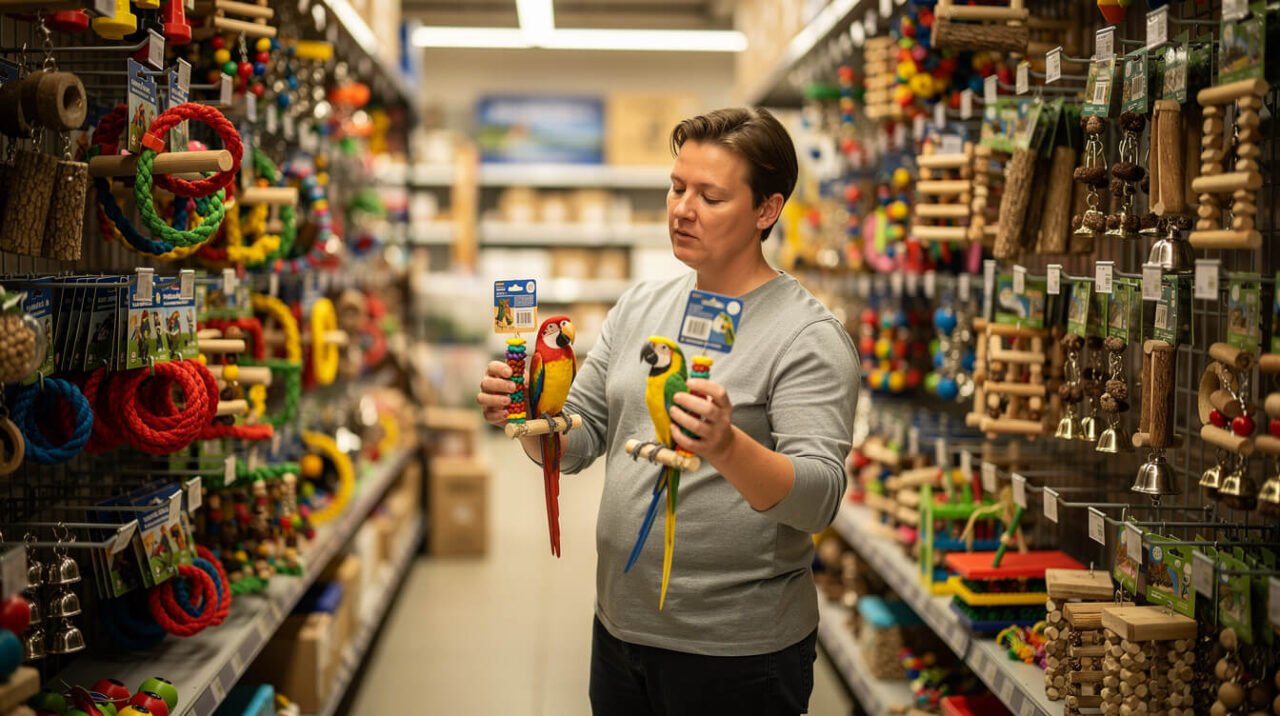
This is the number nobody wants to say out loud before you bring a parrot home, and it scales hard with beak strength: the birds most likely to destroy a toy in a day are also the birds whose toys cost the most.
Rough monthly enrichment budgets
- Small birds (budgies, cockatiels, parrotlets): typically $10–25/month in rotating toys, since individual toys are inexpensive and last reasonably well.
- Medium birds (conures, quakers, small cockatoos): commonly $25–50/month, as toys are sturdier and priced accordingly, with tougher chewers going through them faster.
- Large birds (African greys, Amazons): often $40–80/month for durable, appropriately sized toys.
- X-large birds (macaws, large cockatoos): can realistically run $60–150+/month for birds that treat a “large” toy as a same-day project.
These are general ranges, not fixed prices — they’ll shift with your region, how hard an individual bird chews, and how much you supplement with DIY enrichment (more on that below, and it genuinely does bring the number down). If a figure here doesn’t match what you’re seeing at checkout, trust your receipts over this list; treat it as a planning baseline before you bring a parrot home, not a guarantee.
If you haven’t sorted out the cage itself yet, our complete parrot cage guide covers sizing and setup costs in the same realistic, no-surprises way.
DIY vs. store-bought enrichment ideas
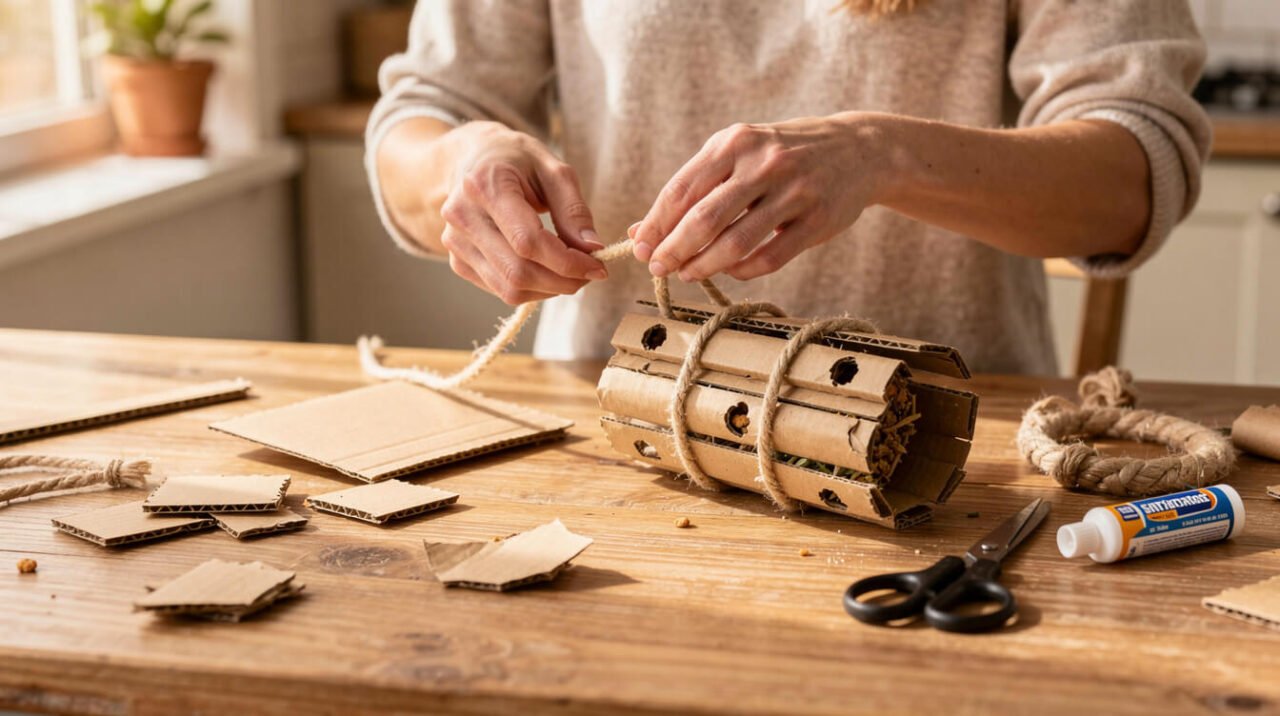
DIY enrichment isn’t just a budget trick — for foraging toys especially, homemade often beats store-bought, because you control exactly what’s hidden and how hard it is to find.
Easy, safe DIY options
- Foraging wraps: Wrap a favorite vegetable or nut in a few layers of unbleached parchment or coffee filter paper, secured with bird-safe cotton string.
- Cardboard puzzles: Untreated cardboard boxes and toilet paper tubes with treats tucked inside — cheap, disposable, and genuinely engaging for most species.
- Skewer kebabs: Stainless steel bird-toy skewers threaded with safe vegetables, then hung in the cage.
- Repurposed household items: Untreated wood clothespins, natural wicker baskets (no synthetic dye or varnish), and plain brown paper bags all make solid, low-cost shredding material.
The caveat: DIY only works if you apply the same materials scrutiny as store-bought — no treated wood, no synthetic rope, no small parts that could be swallowed, and nothing scavenged from a hardware store without checking it’s genuinely non-toxic. When in doubt, buy the toy instead of improvising with an unknown material.
A mixed approach — a couple of well-made store-bought foraging toys plus a rotating supply of cardboard and paper DIY enrichment — is how most experienced keepers keep both the budget and the boredom in check.
Materials to keep out of the DIY pile
A few household items look promising for enrichment but aren’t worth the risk: anything treated with varnish, stain, or pressure-treatment chemicals; rubber bands and hair ties (an entanglement risk and often not food-safe); glossy or ink-heavy printed paper and cardboard (some inks aren’t formulated for ingestion); and any wood you can’t confidently identify as untreated and non-toxic to birds, since some common ornamental woods are genuinely harmful. When you’re not sure, a store-bought toy with a labeled material list is the safer call than an improvised substitute.
Signs your parrot is bored (and what that has to do with toys)
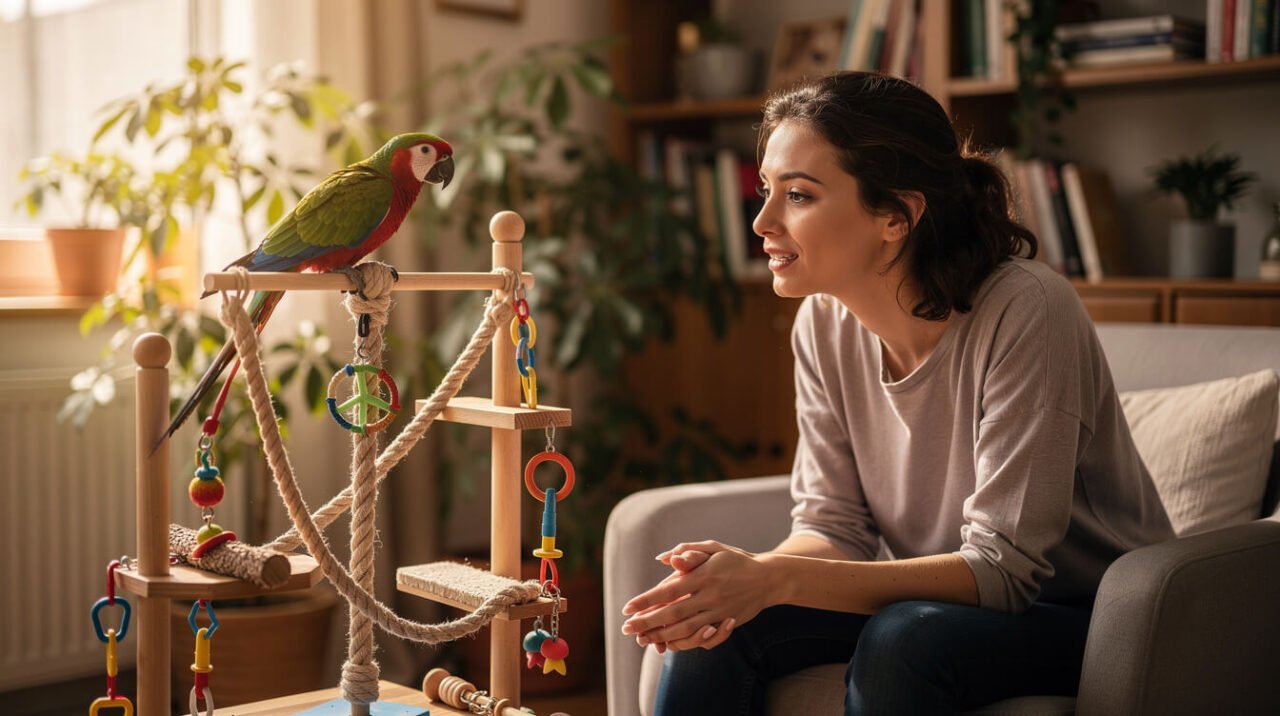
Toys are a tool for a real problem, not decoration — and an under-enriched parrot usually tells you so, if you know what to watch for.
Common signs of under-enrichment
- Excessive or repetitive screaming beyond your species’ normal vocal baseline, especially when it clusters around times you’re not in the room.
- Feather destruction or picking — though this always warrants a veterinary check first, since medical causes need to be ruled out before you assume it’s purely behavioral.
- Pacing, cage-bar biting, or repetitive movement that doesn’t resolve with more toys alone.
- Ignoring food or toys entirely paired with flat, withdrawn behavior — worth a vet visit, not just a new toy.
- Redirected chewing onto furniture, cords, or woodwork during out-of-cage time, which often just means the in-cage chew options aren’t matched to how much your bird actually needs to gnaw.
A quick word on the medical line: boredom and genuine illness can look similar from across the room, and toys won’t fix a health problem dressed up as a behavior problem. If a change in behavior is sudden, severe, or paired with any physical symptom, see your avian veterinarian before assuming it’s an enrichment gap.
For the birds specifically featured in this guide, our white-faced cockatiel care and personality guide is a good next read on matching enrichment to a specific species’ temperament.
Frequently asked questions
How do I know if a toy is too big or too small for my bird?
Watch how your bird interacts with it in the first few days. A toy that’s too big often gets ignored because it’s intimidating or physically awkward to manipulate; a toy that’s too small tends to be destroyed almost immediately because there’s no real resistance. Use the size classes above as a starting point and adjust from there.
Can I leave toys in the cage overnight?
Most well-made, properly inspected toys are fine left in overnight. The exception is anything already showing wear from your weekly check — fraying rope, loosened hardware, or cracking plastic should come out immediately rather than waiting for the next scheduled inspection.
Do older parrots need fewer toys?
Not necessarily fewer, but often different ones. Older birds may prefer familiar, lower-intensity foraging and preening toys over destructible chew toys, particularly if beak or grip strength has changed. If you notice a real shift in what an older bird engages with, that’s a reasonable prompt for a wellness check with your avian vet rather than just a toy swap.
Final thoughts
Good parrot toys aren’t about buying the flashiest thing on the shelf — they’re about matching material, size, and type to the actual bird in front of you, checking that hardware and materials are genuinely safe, and rotating enough to keep things interesting without turning the cage into clutter. Get those basics right, budget honestly for your bird’s size and chew rate, and you’ll spend less on replacements while giving your parrot enrichment that actually works. Your bird doesn’t need every toy in the store — it needs the right few, safely made, and refreshed often enough to stay interesting.

Emily Chen is a passionate avian specialist with over a decade of experience in nurturing and training birds of all feathers. From the melodious canaries to the intelligent parrots, Emily’s expertise spans a wide range of avian care, including diet, habitat setup, and behavioral training.