Can Cats Eat Pumpkin? The Safe Amount, and the Litter-Box Sign That Isn’t Constipation
Can cats eat pumpkin? Yes. Plain cooked pumpkin and canned 100% pumpkin are safe for most cats in small amounts, and plenty of cats lick the spoon clean. Two things matter more than “yes,” though, and most guides skip both. First, the litter-box sign that sends people reaching for pumpkin, a cat squatting and straining, is sometimes not constipation at all. In a male cat it can be a blocked bladder, which is an emergency. Second, the amounts published online run about twelve-fold for the same cat, because a treat-sized taste and a vet-directed amount get written up as one number.
Below: the safe kinds, what a teaspoon of pumpkin really adds, the blocked-bladder check, how much to give, and the pie-season extras. If your cat is straining in the litter box right now and you can’t find fresh urine clumps, stop reading and call your vet or an emergency clinic. The section on why is right below the short answer.
Can cats eat pumpkin? The short answer
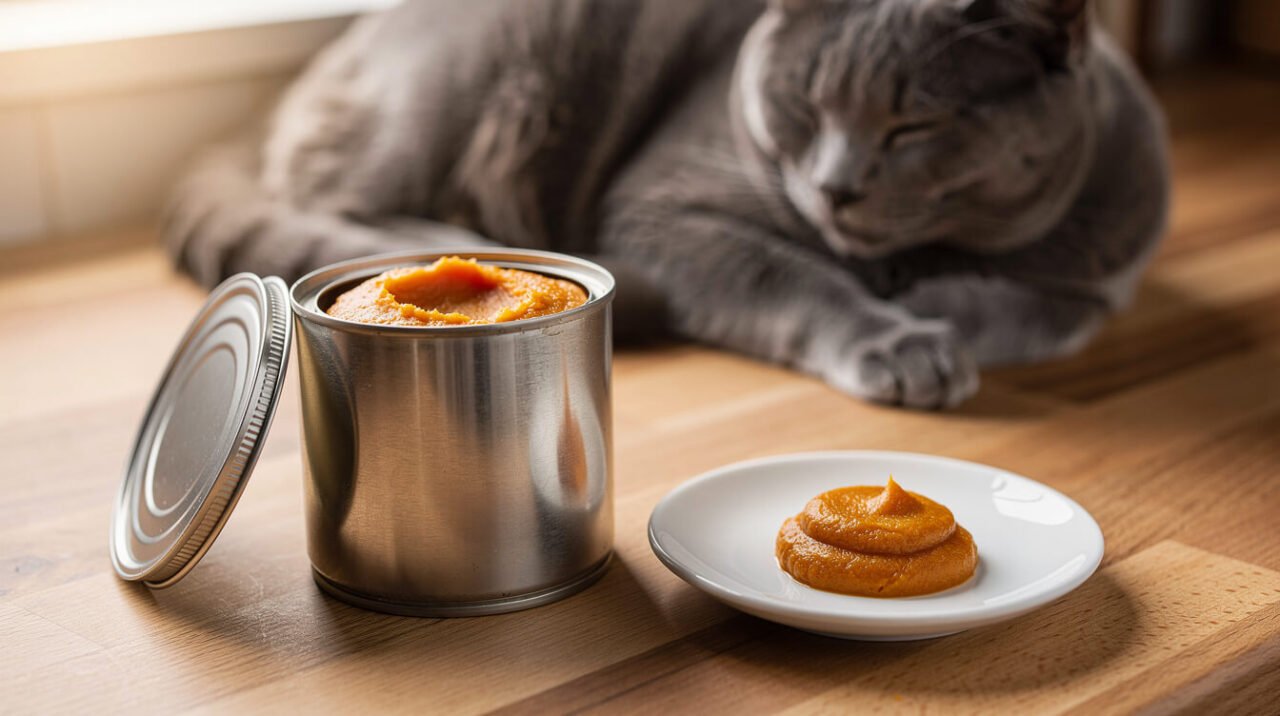
Yes, cats can eat pumpkin, as long as it’s the right kind and a small amount. Here’s the quick version.
- Safe: canned pumpkin whose label lists one ingredient, pumpkin. Also safe: fresh pumpkin you’ve peeled, seeded, and cooked plain (baked, steamed, or boiled) until soft, then mashed smooth.
- Skip: raw pumpkin, the rind, the stem, and the leaves. Raw pumpkin isn’t toxic, but it’s hard for a cat to chew and digest, and Chewy’s veterinary team notes the leaves and stems are covered in sharp little hairs that can irritate the mouth and gut.
- Skip: pumpkin seeds. Sources disagree here (more below), and there’s nothing in them your cat needs.
- No: pumpkin pie, pie filling, pumpkin bread, and pumpkin spice anything. These are sweetened, spiced, buttery, or all three.
- No: the carved jack-o’-lantern on the porch. Once it softens and spoils, it’s moldy food waste.
The habit that matters most is reading the can. “100% pure pumpkin” and “pumpkin pie mix” sit side by side in near-identical cans, and pie mix is the sweetened, spiced one. Check for salt too, which matters for cats with kidney or heart disease (more in the pie section). And if your cat eats a prescription diet or has a diagnosed condition, ask your veterinarian before adding anything, pumpkin included.
Is pumpkin good for cats? What a teaspoon actually adds
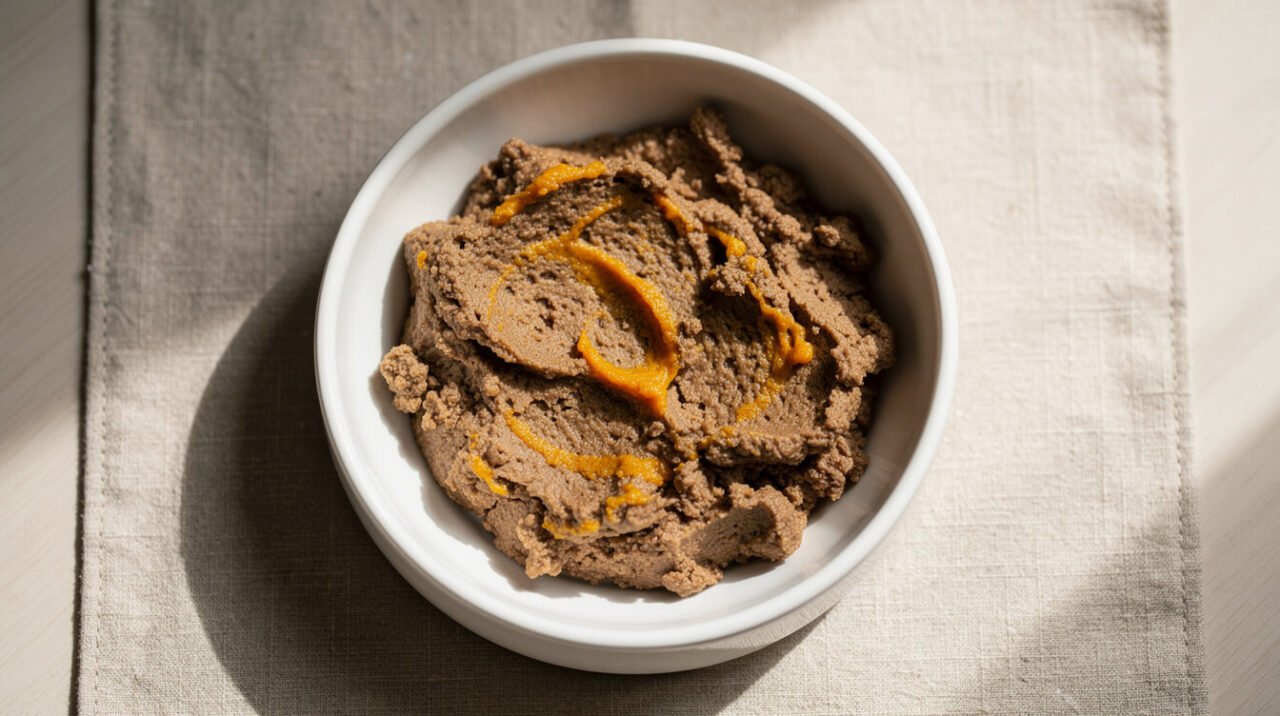
Cats are obligate carnivores. Their bodies are built to run on animal protein and fat, and they don’t need any vegetable in their diet, pumpkin included. So pumpkin is never a nutritional upgrade for a healthy cat on a complete food. At best it’s a tasty extra, and sometimes a small helper for stool consistency. If you want the bigger picture on plants and cats, our guide to which vegetables cats can eat walks through the safe list and the dangerous ones.
The usual pitch is that pumpkin is “high in fiber.” Here’s the size of that claim, using USDA’s numbers for canned pumpkin without salt (2.9 g of fiber, 34 calories, and about 90 g of water per 100 g, where a cup weighs 245 g). The arithmetic below is ours:
- One teaspoon of canned pumpkin weighs about 5 g. That’s roughly 0.15 g of fiber, under 2 calories, and about a teaspoon’s worth of water.
- Tufts University’s veterinary nutrition team puts canned pumpkin at 0.4 g of fiber per tablespoon, against 3.5 g for psyllium husk. That’s close to nine times the fiber for the same spoonful.
- Dr. Lisa Freeman, a board-certified veterinary nutritionist at Tufts, calculated that to match the fiber in one popular high-fiber therapeutic diet, “you’d need to feed more than 2 ½ cups of pumpkin per day to a cat.” That’s around 120 teaspoons.
So why do so many cats seem to do better with a spoonful of pumpkin? Part of the answer is probably the food it rides in. Most canned cat foods are roughly three-quarters water or more, so a 3-ounce can carries more than ten times as much water as the teaspoon of pumpkin stirred into it. Cornell’s Feline Health Center lists making sure the cat is well hydrated first among its constipation treatments. A cat who goes from dry food to wet food with a pumpkin topper gets the moisture, the fiber, and the attention all at once. The pumpkin gets the credit.
None of that makes pumpkin useless. It’s a gentle tool, not a strong one. When a cat needs real fiber support, ask your vet about a therapeutic diet or a supplement.
Pumpkin for constipation: first, rule out a blocked bladder
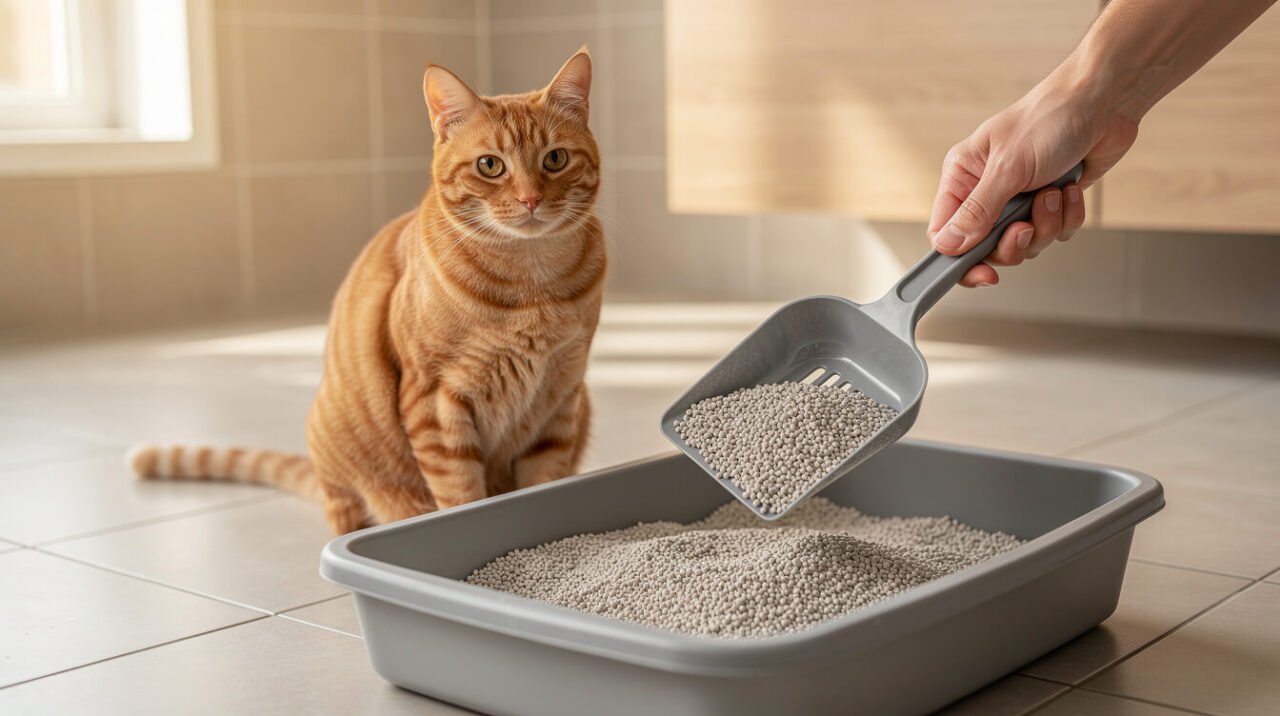
This is the most important section on the page, and none of the top-ranking pumpkin guides we read mention it. Pumpkin is most often suggested for constipated cats. But a cat squatting in the litter box and pushing with nothing to show for it may be straining to urinate, not to pass stool. From the doorway, the two look almost the same.
Emergency check: is it the bladder?
Go now (to your vet or, after hours, an emergency clinic) if your cat, especially a male cat:
- keeps going in and out of the litter box, squatting and straining
- produces little or no urine (no fresh clumps, or only tiny ones, maybe pink-tinged)
- cries out in the box, or keeps licking at their back end
- seems restless, hides, stops eating, or vomits
Don’t give pumpkin, don’t wait to see if it passes, and don’t wait for morning.
Here’s why it’s that urgent. Cornell’s Feline Health Center calls urethral obstruction “an absolute emergency, requiring immediate veterinary treatment.” When the urethra is plugged, urine can’t leave the body, and waste and potassium build up in the blood. Cornell’s wording is blunt: “The time from complete urinary obstruction until death may be less than twenty-four to forty-eight hours.” Male and neutered male cats are at greater risk than females, Cornell explains, “because their urethra is longer and narrower.” Females can block too, just less often.
The 10-second litter check
Before you open the can of pumpkin, look in the litter box. Scoop through it and check for urine clumps of a normal size since the last clean.
- Normal clumps, plus little or no stool, and a cat who’s otherwise eating and acting like themselves: constipation is more likely. Read on, and call your vet for advice.
- No clumps, or only tiny ones, and a cat who keeps trying: treat it as a blockage until a vet says otherwise. Southern Arizona Veterinary Specialty & Emergency Center puts it plainly: a male cat straining with little or no urine “should be treated as a life-threatening blockage, not constipation, until a veterinarian confirms otherwise.”
Not sure which you’re seeing? Call. No vet will mind you asking.
When it really is constipation
Constipation is the less urgent of the two, but it still deserves real attention. Cornell says it’s important to “treat it fairly aggressively to prevent progression,” because severe, repeated cases can lead to megacolon, where the colon stretches and stops working. Cornell’s treatment list runs from hydration and diet to laxatives, enemas, and motility drugs, so fiber is one tool, not the whole plan. A cat who strains for more than a day, stops eating, or vomits needs an exam. So does one whose constipation keeps coming back, even if pumpkin “fixes” it every time. Older cats deserve extra attention here. If you’re caring for one, our senior cat care tips cover the routine checks that catch problems early.
For a mild, occasional case that your vet is happy for you to manage at home, pumpkin in wet food is a reasonable first step. Which brings us to how much.
How much pumpkin can a cat have? Two different amounts
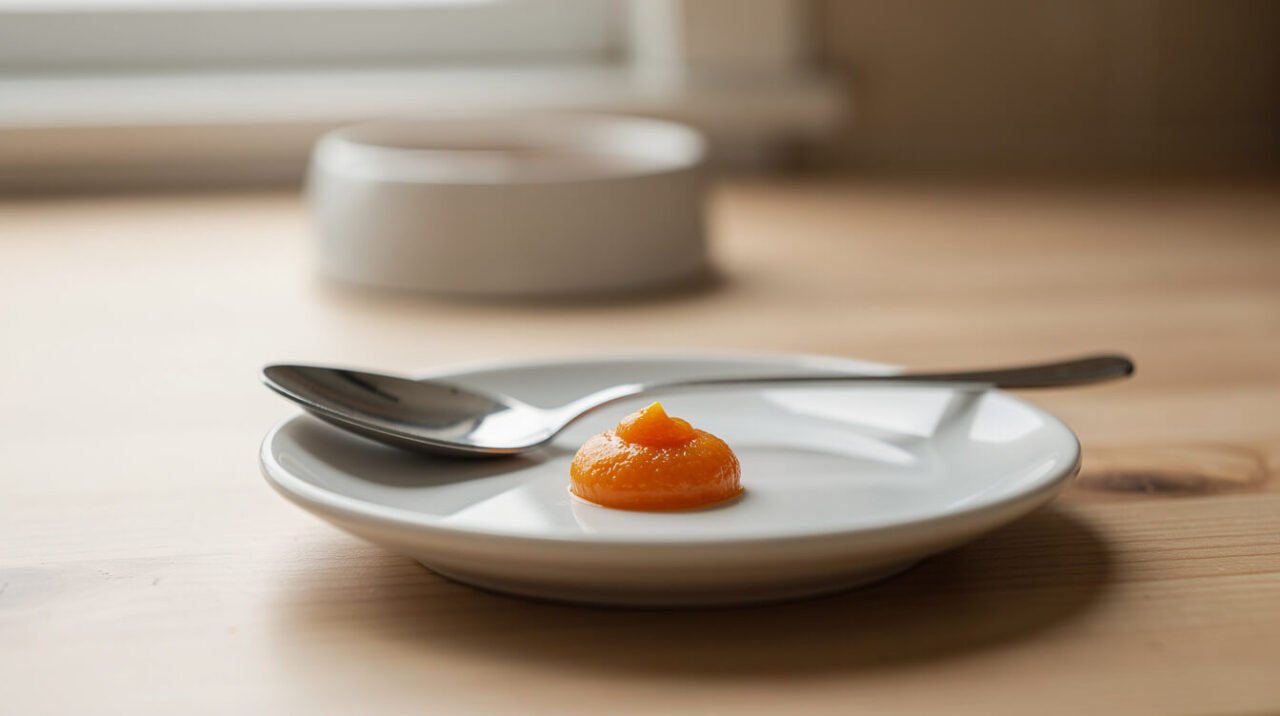
Look up “how much pumpkin for a cat” and you’ll find answers from half a teaspoon to two tablespoons. Most of that spread comes from two different jobs being described as one. Here’s what the sources we read actually say.
| Source | Amount | For what |
|---|---|---|
| Weruva (cat food brand) | ½ to 1 tsp a day | “A good starting point” for most adult cats |
| Chewy (written and reviewed by veterinarians) | ½ tsp small cats and kittens, 1 tsp adults, up to 4 tsp large cats | General feeding |
| PetMD (written by a veterinarian) | 2 to 4 tsp mixed into canned food | Mild constipation |
| PetMD | 1 to 4 tsp | Diarrhea, after the vet has checked a stool sample |
| Vet answers on a retailer’s Q&A | 1 tsp per 10 lb once or twice a day, up to “a tablespoon to each feeding” | Constipation |
| Fruitables (treat brand) | “Never exceed one to two tablespoons per day” | Upper limit for stomach upset |
Half a teaspoon to two tablespoons (six teaspoons) is a twelve-fold range for the same cat. Here’s how we’d read it.
Amount 1: the everyday treat
About ½ teaspoon a day for a small cat, up to 1 teaspoon for a larger adult. That’s where the treat-sized sources agree, and it’s plenty for a cat who simply likes the taste. Start smaller, a pea-sized dab, and build up over a few days. Even a full teaspoon is under 2 calories, so it won’t upset a weight plan.
Amount 2: the vet-directed amount
The 1 to 4 teaspoon range belongs to your veterinarian. That’s the zone the veterinary sources use for constipation or diarrhea, and PetMD frames the diarrhea amount as something your vet recommends “after checking a stool sample.” Your vet will set the amount from your cat’s size, the problem, and what else is going on. Don’t work up to it on your own for a cat with ongoing stool problems, because the stool problem is the thing that needs a diagnosis.
A units trap to watch for
These amounts are all teaspoons, not tablespoons. A tablespoon is three teaspoons, so mixing them up triples the dose. PetMD’s article also mentions “about 2-3 tablespoons,” but that’s the amount of canned cat food to stir the pumpkin into, not the pumpkin. It’s an easy line to misread on a quick skim.
Too much pumpkin usually shows up as loose stool or gas. Cut back if you see it, and call your vet if your cat seems unwell.
The weekly care guide
Get it right for your animal, every week
One email a week: new care guides, species deep-dives, and the safety answers keepers search for, written by our specialists. No spam. Unsubscribe anytime.
Pumpkin for diarrhea and hairballs: when it’s fine, when it’s a vet call
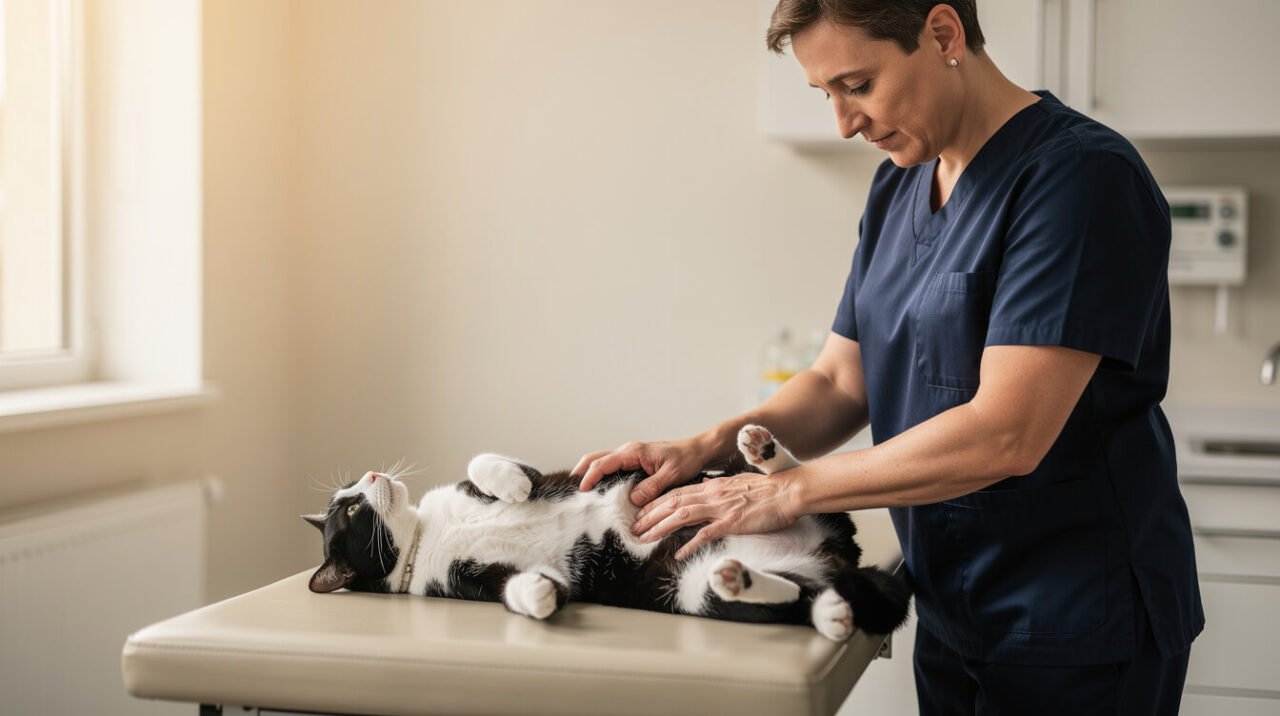
Pumpkin gets recommended for loose stool too. The idea is that fiber absorbs water and firms things up. That’s real, but small, as the fiber section shows. And diarrhea in cats has a long list of causes, from a food switch to parasites to inflammatory bowel disease. A spoonful of pumpkin can’t tell them apart, so the order matters: vet first, pumpkin if the vet says so.
Call your veterinarian promptly, rather than trying pumpkin, if your cat:
- is a kitten, a senior, or has a known health condition
- has blood in the stool, black or tarry stool, or is also vomiting
- is lethargic, hiding, or not eating
- has diarrhea that lasts more than a day or so, or keeps coming back
- is losing weight. Our guide to why a cat might be losing weight covers the causes worth ruling out.
For a healthy adult with one soft stool after a food change, a little pumpkin in wet food is unlikely to hurt. Just don’t let it delay a visit.
What about hairballs?
Some brands sell pumpkin as a hairball remedy. We couldn’t find good evidence for that in cats, and a teaspoon’s worth of fiber makes a big effect unlikely. Regular brushing does more. Frequent hairballs are worth a vet visit in their own right, because they can point to over-grooming or a gut problem pumpkin won’t touch.
Pumpkin seeds, raw pumpkin, pie, and pumpkin spice
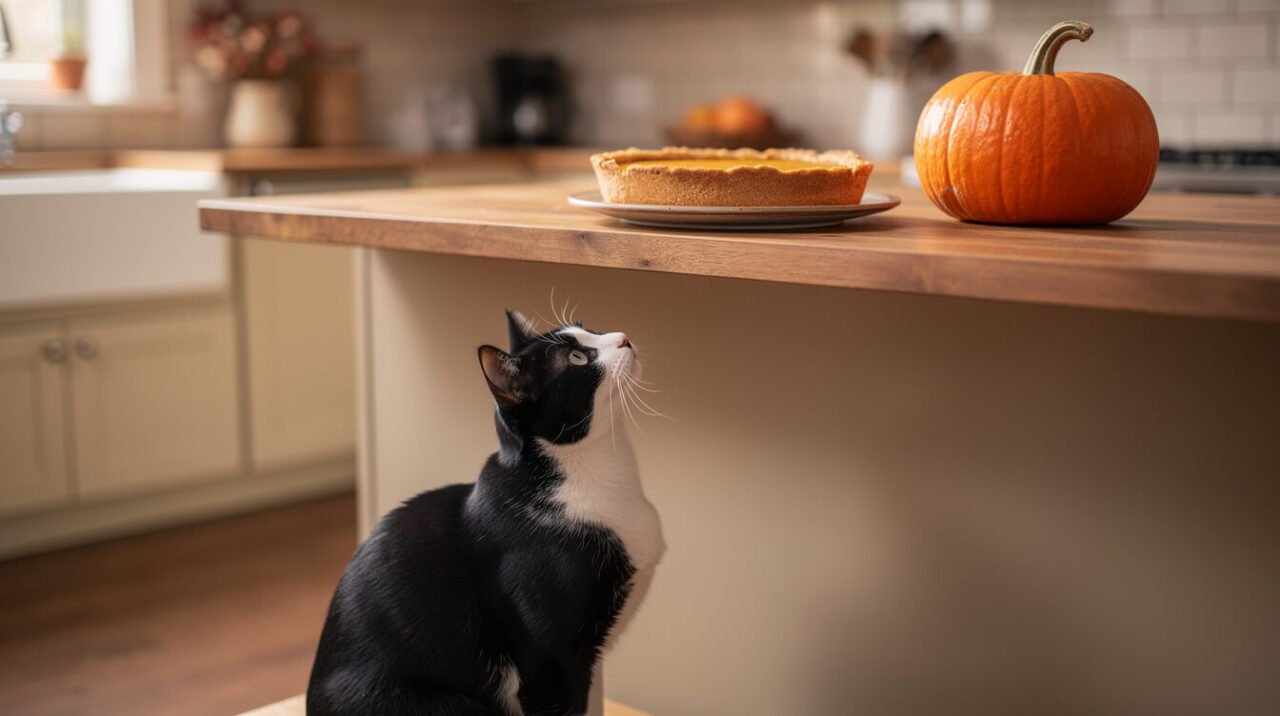
Pumpkin seeds: sources disagree, so we’d skip them
Chewy’s FAQ gives a flat “No,” calling seeds a choking hazard. PetMD says they’re “not toxic to cats” but can become a choking hazard, can cause an intestinal obstruction if a cat eats too many, and should only be fed in small quantities “with you close by,” unsalted and unroasted in oil. Neither names a benefit a cat needs, so our call is to skip them. If your cat swipes one from the kitchen floor, watch for gagging, vomiting, or a lost appetite, and call your vet if you see any of them.
Raw pumpkin and jack-o’-lanterns
Raw flesh isn’t toxic, just tough to digest, and the stem and leaves carry those irritating hairs. The bigger worry is a carved pumpkin that has sat out for days and started to mold. Keep cats away from it, and compost it once it starts to go.
Pumpkin pie and pie filling
PetMD notes that pie spices such as cinnamon, nutmeg, ginger, and allspice “can be considered mildly toxic and result in gastrointestinal upset,” and that “a small lick of pumpkin pie filling will likely cause no harm.” Pie also brings sugar, butter, cream, and crust, none of which a cat needs. Cats can’t even taste the sweetness: researchers found the cat gene for the sweet taste receptor is a non-working pseudogene (Li et al., 2005). So a lick is not an emergency. A cat who got into a whole slice deserves a call to your vet.
Xylitol: a dog emergency, less clear in cats
Sugar-free and keto bakes can contain xylitol, which is dangerous for dogs. The cat evidence is much thinner. One small study gave xylitol to six healthy cats at doses that harm dogs and found no toxic effects (Jerzsele et al., 2018). Six cats is not a green light, though, so keep sweetened, sugar-free, and spiced bakes away from every pet. If your cat ate a large amount of anything you’re unsure of, call your vet. You can also call the ASPCA Animal Poison Control Center at (888) 426-4435 (a consultation fee may apply) or the Pet Poison Helpline at (855) 764-7661 ($99 per incident). If there’s a dog in the house too, our guide to pumpkin for dogs ranks the pie-season risks for them, xylitol included.
Salt in canned pumpkin
Not every canned pumpkin is salt-free. Tufts points out that canned pumpkin without salt has only about 12 mg of sodium per cup, while “some canned pumpkin brands with salt contain nearly 600 milligrams of sodium per cup,” which is “way too much sodium for a dog or cat with heart or kidney disease.” Check the label for “no salt added,” especially for older cats, who are more likely to have kidney disease.
How to serve pumpkin to a picky cat
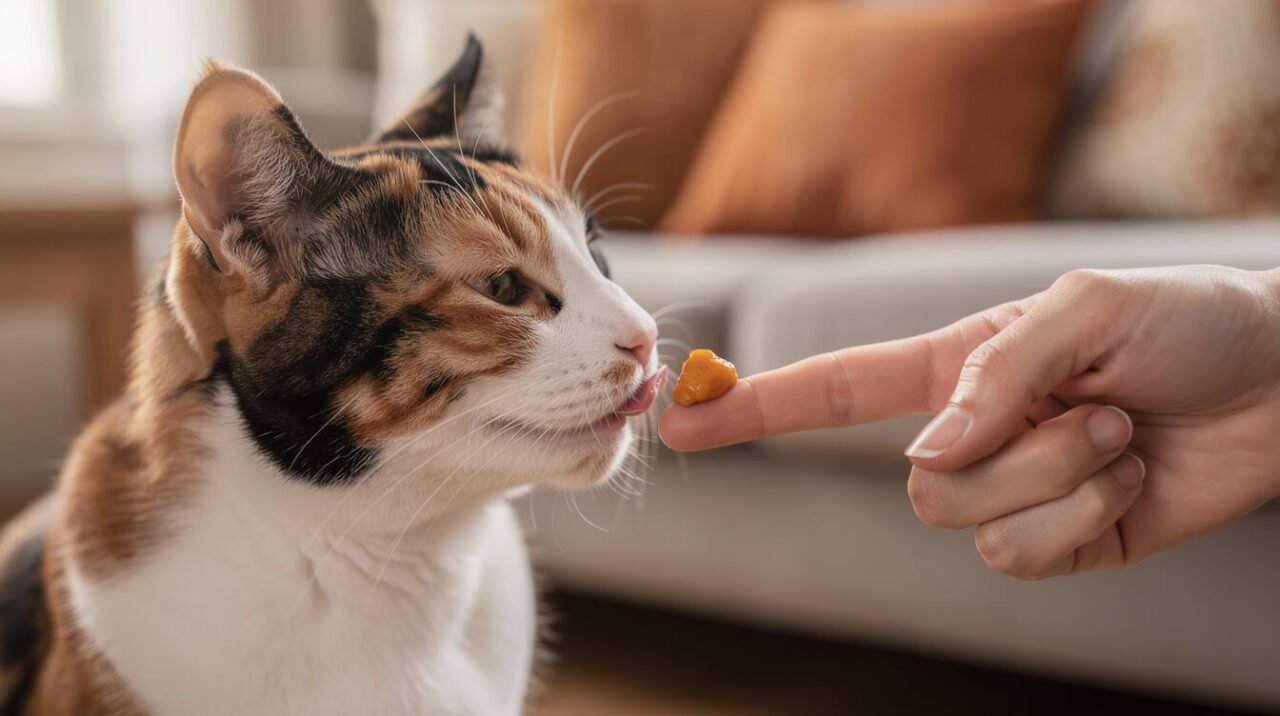
Some cats dive in. Others sniff and walk off. Both are normal, and since a cat doesn’t need pumpkin, a refusal costs nothing. Here’s how to give it a fair try.
- Start tiny. A pea-sized dab, about ¼ teaspoon, stirred all the way into a favorite wet food. Raise it to the everyday amount over three to five days.
- Mix it in completely. Many cats are more likely to accept pumpkin blended smooth through their food than sitting on top as an orange blob.
- Serve it at room temperature. Cold food straight from the fridge smells weaker, and many cats eat by nose.
- Try it plain on a spoon. A surprising number of cats will lick a little pumpkin off a spoon or your fingertip but refuse it mixed in. Let your cat pick.
A whole can is a lot of pumpkin for one cat. Opened canned food keeps in the fridge for about three to four days, in a covered glass or plastic container rather than the open can. For longer storage, spoon teaspoon-sized portions into an ice-cube tray, freeze, then bag the cubes and thaw one at a time in the fridge.
If there’s a bearded dragon basking somewhere in your house too (the shop here is small and reptile-first for now), the Bearded Dragon Crown Sunglasses King T-Shirt is our nod to multi-species homes.

For homes with more than one kind of animal
Cat on the windowsill, bearded dragon under the basking lamp? The Bearded Dragon Crown Sunglasses King T-Shirt is a soft, everyday tee for keepers who are a little obsessed, in the best way.
Make the bowl the main event
The bigger habit is more moisture, every day. If your cat lives on dry food and you’re reaching for pumpkin because of hard stools, ask your vet about adding wet meals. A fountain can tempt some cats to drink more, too. Our pet fountain review looks at one option. And if you’re rethinking your cat’s food in general, here’s our guide on how to choose the best cat food. Those changes do more for most cats’ digestion than pumpkin can.
Can cats eat pumpkin? Frequently asked questions
Can cats eat pumpkin every day?
A healthy adult cat can have a small amount, around ½ to 1 teaspoon, every day. PetMD agrees there’s no reason a cat can’t have a little daily, though there’s also no reason they have to. If you’re giving it every day because your cat’s stools aren’t right without it, that’s a sign to talk with your vet about why.
Can kittens eat pumpkin?
Ask your vet first. Kittens’ stomachs are sensitive, and constipation or diarrhea in a young kitten can turn serious faster than in an adult. One vet answering on a retailer’s Q&A warned that constipation “can be deadly for neonates,” meaning very young kittens. For a healthy, weaned kitten, a vet may okay a tiny taste. Our first-time kitten owner FAQ covers more of the early basics.
Why does my cat love pumpkin so much?
Honestly, nobody knows for sure. It isn’t the sweetness, because cats can’t taste sweet. Our best guess is the smooth, moist texture, and the fact that it usually arrives mixed into food they already love. Some cats simply like it, and that’s reason enough for a small treat.
Can cats with diabetes or kidney disease eat pumpkin?
Ask your vet first. Pumpkin adds a little carbohydrate, which matters for a diabetic cat on a carefully managed diet. Salted canned pumpkin adds sodium, which matters for a cat with kidney or heart disease. Chewy and Weruva both say to check with your vet before giving pumpkin to cats with these conditions, and we agree.
Final thoughts on pumpkin for cats
So, can cats eat pumpkin? Yes: plain, cooked or canned 100% pumpkin, in teaspoon-sized amounts, is a safe little extra that many cats enjoy. Keep its job in proportion, though. A teaspoon carries a sliver of fiber, and the wet food it’s mixed into is probably doing more of the work. For any stool problem that sticks around, your vet has much stronger tools.
The one habit to take away is the litter check. Before you treat a straining cat for constipation, look for urine clumps. If they’re missing, especially in a male cat, skip the pumpkin and get to a vet now. That few seconds of checking is the most caring thing you can do in that moment.
You’re already doing the hard part, reading up before you reach for the spoon.
Before you go
Keep learning your animal
We publish a new guide every day. The best of them land in one short weekly email, so you never miss the one about your species.
Dr. Lila Monroe is a seasoned veterinarian with a passion for feline health and behavior, boasting over 20 years of experience in the field. With her extensive knowledge of cat medicine combined with a deep understanding of the nuanced dynamics of cat behavior, Lila offers readers invaluable insights into creating a nurturing environment for their feline friends.