Can Dogs Eat Mashed Potatoes? Plain vs. Holiday Mash, and Why “He Seems Fine” Isn’t the All-Clear
Can dogs eat mashed potatoes? Plain ones, yes. A spoonful of potato that’s been boiled, peeled, and mashed with nothing but a splash of its own cooking water is a safe treat for most healthy dogs. The holiday version is a different dish. Butter, cream, cheese, and salt are mostly a stomach-upset and fat problem. Garlic, onion, and chives are a red-blood-cell problem, and they’re the part almost every guide skips past. Onion and garlic poisoning is delayed, so a dog who seems completely fine after licking the bowl on Thursday may not be fine by Sunday.
Below: every common mashed potato ingredient ranked by how much it matters, how long to watch your dog after a garlic-mash mishap, a portion table with the calorie math shown, the instant-mash labels we actually read, and how to give your dog their own safe spoonful this Thanksgiving.
Can dogs eat mashed potatoes? The short answer
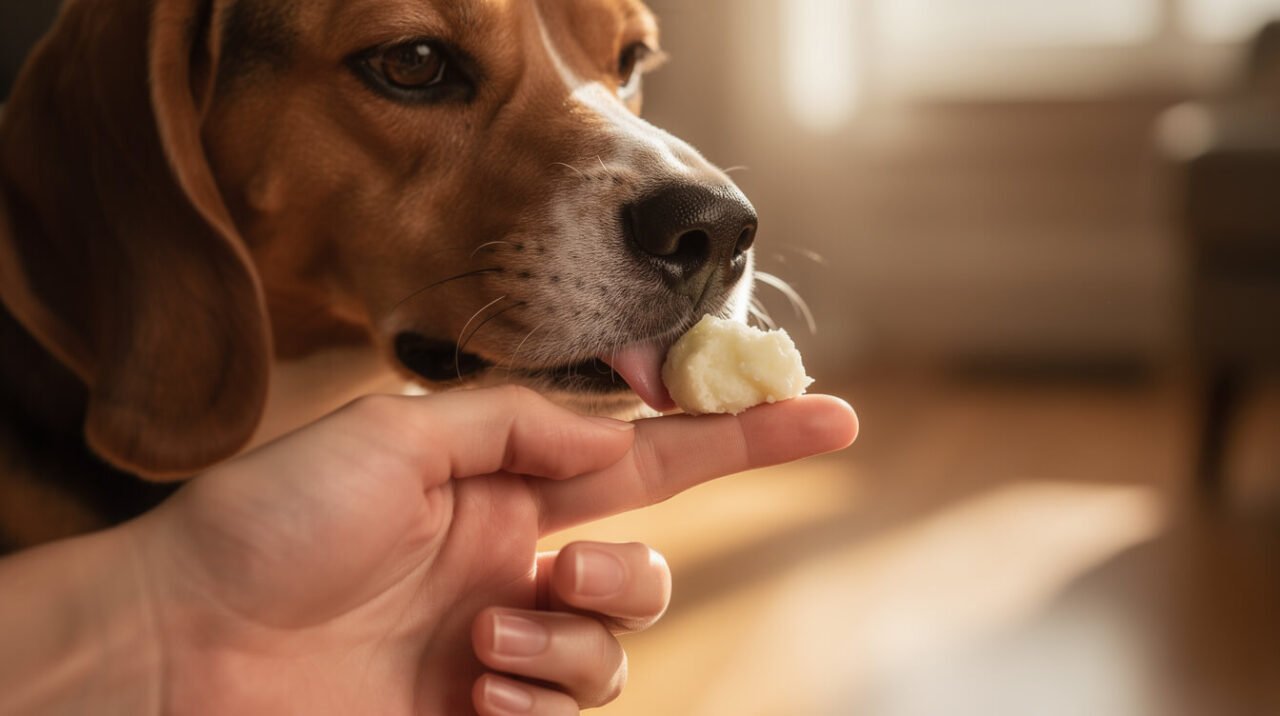
Cooked white potato isn’t toxic to dogs. It’s an easily digested starch, and it shows up in plenty of commercial dog foods and in the bland diets vets suggest for upset stomachs. So the honest answer to “can dogs eat mashed potatoes” depends entirely on what’s in the bowl.
- Plain mash: yes, in small amounts. Peeled potato, boiled until soft, mashed with water or the potato’s own cooking water. No butter, milk, salt, or seasoning.
- Holiday mash: usually no. Most family recipes include at least one ingredient that doesn’t belong in a dog, and many include garlic or chives.
- Raw, green, or sprouted potatoes: never. These contain solanine, a natural toxin concentrated in the skin, the green patches, and the sprouts.
Two groups should skip potato unless their vet says otherwise. Diabetic dogs, because potato is a fast-digesting starch that can spike blood sugar (PetMD’s veterinary-reviewed guidance says the same). And dogs on a prescription or elimination diet, because a single “harmless” spoonful can undo weeks of a diet trial.
Mashed potato is a treat, not a food group. Your dog’s complete and balanced diet already covers what they need, so think of potato as a taste of the holiday, not a side dish.
Plain mash vs. holiday mash: every ingredient, ranked
Most pages lump “butter, milk, garlic, onion, and salt” into one sentence, as if they were equally risky. They aren’t. Here’s how we’d rank them, from the ingredients that matter most to the ones that matter least.
1. Garlic, onion, chives, and shallots: the real concern
These are all members of the Allium family. They damage red blood cells and can cause anemia. Garlic mash, chive-topped mash, and mash made with onion powder all belong here. The Merck Veterinary Manual notes that garlic is 3 to 5 times more toxic than onion, and that poisoning in dogs is most often linked to concentrated forms like garlic or onion powder, dehydrated flakes, and dry onion soup mix. These are the forms that end up in boxed mash, seasoning blends, and gravy. We give this its own section below, because the timing is what catches people out.
2. Butter, cream, cheese, sour cream, and bacon: the fat load
This is the difference most people underestimate. According to USDA FoodData Central, plain boiled potato has about 0.1 grams of fat per 100 grams. USDA’s standard home-style mash made with whole milk and butter has about 4.2 grams, roughly 40 times as much, and plenty of holiday recipes use far more butter and cream than that. A rich, fatty meal can cause vomiting and diarrhea. Veterinary Partner calls a sudden high-fat meal “the classic cause” of pancreatitis in dogs. Miniature Schnauzers, overweight dogs, and any dog who’s had pancreatitis before are at higher risk.
3. Milk: a tummy-upset risk for some dogs
The ASPCA explains that pets don’t have much lactase, the enzyme that breaks down milk sugar, so dairy can cause diarrhea or other digestive upset. Some dogs handle a little milk fine, and others don’t.
4. Salt: real, but not usually the problem at spoonful size
Excessive salt can cause thirst, vomiting, and, in large amounts, serious illness. But the amount matters. USDA lists home-style milk-and-butter mash at about 317 mg of sodium per 100 grams, which works out to roughly 40 mg in a tablespoon. One spoonful of salted mash isn’t a salt emergency, and we’re not going to pretend it is. The bigger salt risks at a holiday table are a dog emptying the gravy boat or raiding a whole bowl.
What “plain” actually means
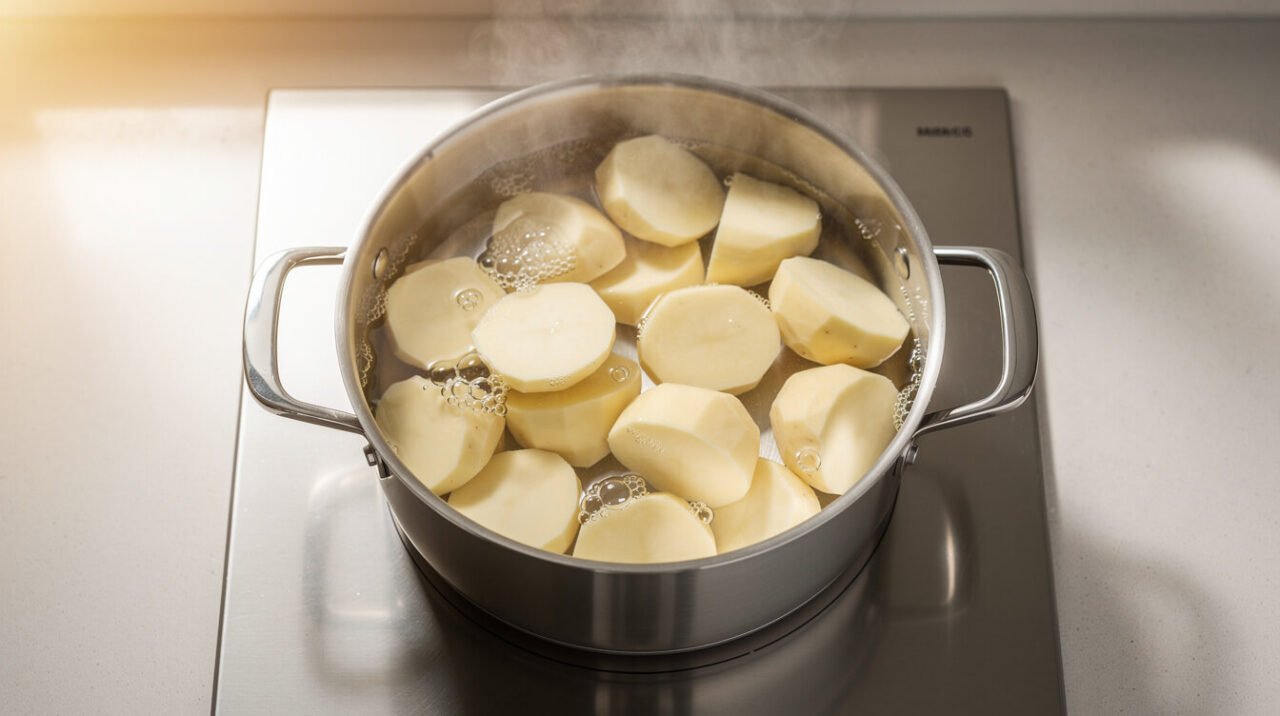
Peel the potato (this removes most of the skin, where solanine concentrates) and cut away any green patches or sprouts. Then boil until fork-soft and mash with a little of the cooking water. That’s it. Set your dog’s portion aside before anything else goes into the pot.
Garlic, onion, and why “he seems fine” isn’t the all-clear
Here’s what makes onion and garlic different from most kitchen hazards. A dog who eats something too fatty usually shows it within the day. A dog who eats garlic mash can look completely normal for days.
Merck describes the timeline. The oxidizing compounds start damaging red blood cells within the first 24 hours, and that damage peaks around 72 hours. Red blood cells then break down, a process called hemolysis, which “typically occurs 3–5 days after exposure.” Clinical signs are “generally not noted until substantial hemolysis has occurred, usually a few days after exposure.” A veterinary toxicology brief from the ASPCA adds that a dog’s red-cell count may not hit its lowest point until several days after eating the onion.
So a dog who licks a plate of garlic mash on Thanksgiving afternoon and seems fine that evening hasn’t cleared it. The window to watch runs well into the following week.
What to watch for, and for how long
If your dog ate mashed potatoes made with garlic, onion, chives, or onion or garlic powder (or gravy or stuffing, which often contain them), watch for these over the next several days, not just the next few hours:
- tiredness, weakness, or not wanting to walk or play
- not eating
- fast breathing or a racing heart
- pale or yellowish gums
- red or brown urine
- collapse
Don’t wait for signs before calling. Merck notes that treatment starts with early decontamination, so the most useful call is the one you make right away, even if your dog seems normal. Phone your veterinarian, or the ASPCA Animal Poison Control Center at (888) 426-4435 (a consultation fee may apply) or Pet Poison Helpline at (855) 764-7661 ($99 per incident). Tell them your dog’s weight, roughly how much was eaten, and what was in it. Don’t try to make your dog vomit at home unless a vet tells you to.
How much garlic is too much?
We’re not going to give you a “safe” amount, and here’s why. Merck reports that dogs have shown clinical signs after eating 15 to 30 grams of raw onion per kilogram of body weight, and that garlic is several times stronger. Those are levels where dogs got sick, not a line below which every dog is fine. Individual dogs vary a lot. Concentrated powders pack far more into a spoonful than fresh cloves do. And repeated small amounts over a long weekend of leftovers add up. The ASPCA’s toxicology brief opens with exactly that kind of case: a dog who’d been given onions with meals for about a week.
Akitas, Shiba Inus, and other Japanese breeds
Some dogs inherit a red-blood-cell trait (called “HK,” for high potassium) that makes them more vulnerable to onion damage. In a 1992 study, HK dogs fed onion developed far more damaged red blood cells than ordinary dogs given the same amount (Yamoto and Maede, American Journal of Veterinary Research). The ASPCA brief notes this susceptibility in Japanese breeds such as Akitas and Shiba Inus. If you share your home with one, be extra careful with any allium dish.
How much mashed potato can dogs eat? A portion table with the math
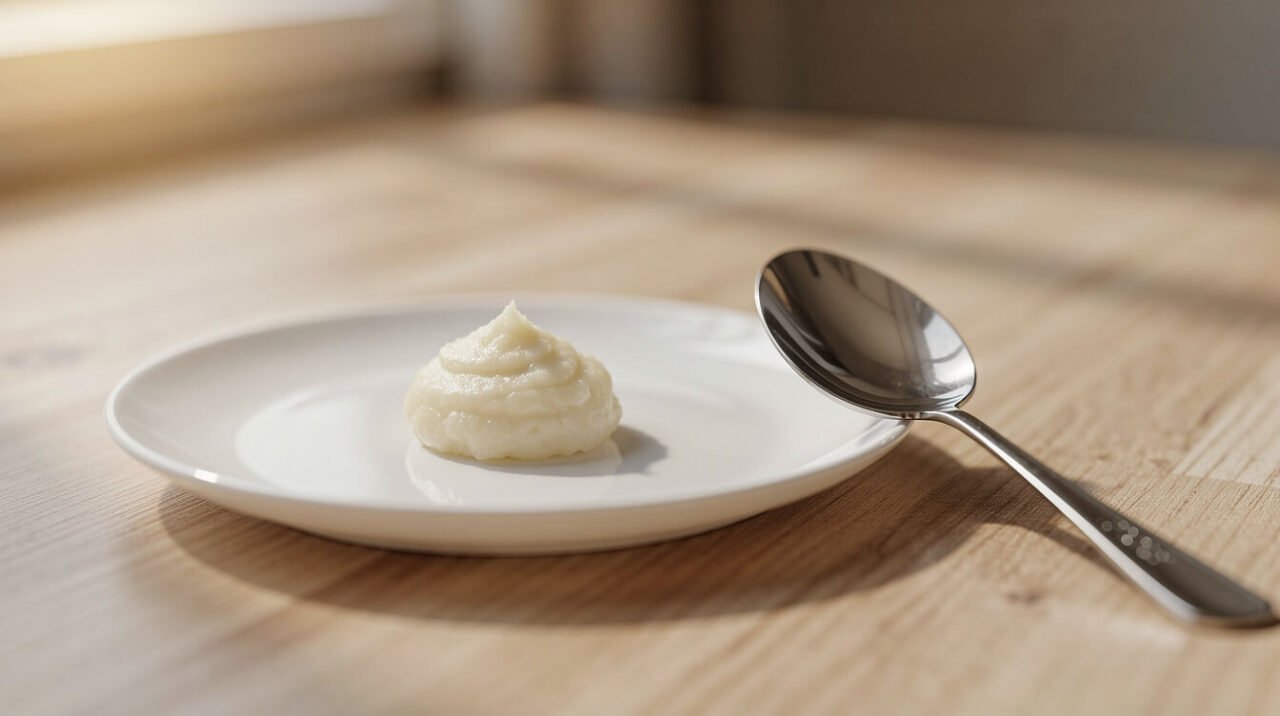
Vets commonly suggest keeping all treats to about 10% of a dog’s daily calories. Here’s what that means for mashed potato.
The calories. USDA FoodData Central lists plain boiled potato at about 86 calories per 100 grams, and a cup of mash weighs about 210 grams. That makes a tablespoon of plain mash roughly 11 calories and a teaspoon about 4. USDA’s milk-and-butter mash comes in at about 113 calories per 100 grams, or roughly 15 per tablespoon. Rich holiday recipes run higher. As the section above shows, the jump in fat matters more than the jump in calories.
The daily need. The Merck Veterinary Manual estimates resting energy needs as 70 × (body weight in kg)0.75, and a typical neutered adult dog needs about 1.6 times that. These are starting estimates. Your vet can give you your own dog’s real target, and it’s often lower for less active or overweight dogs.
| Dog’s weight | Approx. daily calories (neutered adult) | 10% treat budget | Suggested plain mash serving |
|---|---|---|---|
| 10 lb (4.5 kg) | ~350 | ~35 | About 1 teaspoon (about 4 calories) |
| 25 lb (11.3 kg) | ~690 | ~70 | 1–2 teaspoons (about 4–8 calories) |
| 50 lb (22.7 kg) | ~1,160 | ~115 | 2–3 teaspoons, about 1 tablespoon (about 8–11 calories) |
| 80 lb (36.3 kg) | ~1,650 | ~165 | 1–2 tablespoons (about 11–22 calories) |
Why the servings sit well below the budget. The 10% budget covers every treat that day, and Thanksgiving tends to come with several. More importantly, calories aren’t what limits mashed potato. A big serving of a starch your dog doesn’t usually eat is what causes gas and loose stools. Our servings match a veterinarian-reviewed potato chart on Chewy’s education site, which runs from 1 teaspoon for dogs up to 20 pounds to 1–2 tablespoons for dogs of 51–90 pounds.
One thing to watch if you’re comparing pages: one popular site’s table suggests 1–2 tablespoons for dogs of 5–10 kg, while its own FAQ says small dogs should have “a teaspoon or two.” That’s a threefold difference on the same page. When in doubt, use teaspoons for small dogs.
Practical rules
- First time? Start at the low end and watch for loose stool or gas over the next day.
- Cut back on regular treats that day, so the potato replaces them rather than adding to them.
- One spoonful on the day, not four days of leftovers. Daily mash turns a treat into a diet change.
The weekly care guide
Get it right for your animal, every week
One email a week: new care guides, species deep-dives, and the safety answers keepers search for, written by our specialists. No spam. Unsubscribe anytime.
Instant mash, gravy, skins, fries, and the rest of the side-dish table
Instant and boxed mashed potatoes
“Read the label” is the usual advice. We went and read some. On Idahoan’s own ingredient lists, Original is just dried potatoes plus an emulsifier and preservatives. Loaded Baked lists dehydrated onion and chives, and Hidden Valley Ranch lists dried garlic and dried onion. Those are the concentrated forms Merck warns about. The surprise was Butter & Herb, which lists dried onion even though nothing in its name suggests it. And Buttery Homestyle lists no onion or garlic, but it does list “natural flavors,” which doesn’t tell you what’s inside.
The lesson isn’t about one brand. A flavor name won’t tell you whether a box contains onion. If the label isn’t plain, or you can’t read it, boil a potato for your dog instead. And remember that the flavor packet only tells you part of it: once you prepare the mix with milk and butter, you’ve made the holiday version anyway.
Gravy
Skip it. Gravy is drippings, fat, and salt, and many gravy mixes and homemade gravies contain onion or garlic. If your dog gets into the gravy, treat it like garlic mash and call your vet.
Potato skins and peels
A little skin from a cooked, non-green potato usually isn’t a problem, but skins concentrate solanine and are harder to digest. Peeled is the safer default. Raw peelings in the kitchen trash are a different matter. Raw, green, or sprouted potatoes are the solanine risk, and so are the leaves and stems of potato plants in the garden. If your dog eats raw peelings or green potatoes, call your vet for advice.
Fries, hash browns, tater tots, and chips
These are fried, salty, and often seasoned with onion or garlic. They aren’t toxic in themselves, but they’re a poor treat. A fry that falls on the floor is usually just an upset-stomach risk. A whole basket is a fat-and-salt problem.
Loaded mash and potato casseroles
Cheese, sour cream, bacon, and chives together make a worst-of-both dish: high fat plus allium. Keep it off the floor and out of reach.
Sweet potatoes
Plain cooked sweet potato is another option many dogs enjoy, with its own rules. We cover them in our guide to raw vs. cooked sweet potato for dogs.
Mashed potatoes on a bland diet: when it helps, when it’s a vet visit
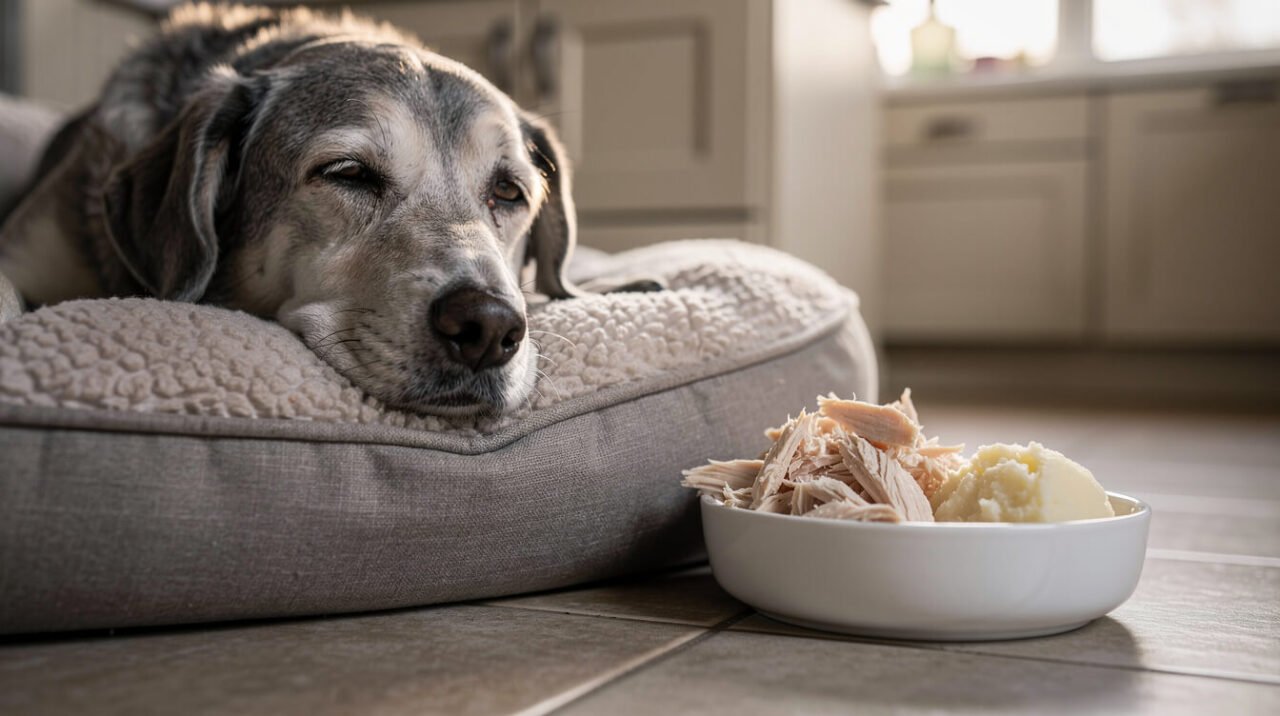
Many owners first wonder about mashed potatoes when their dog has an upset stomach. That makes sense. PetMD’s veterinarian-written guide to bland diets lists plain potato alongside white rice as a common carbohydrate in a homemade bland diet, usually paired with a lean protein like boiled chicken. (Our guide to raw vs. cooked chicken for dogs covers the protein side.)
A bland diet works best as a short, vet-guided plan, not a cure. PetMD says if your dog recovers quickly, usually within 48 hours, they can go back to their regular diet. If symptoms last longer than 48 hours, call your vet.
Call your vet first, before trying home food, if:
- your dog is a puppy, a senior, or has a chronic health condition
- there’s blood in the vomit or stool, or the stool is black
- your dog is lethargic, won’t drink, or can’t keep water down
- vomiting is repeated, or your dog seems to have belly pain (a hunched back or “praying” stretch)
- your dog may have eaten something toxic, including garlic or onion mash
- your dog is diabetic or has had pancreatitis
For a bland diet, the potato has to be truly plain: no butter, milk, or salt. That’s the whole point.
A dog-safe Thanksgiving spoonful
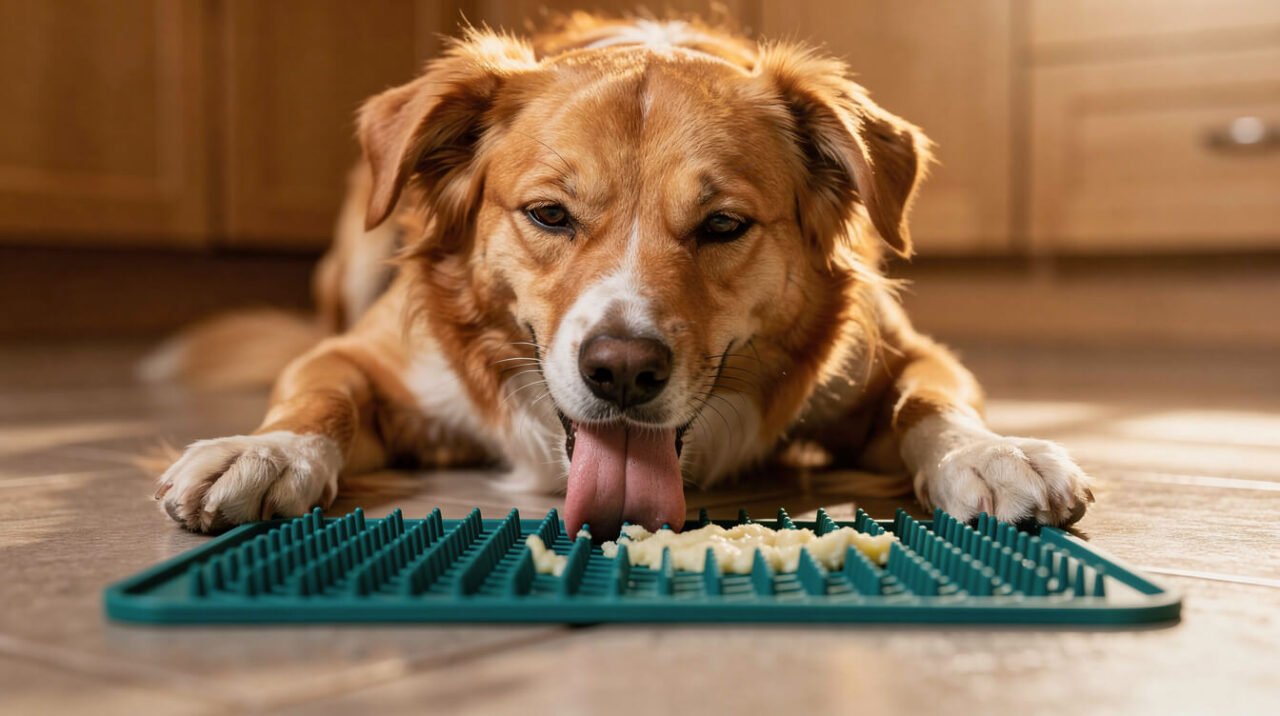
Your dog doesn’t need to be left out of the holiday. They just need their own version, made before the butter goes in. Here’s a simple plan:
- Scoop first. When the potatoes are boiled and drained, set aside one or two plain chunks for your dog before you add anything. Mash with a little cooking water.
- Portion it. Use the table above: about a teaspoon for a small dog, a tablespoon or two for a big one.
- Make it last. Spread a thin layer on a lick mat, or stuff it in a rubber food toy and freeze it. A few minutes of licking is a better holiday treat than a gulp.
- Keep it plain. No gravy, no butter, no chives, no “just a little” of the good stuff.
- Brief your guests. Ask people not to slip food under the table, and explain why to kids. Most garlic mash accidents come from someone being kind.
Plain mash pairs nicely with a little plain pumpkin for dogs or a stick of plain celery, if your dog likes crunch. Whatever you share, keep it small. And if your household also includes a scaly roommate watching the feast from the basking spot, the Bearded Dragon Crown Sunglasses King T-Shirt makes a fun holiday gift for the keeper at your table.
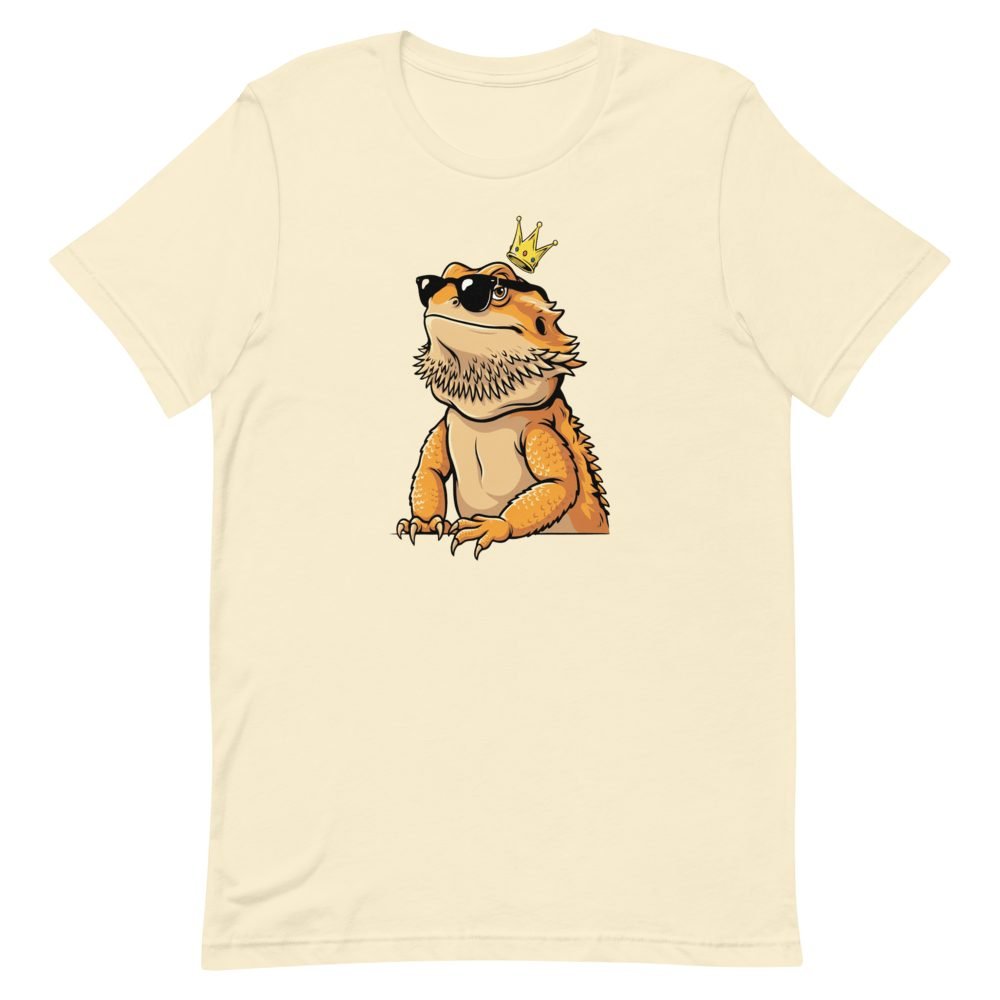
A holiday gift for the keeper in the family
Dog waiting by the table, bearded dragon basking in the next room? The Bearded Dragon Crown Sunglasses King T-Shirt is a soft, everyday tee for keepers who are a little obsessed, in the best way.
Make the day easier on your dog
For many dogs, the hardest part of Thanksgiving isn’t the food. It’s the doorbell, the crowd, and the dropped plates. A quiet room with their bed, water, and a long-lasting chew lets them step away. Set the trash somewhere they can’t reach, since it’ll hold bones, string, foil, and scraps of everything above. Sharing a home with a cat too? Read our guide to which bits of turkey cats can have.
Can dogs eat mashed potatoes? Your other questions, answered

Can dogs eat mashed potatoes every day?
We don’t recommend it. Plain potato is safe but it’s mostly starch, and it doesn’t add anything a complete dog food doesn’t already provide. Daily servings add calories and can crowd out the balanced diet. Keep it an occasional treat.
Can puppies eat mashed potatoes?
A weaned puppy can have a tiny taste of plain mash, but puppies need carefully balanced nutrition to grow, and their stomachs upset easily. Keep it to a lick, and skip it entirely if your puppy has had any tummy trouble.
My dog ate mashed potatoes with butter and milk. What now?
If there was no garlic, onion, or chives in it, the likely result is, at worst, a day of soft stool or some vomiting. Call your vet if vomiting is repeated, if your dog seems to have belly pain or won’t eat, or if they’ve had pancreatitis before. If there was any allium in it, call your vet now, even if your dog seems fine (see the box above).
Are white potatoes good for dogs?
They’re a fine occasional carbohydrate, cooked and plain, and they provide some potassium and vitamin C. But dogs don’t need them. They’re starchy, and diabetic dogs should skip them unless their vet approves.
What is the number one food dogs should never eat?
There isn’t a single answer. Toxicologists usually name grapes and raisins, chocolate, xylitol (a sweetener in some sugar-free products), and the onion family among the most dangerous. On a holiday table, the onion family is the one hiding in the most dishes. (Our popcorn guide covers another buttered-bowl favorite.)
My dog licked the mashed potato bowl. Can I still serve it to guests?
We’ve all been there, and we’re not judging. But no. It’s a hygiene question, not a toxicity one: a dog’s mouth carries bacteria you don’t want in the serving bowl. Give your dog the bowl to finish (only if it was plain), and make a fresh batch for the table. Then check whether that mash had garlic or chives in it. If it did, see the box above.
The bottom line
Can dogs eat mashed potatoes? Plain ones, in small amounts, yes. The potato was never the problem. What matters is what goes into it: fat that can trigger stomach upset or pancreatitis, and garlic, onion, and chives that damage red blood cells days after your dog seems fine. Set your dog’s spoonful aside before the butter goes in, keep it to the portion table, and if they get into the holiday version, check the recipe for alliums and call your vet if you find any. That’s how your dog gets to share the day safely.
Before you go
Keep learning your animal
We publish a new guide every day. The best of them land in one short weekly email, so you never miss the one about your species.

Meet Jake Harrington, your go-to guru for all things canine. With over 15 years of professional dog training experience, Jake has transformed the lives of thousands of dogs and their owners. His journey began in the bustling streets of a major city, where he discovered his natural affinity for understanding canine behaviors and communication.