Can My Dog Eat Raw Chicken? Separating the Countertop Accident From the Raw-Diet Decision
If you’re standing in the kitchen wondering can my dog eat raw chicken, there are two questions hiding inside that one, and they have different answers. If your dog just grabbed a thigh off the counter, you want triage. If you’re weighing up a raw diet because a friend swears by it, you want evidence. This guide handles both separately, because mixing them up is how people end up either panicking over nothing or making a long-term feeding decision on a single anecdote.
Below: the honest short answer, the pathogens raw poultry carries and how often, a research finding on raw chicken and canine paralysis that almost no consumer article mentions, the truth about raw bones and chicken necks, a 48-hour watch list for accidents, and what to do instead — including the one number that makes cooked chicken safe.
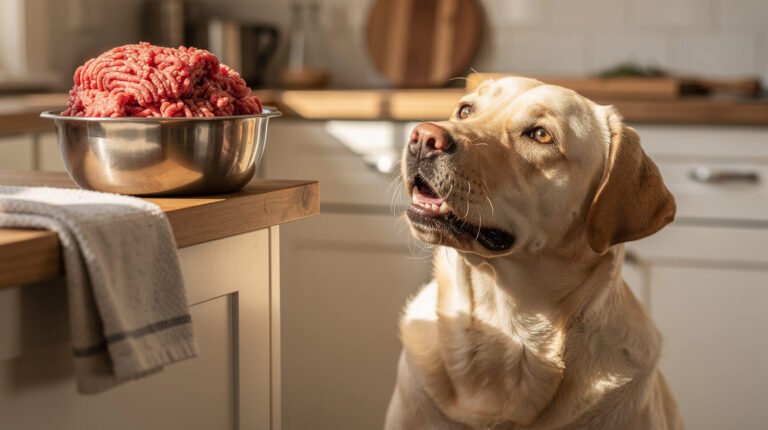
Can my dog eat raw chicken? The short answer

No — not as something you deliberately feed. Raw poultry is the single most reliably contaminated meat in the average kitchen, and the veterinary consensus bodies are unusually united on this one. The American Veterinary Medical Association discourages feeding any raw or undercooked animal-sourced protein to dogs and cats, citing risk to both the animal and the people living with it. Cornell’s Riney Canine Health Center and the FDA’s Center for Veterinary Medicine land in the same place.
But if your dog already ate some, take a breath. Most healthy adult dogs who steal a piece of raw chicken are completely fine. Dogs have shorter digestive tracts and more acidic stomachs than we do, and a single exposure in a robust immune system usually amounts to nothing, or at worst a day of loose stool. The risk is real but it is a probability, not a certainty, and it is not an emergency in the way chocolate or grapes are an emergency. There is no toxin here to race against — which means you have time to observe rather than panic.
So the honest framing is this: a countertop accident is a watch and wash your hands situation. Feeding raw chicken as a routine is a different decision entirely, and that’s the one worth thinking hard about. First-time owner, already second-guessing yourself? Looking it up before anything goes in the bowl is exactly right.
Three things change the calculus and make a vet call sensible sooner rather than later:
- Bones were involved — especially necks, wings, or carcass frames. A physical risk rather than a bacterial one, on a faster clock.
- Your dog is not a healthy adult — puppies, seniors, pregnant dogs, and any dog who is immunosuppressed or has inflammatory bowel disease has less margin.
- Someone in your household is vulnerable — an infant, an adult over 65, anyone pregnant or immunocompromised. This one is about the people, and it’s the part the internet skips.
What’s actually in raw poultry: four pathogens and the real numbers
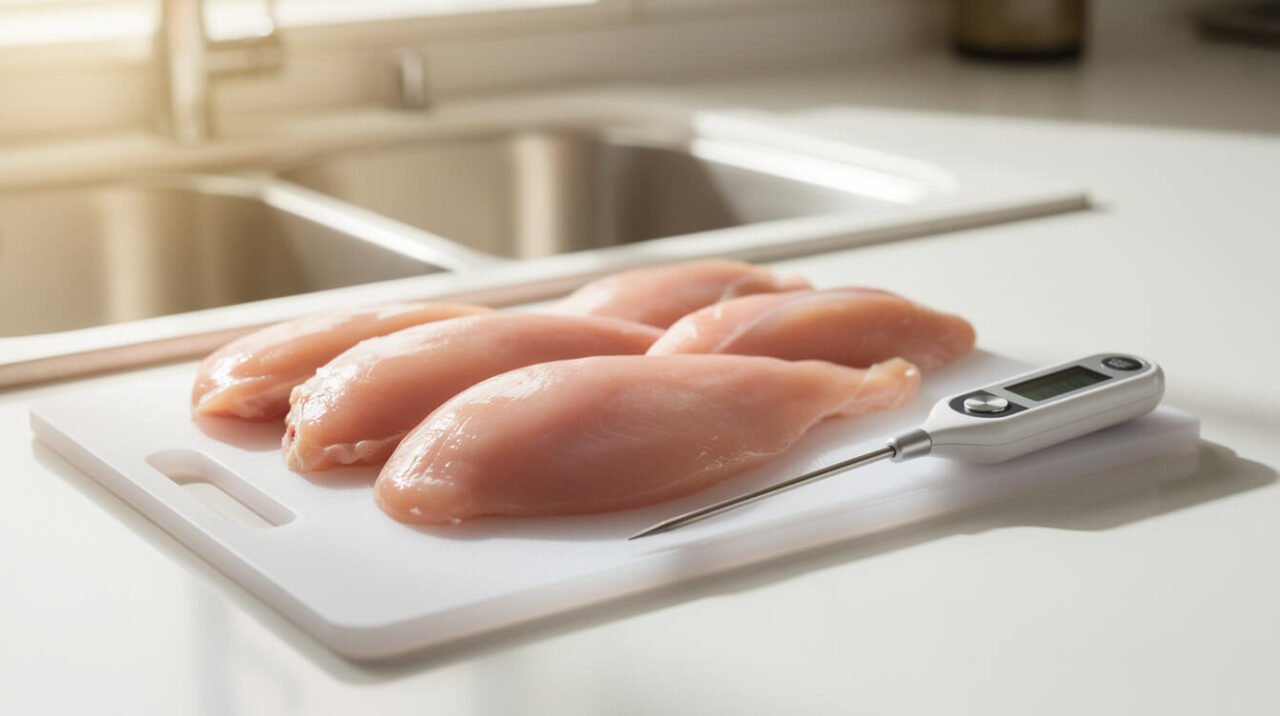
Most articles tell you raw chicken “can contain bacteria” and leave it there. That’s true and useless. Here’s what the surveillance data actually shows.
In a two-year study running from October 2010 to July 2012, the FDA’s Center for Veterinary Medicine screened over 1,000 pet food samples. Of the 196 commercial raw pet food samples tested, 15 came back positive for Salmonella and 32 for Listeria monocytogenes. For comparison, across 120 dry dog food samples: zero Salmonella, zero Listeria. That’s roughly 8% and 16% versus effectively nothing. A separate FDA analysis cited by Cornell’s Riney Canine Health Center puts the odds of finding a foodborne pathogen in frozen raw pet diets bought online at about one in three.
Those are commercial raw products, made by companies whose entire job is controlling contamination. Supermarket chicken, sold on the assumption you’ll cook it, isn’t held to a lower standard so much as a different one: the safety step is you, at the stove.
The four organisms worth knowing by name
- Salmonella — the famous one. Vomiting, diarrhea (sometimes bloody), fever, lethargy. Critically, plenty of infected dogs show no signs at all while still shedding live bacteria in their stool for days to weeks.
- Campylobacter — less famous, and the one that matters most here. Common in poultry, causes gastrointestinal upset, and is implicated in something considerably worse. More on that next.
- Clostridium perfringens — associated with acute diarrhea and, in dogs, hemorrhagic gastroenteritis.
- Listeria monocytogenes — often mild or silent in dogs, genuinely dangerous to pregnant people, newborns, and anyone immunocompromised.
There’s a fifth problem that isn’t a species at all. A University of Pennsylvania study found 10% of canine raw food products carried Gram-negative bacteria producing extended-spectrum beta-lactamases — enzymes that break down penicillins and cephalosporins and make an infection much harder to treat. Cornell’s point is worth sitting with: even once the bacteria clear, resistance genes can persist in the gut microbiome of the dog and the household. You’re not just gambling on this week’s diarrhea.
And a detail that catches out careful owners: freeze-drying is not cooking. Drying is one of the methods labs use to preserve bacteria for long-term storage. Freeze-dried toppers, coated kibble, and dried treats sit on the same shelf as cooked products, often with nothing on the bag to say the contents were never heated.
The paralysis link almost no one mentions

This is the part that isn’t in the Purina, Hill’s, or Petco write-ups, and it’s the single strongest reason we’d steer you away from raw chicken — particularly if you have a small dog.
In 2018, a team led by the University of Melbourne’s U-Vet Werribee Animal Hospital published a case-control study in the Journal of Veterinary Internal Medicine investigating acute polyradiculoneuritis, or APN. APN is the canine counterpart of Guillain-Barré syndrome in people: the immune system loses regulation and attacks the dog’s own nerve roots. It starts as hind-limb weakness, sometimes with a change in the dog’s voice or a choppy gait, and can climb to the front legs, neck, head, and face. If it reaches the chest muscles, a dog can die of it.
The researchers compared 27 dogs showing APN signs against 47 dogs without. Two findings stood out:
- Dogs that had eaten raw chicken meat had a more than 70-fold increase in the odds of developing APN.
- On fecal samples collected within seven days of clinical signs appearing, APN dogs were 9.4 times more likely to have had a Campylobacter infection than controls.
The proposed mechanism is the same one described in humans, where Campylobacter is now considered a trigger in up to 40% of Guillain-Barré cases: molecules on the bacterial surface resemble part of the structure of nerve cells closely enough that the immune response aimed at the bacteria also hits the nerves. Chief investigator Dr. Matthias le Chevoir noted that his clinic alone sees around 30 APN cases a year, that recovery can take six months or more, and that roughly three in ten do not recover.
The study also found APN over-represented in smaller breeds — and the authors’ read on why is the practical detail to take home: small dogs are the ones most likely to be given raw chicken necks.
Now the honest caveat, because the number deserves one
A 70-fold increase sounds apocalyptic, and we won’t let it sit there unexamined. This was a single case-control study, small sample, from one referral hospital that sees an unusual concentration of neurological cases. It shows an association, not a proven causal chain. And APN is rare — multiplying a very small baseline by 70 still leaves a small absolute risk. Your dog is not likely to be paralyzed by one stolen thigh, and anyone telling you otherwise is selling fear.
What the finding does justify is this: there is a plausible, biologically coherent, published link between a routine feeding practice and a devastating outcome, and the practice has no nutritional upside you can’t get from cooked chicken. When the downside is a six-month nursing job with a 30% non-recovery rate and the upside is zero, the decision isn’t close. That’s the reasoning — not the scare number.
Raw chicken bones and necks: why “raw bones are safe” is only half true
The raw-feeding world has a maxim: cooked bones splinter, raw bones don’t. The first half is correct and important. Cooking dries collagen out of bone, making it brittle, so a cooked chicken bone can shatter into shards that perforate the esophagus, stomach, or intestine. Never give a dog cooked bones of any kind. If your dog got into the roast carcass rather than the raw package, that’s the more urgent of the two scenarios — worth a call to your vet today.
The second half is where the maxim overreaches. Raw bones are more pliable than cooked ones, which genuinely reduces the splintering risk. It does not eliminate the other four problems:
- Obstruction. A bone or a wad of bone fragments can lodge anywhere along the tract. Signs include repeated unproductive retching, refusing water, a tense or painful belly, and straining without producing stool. This is an emergency clock measured in hours, not days.
- Choking. Dogs who inhale food rather than chew it are most at risk, and chicken necks are exactly the wrong shape and size for a small, enthusiastic swallower.
- Tooth fracture. Weight-bearing bones crack the slab-shaped carnassial teeth. Chicken bones are less guilty than beef marrow bones, but the risk isn’t zero.
- Constipation and bone-fragment impaction. Enough bone in one sitting produces hard, pale, crumbly stool and a dog straining uncomfortably for days.
Chicken necks deserve their own paragraph, because they’re the item the Melbourne research pointed at. They’ve been recommended for years as a dental chew for small dogs, on the reasoning that gnawing scrapes plaque. The dental logic isn’t wrong. But it stacks a bacterial risk, an obstruction risk, and a possible APN trigger onto the smallest dogs, who have the least margin on all three. The U-Vet team’s recommendation after publishing was to choose regular dog food over necks, and several clinics that had previously advised necks for dental health reversed course to raw beef or lamb bones.
If dental health is the goal — and it’s a legitimate one, periodontal disease being among the most under-treated conditions in dogs — ask your vet about products carrying the Veterinary Oral Health Council seal, or about brushing. The evidence base there is far better than the evidence for necks.
The weekly care guide
Get it right for your animal, every week
One email a week: new care guides, species deep-dives, and the safety answers keepers search for, written by our specialists. No spam. Unsubscribe anytime.
Your dog ate raw chicken: what to do over the next 48 hours

Start here: your dog is probably fine, and you haven’t done anything wrong. Dogs counter-surf. It’s what they are. Nobody needs a lecture about lids.
In the first ten minutes
Do not make your dog vomit. Not with hydrogen peroxide, not with salt, not with anything you read on a forum. Inducing vomiting at home carries real risks — aspiration pneumonia, and stomach ulceration from peroxide — and for raw chicken there is nothing to gain from it, because the concern is bacterial colonization rather than a toxin you can still get back out. If bones were swallowed, vomiting them back up drags sharp material back through the esophagus, which is worse than letting it pass. Only induce vomiting if a veterinarian on the phone tells you to.
Instead: work out how much and what. Boneless meat only, or bones too? How long ago? Fresh from the package, or had it been sitting out? Write it down — you’ll want it if you end up calling. Then clean up: the counter, the floor, the bowl, the packaging, and your hands, with soap and warm water for a full 20 seconds.
The 48-hour watch list
Most bacterial gastroenteritis shows up within 6 to 72 hours. Keep your dog’s normal food and routine, keep fresh water available, and watch for:
- Vomiting, particularly repeated or unproductive attempts
- Diarrhea, and whether there’s blood or mucus in it
- Lethargy, or a dog who suddenly doesn’t want their walk
- Loss of appetite for more than one meal
- Fever — a warm, dry-nosed, flat dog who wants to be left alone
- A tense, bloated, or painful abdomen
- Any hind-leg weakness, wobbliness, or change in bark in the weeks afterward
Call your veterinarian if
We inform care here, we don’t diagnose — so the threshold is deliberately low. Call your vet if: vomiting or diarrhea lasts more than 24 hours or contains blood; your dog is lethargic, feverish, or refusing water; the belly is tense or painful; there’s any retching without producing anything; bones were eaten and your dog is under about 20 lb, a puppy, a senior, or has any chronic illness; or you spot any of that hind-leg weakness at any point in the following weeks. If you can’t reach your regular clinic, an emergency vet is the right call — and with a possible obstruction, sooner beats cheaper. Trust your read on your own dog: you know their normal better than any article does.
The part about the humans
This is genuinely the most overlooked risk, and it isn’t your dog’s. A dog who ate contaminated raw chicken can shed live Salmonella or Campylobacter in their stool for days to weeks while appearing completely healthy. That means their rear end, their tongue, their bedding, their food bowl, and every surface in your yard.
For a healthy adult household this is a hand-washing problem. If you live with an infant, anyone pregnant, anyone over 65, or anyone immunocompromised, it’s a bigger deal, and worth mentioning to your own doctor as well as your vet. For two weeks after a known exposure: wash hands after contact with the dog, keep them off beds and out of the kitchen, no face-licking, pick up stool promptly, and run bowls and bedding through the hottest wash they’ll tolerate.
Thinking about a raw diet? The honest picture
Raw feeders are not fools, and we’re not going to pretend otherwise. The appeal is real: glossier coats, smaller stools, better appetite in fussy dogs, and a reaction to genuine frustration with ultra-processed kibble. Some of that holds up — fresh, minimally processed food is more digestible, which does mean less waste out the other end.
What doesn’t hold up is the safety argument, specifically the claim that a dog’s acidic stomach handles poultry pathogens so reliably that contamination doesn’t matter. Dogs are more resistant than we are. They are not immune, they can shed these organisms without symptoms, and the household exposure runs through them either way.
So here’s the honest picture. If you have read the AVMA position, the FDA surveillance numbers, and the Melbourne APN finding and you still want to feed raw, that’s your call to make with your own veterinarian — ideally a board-certified veterinary nutritionist, because the other failure mode of home-prepared raw diets is nutritional, not bacterial. Published analyses of homemade recipes turn up calcium-to-phosphorus ratios and vitamin levels that are frankly alarming, and growing puppies and large breeds pay for that in their skeletons.
If you proceed anyway, these are the risk reductions that actually move the needle:
- Skip poultry. Of all the raw proteins, chicken carries the Campylobacter and APN association. If the point of raw is the raw, beef and lamb don’t carry that particular signal.
- No necks, no wings, no carcass frames — especially for dogs under about 20 lb.
- Don’t rely on freezing as a kill step. Freezing reduces Campylobacter counts substantially, but it isn’t reliable sterilization, and Salmonella survives it well.
- Treat the prep area like a raw-chicken station for humans — dedicated board, hot soapy wash, sanitized bowls after every meal, nothing thawing where food for people gets made.
- Don’t do it at all if your household includes anyone in the vulnerable groups above. That one isn’t a preference. The exposure falls on someone who didn’t choose it.
- Consider gently cooked instead. Cooked fresh-food services and balanced home-cooked recipes give you most of what people want from raw, minus the pathogen load.
The safer way to feed your dog chicken
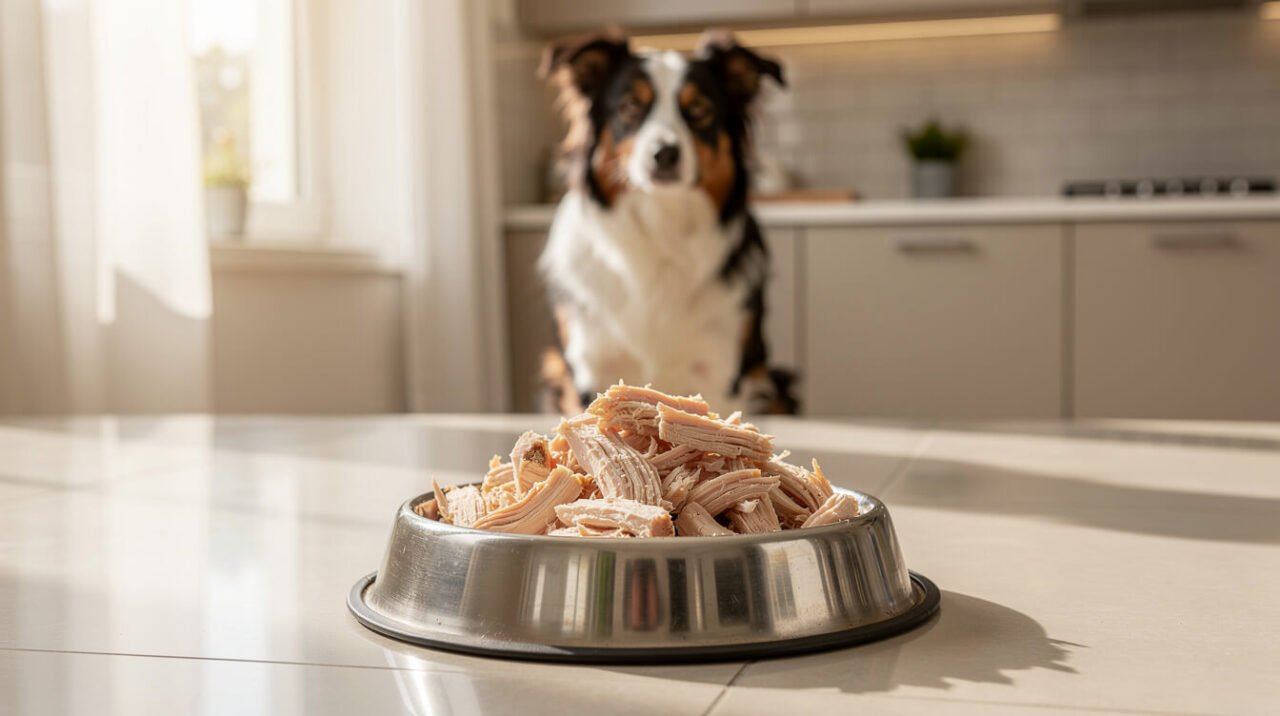
Here’s the good news lost in all of the above: chicken is an excellent food for dogs. Lean, highly digestible, complete protein, and most dogs are wild about it. The whole problem is one variable, and it has a number attached.
Cook boneless chicken to an internal temperature of 165°F (74°C). That’s the USDA safe minimum for poultry, the same target whether it’s going in your sandwich or your dog’s bowl. A cheap instant-read thermometer removes the guesswork; “the juices run clear” is folklore, not a measurement. At 165°F, Salmonella, Campylobacter, Listeria, and Clostridium stop being your problem.
How to prepare it
- Plain. Poach or bake it in water with nothing added. No salt, no oil, no butter, no rub.
- No onion or garlic, ever. Both are genuinely toxic to dogs and both hide in stock, broth, rotisserie seasoning, and most leftovers. This is the reason “I’ll just share my chicken” often isn’t as safe as it sounds.
- Boneless and skinless. Skin is mostly fat, and a big fat load can trigger pancreatitis — the same mechanism we cover in our guide to olive oil for dogs.
- Shredded or diced small, cooled to room temperature before it goes in the bowl.
- Refrigerate for up to three days, or portion and freeze. Treat it like food for people, because it is.
How much is reasonable
The working rule most veterinarians use: treats and extras should stay under 10% of daily calories, with the other 90% coming from a complete, balanced diet. Plain cooked chicken breast runs roughly 165 calories per 100 g (about 3.5 oz), which puts a sensible daily topper at somewhere around:
- 10 lb dog — about 2 teaspoons of shredded chicken
- 25 lb dog — about 1 tablespoon
- 50 lb dog — about 2 tablespoons
- 75 lb dog — about 3 tablespoons
Those are deliberately modest ballpark figures, based on typical maintenance energy needs for a neutered adult dog at a healthy weight. Your dog’s actual requirement swings with age, activity, and metabolism — a working border collie and a ten-year-old pug of the same weight are not the same animal. If your dog is on a prescription diet or being managed for weight, run extras past your vet first. We use the same arithmetic in our weight-based quinoa serving chart and the portion tables for popcorn.
One aside, since we’re on the subject of things keepers get attached to: our shop is currently built for the reptile side of the GeoZoo family, so there’s nothing canine in it yet. If there’s a bearded dragon person in your house, though, the Bearded Dragon Crown Sunglasses King T-Shirt is the one they’d actually wear. Dog designs are on the list.

Wear the obsession
Our shop is reptile-first for now. If there’s a bearded dragon in the family, the Bearded Dragon Crown Sunglasses King T-Shirt is the one the keeper in your house will actually reach for. Dog designs are in the works.
Can my dog eat raw chicken? Frequently asked questions
My dog has eaten raw chicken for years with no problems. Does that mean it’s fine?
It means you’ve been lucky, and luck is a real thing that happens to a lot of dogs — contamination is probabilistic, and plenty of raw chicken carries nothing at all. What your experience can’t show you is the rest of the distribution, or the household exposure, which is invisible by definition. We won’t tell you those years were a mistake. Only that the odds don’t reset in your favor because they’ve been kind so far.
Is raw chicken safe if it’s human-grade or organic?
No. “Human-grade” and “organic” are claims about sourcing and production standards, not sterility. Human-grade chicken is safe for humans because humans cook it. There’s no evidence organic poultry carries less Campylobacter.
Does freezing raw chicken make it safe for dogs?
Not reliably. Deep freezing reduces Campylobacter counts meaningfully, which is why some clinics list “not stored in a deep freezer” as a risk factor, but it’s a reduction rather than elimination. Salmonella survives freezing and thawing comfortably. Heat is the kill step.
What about raw chicken for puppies?
Don’t. Puppies have immature immune systems and much less fluid reserve, so a bout of gastroenteritis that would inconvenience an adult dog can dehydrate a puppy quickly. Add the developmental nutrition stakes and the obstruction risk in a small esophagus, and there’s no version of this that’s worth it.
My dog ate raw chicken and seems totally fine. Do I still need the hygiene precautions?
Yes, and this is the answer most owners are surprised by. A symptom-free dog can still shed live bacteria in their stool for days to weeks. If anyone in your home is pregnant, very young, over 65, or immunocompromised, keep the hand-washing and bedding hygiene up for about two weeks even if your dog never misses a meal.
Is raw chicken worse than raw beef for dogs?
For this specific concern, yes. Poultry is the primary reservoir for Campylobacter, and chicken is the meat with the published APN association. Raw beef carries its own Salmonella and E. coli risk — we go through the handling rules in our guide to raw ground beef for dogs — but it doesn’t carry that particular neurological signal.
My dog ate a cooked chicken bone. Is that different?
Yes, and more urgent. Cooked bone is brittle and can splinter into sharp fragments. Call your veterinarian today rather than waiting out a watch list.
Final thoughts
So: can my dog eat raw chicken? Not by design. The pathogen load is documented, the household risk lands on the people you live with as much as the dog, and the Melbourne APN work gives us a plausible route from a bag of chicken necks to a dog who can’t stand up. Against all that, the nutritional upside over cooked chicken is essentially nil.
And if it already happened, hold both thoughts at once: the long-term case against raw chicken is strong, and your dog who nicked one thigh off the counter is very likely going to be completely fine. Wash your hands, keep an eye on them for two days, and call your vet if anything on that watch list shows up or if you simply don’t like how they seem. That instinct is worth more than a number in an article.
What we’d love you to take away is the thermometer. One cheap instant-read probe, one number — 165°F — and chicken goes from the most contaminated thing in your kitchen to one of the best treats you can give your dog. That’s the whole fix, and understanding why it works is what turns a rule you followed into a decision you made.
If you’re working through the rest of the “can my dog eat this” list, we’ve covered cooked shrimp, breakfast sausage, and avocado with the same approach: the direct answer first, then the detail a keeper actually needs.
Before you go
Keep learning your animal
We publish a new guide every day. The best of them land in one short weekly email, so you never miss the one about your species.

Meet Jake Harrington, your go-to guru for all things canine. With over 15 years of professional dog training experience, Jake has transformed the lives of thousands of dogs and their owners. His journey began in the bustling streets of a major city, where he discovered his natural affinity for understanding canine behaviors and communication.