Can My Dog Eat Raw Spinach? Raw vs. Cooked, Oxalates, and the Dogs That Should Skip It
You are at the counter with a bag of baby spinach in one hand and a dog doing their very best “I would also like that” face at your knee. So: can my dog eat raw spinach? Yes — for most healthy dogs, a small amount of plain, well-washed, finely chopped raw spinach is fine. Not toxic, not an emergency, and also not something your dog needs.
But “yes, in small amounts” is where nearly every article stops, and it leaves the actual question unanswered. The word raw is in what you typed for a reason: you want to know whether to hand over the leaf as-is or put a pan on first, and whether the oxalate thing you half-remember reading is a real concern or internet noise.
Here is the honest version: raw and cooked spinach trade off against each other, nobody resolves that tradeoff clearly, and the most useful thing a page like this can tell you is which dogs the answer changes for. That is where we are going — with a real serving size by weight, and the part of “spinach” that actually sends dogs to the vet, which is almost never the spinach.
Can my dog eat raw spinach? The short answer, and the one real exception
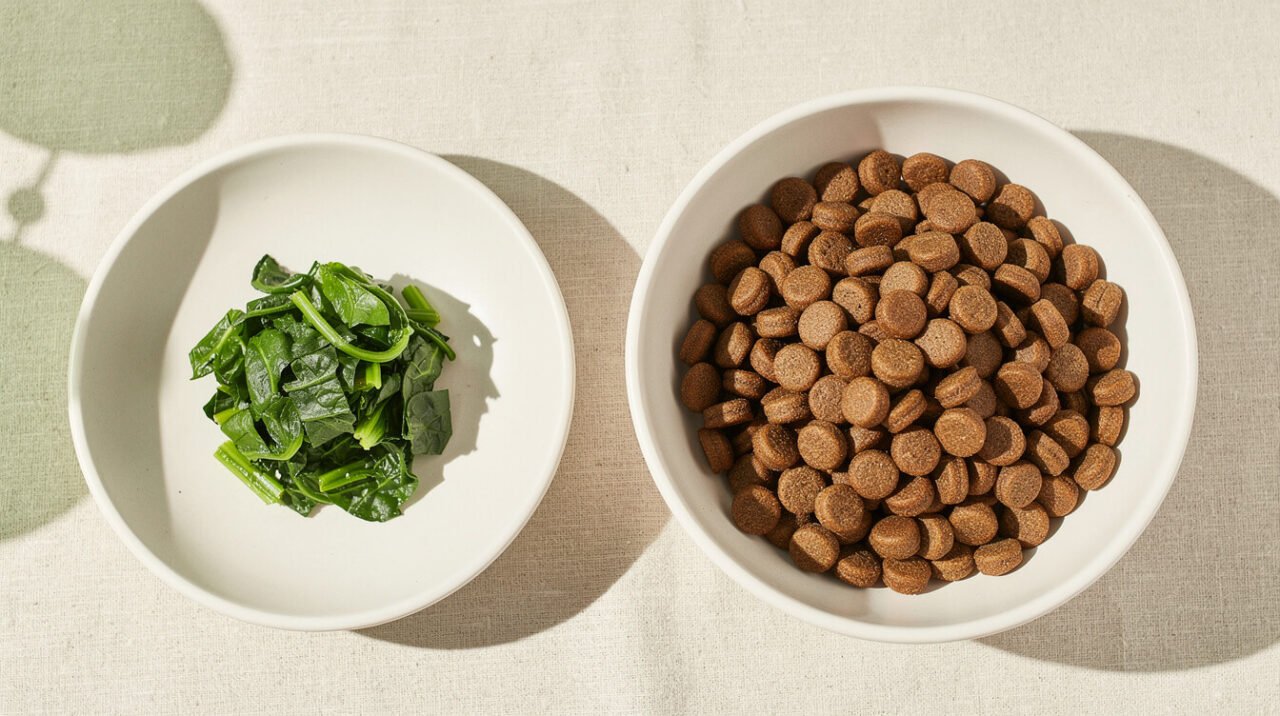
Short answer: yes. Spinach is not toxic to dogs. A few finely chopped raw leaves as an occasional treat is perfectly reasonable, and a dog who hoovers up a dropped leaf off the kitchen floor will almost certainly be fine.
The exception: dogs with a history of calcium-oxalate bladder stones, dogs with diagnosed kidney disease, and dogs eating a prescription veterinary diet should not be given spinach until their own vet says so. That is not a hedge for the sake of hedging — it is the one group for whom the answer genuinely flips, and we get specific about it in section four.
For everyone else, the frame that helps most is this: spinach is a treat, not a food group. Your dog’s complete and balanced food already covers their vitamin and mineral needs. Spinach does contain real nutrition — vitamins A, B, C, and K, iron, beta-carotene, antioxidants, and fiber — but your dog is not deficient in any of it, so adding spinach does not make a good diet better. It makes a boring Tuesday slightly more interesting, which is a completely valid reason to do it. Just don’t do it because you think your dog needs greens, because they don’t.
Worth saying plainly, because a lot of spinach content online gets breathless: a healthy dog eating a small amount of spinach is not in danger. The American Kennel Club notes that a dog would have to eat very large quantities for the oxalate content to cause harm, and that healthy kidneys handle small amounts without trouble. If your dog just ate a leaf, you can put your phone down. If your dog just ate a bowl of creamed spinach, that is section six.
Raw or cooked? What actually changes, and what doesn’t
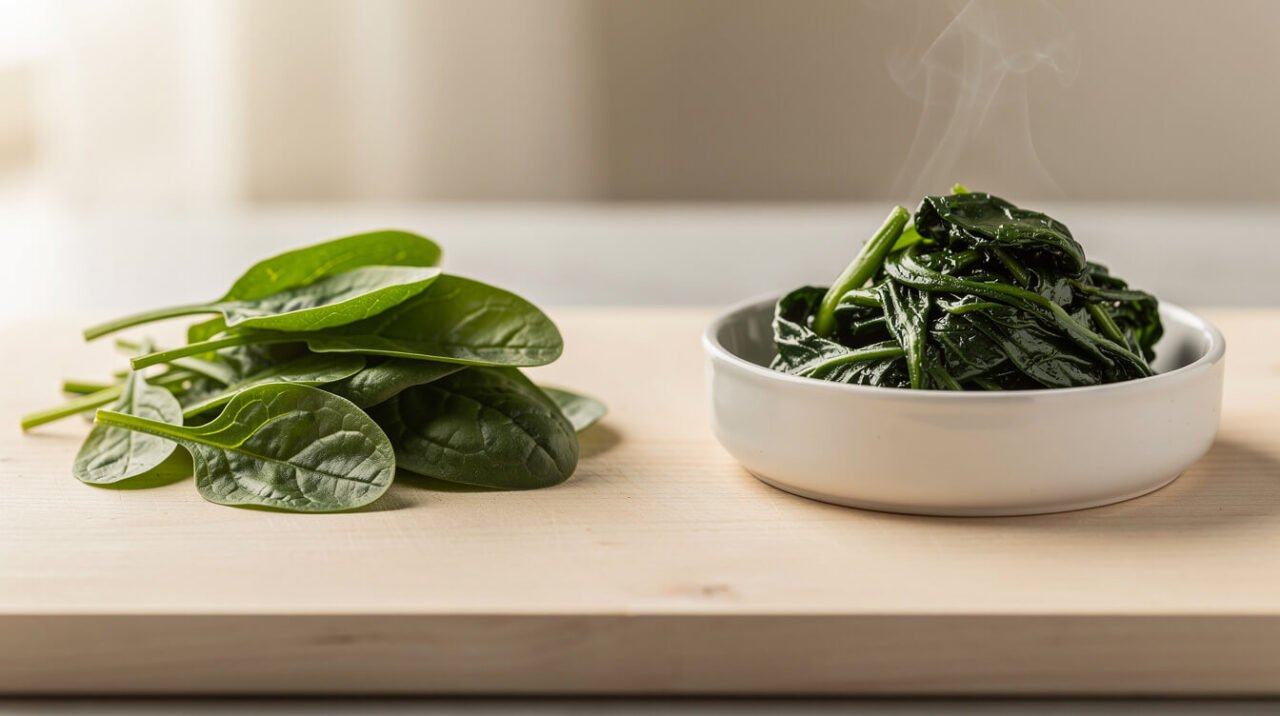
The two most authoritative sources on page one point in opposite directions. The AKC says raw spinach is “difficult for a dog to digest” and recommends steaming. PetMD, whose spinach guidance is reviewed by a veterinarian, says dogs can eat raw leaves but that boiled spinach “loses most of its nutrients.” Read both and you learn that raw is harder to digest and boiled is nutritionally thinner, with no idea what to do.
Here is the tradeoff — with the caveat that most precise figures come from human nutrition research rather than canine studies, so treat the direction as solid and the magnitude as approximate.
Boiling leaches soluble oxalate into the water. This is the real nutritional argument for cooking spinach, and nobody makes it: soluble oxalates dissolve, so when you boil spinach and pour the water away, a meaningful share of the oxalate goes with it. Human studies consistently find sizeable reductions, though figures vary a lot with cooking time and water volume — which is why we are not quoting you a percentage. Steaming reduces oxalate much less, because there is no cooking water to leach into. But boiling also leaches the water-soluble vitamins — vitamin C, the B vitamins, folate. That is what PetMD means. So boiling buys a lower-oxalate leaf and charges you much of the nutrition that was your reason for offering spinach.
Raw keeps the most nutrients and the most oxalate. Both — they are in the same leaf. Raw is also harder for a dog to get anything out of, for a structural reason: dogs lack the enzymes and gut transit time to break down plant cell walls the way a cow or rabbit does, so much of the nutrition is locked inside cellulose your dog cannot open. Which is why whole leaves frequently reappear in the yard looking remarkably like they went in. Not a health problem — the leaf simply passed through as fiber rather than as food.
The practical middle: for most healthy dogs, lightly steamed and finely chopped is the best version of spinach — it softens the cell walls so your dog absorbs something, keeps most of what boiling would wash away, and is gentler on the stomach. But if raw is what you have and your dog is healthy, finely chopped raw spinach in a small amount is fine too; at treat-sized portions the difference is small.
One thing cooking does not do: it does not make spinach safe for the dogs in section four. Boiling lowers oxalate; it does not remove it. For a dog with a stone history or kidney disease, the move is to ask your vet, not to change the cooking method.
Oxalates, explained without the scare
Spinach is high in oxalic acid. That is true, and it is the basis of every alarming spinach headline you have scrolled past. Here is what it actually means.
Soluble oxalates bind calcium and magnesium, which makes those minerals less available and, in large enough quantities, can pull blood calcium down. The resulting calcium oxalate is filtered out by the kidneys, and a big enough load is hard on them — that is the mechanism behind “spinach can cause kidney damage.” Sustained heavy intake has been associated with kidney stress, muscle weakness, and heart-rhythm problems.
Now the part the scary version leaves out: dose is the entire story. A dog with healthy kidneys clears small amounts of soluble oxalate without difficulty, and every credible source says a dog would need an extreme quantity — or a lot of spinach consistently over a long stretch — for any of the above to be in play. A few chopped leaves is nowhere near that line. Two situations are worth telling apart:
- A few leaves, occasionally. Not a meaningful oxalate load for a healthy dog. Fine.
- Spinach as a daily staple, or a large volume at once. A real load, and not something to do without veterinary input — particularly in a homemade diet, where spinach sometimes gets added generously because it reads as healthy.
There is a second compound the AKC leaves out entirely: spinach contains isothiocyanates, the same family found in broccoli and kale, which in large amounts cause significant stomach upset. That is the far more likely outcome of a dog eating too much spinach at once — not kidney trouble, just a bad night of gas, loose stool, or vomiting. Usually self-limiting, and a good reason to keep portions small. If vomiting or diarrhea is severe, bloody, or lasts more than a day, call your vet; dehydration is the thing to watch, especially in small dogs and puppies.
The dogs that should skip spinach until you’ve talked to your vet

This is the most useful section on this page, and the one the entire first page of Google is missing. Every top result mentions calcium-oxalate stones in the abstract. None tell you which dogs that abstraction is about.
1. Dogs with a history of calcium-oxalate bladder stones
If your dog has ever been diagnosed with calcium-oxalate uroliths — the stones, not struvite, which are a different animal — spinach is a food to discuss with your vet first. Dietary oxalate is one of the levers vets manage in these dogs, and spinach is among the highest-oxalate foods in a normal kitchen. This is not a “probably fine” situation. It is an “ask the person managing your dog’s case” situation.
2. Dogs on a prescription urinary or kidney diet
The rule here is stricter than most owners realize: dogs on a therapeutic diet should not be given food or treats from outside that diet. The whole point of those formulations is precise mineral and protein control, and a handful of spinach is a variable nobody wanted. If you want to give your dog a treat, ask your vet which ones are compatible — most will happily name a few.
3. Dogs with diagnosed kidney disease
Kidney disease is a diagnosis, and we are not going to make one from a blog post. But compromised kidneys are exactly the organs that handle the oxalate load, so the reassuring “healthy kidneys clear small amounts easily” does not transfer. If your dog has been diagnosed at any stage, spinach is a conversation with your vet, not a decision at the counter.
4. Breeds over-represented for calcium-oxalate stones
Some breeds appear disproportionately in the veterinary literature on calcium-oxalate urolithiasis. The ones most commonly cited include the Miniature Schnauzer, Bichon Frise, Shih Tzu, Lhasa Apso, Yorkshire Terrier, Pomeranian, and Maltese. Male dogs are over-represented, as are middle-aged and older dogs.
Two caveats, because this is easy to misread. A breed predisposition is not a diagnosis — a healthy Mini Schnauzer who has never had a stone is not forbidden a spinach leaf. And the breed-risk literature is observational, with lists that vary between studies. So the takeaway is modest: if you have one of these breeds, raise the spinach question at your next routine appointment and let your vet weigh in with your dog’s history and urinalysis in front of them. That sentence is the most valuable thing on this page, and page one of Google does not say it.
5. Puppies, pregnant or nursing dogs, and dogs on medication
Growing puppies have genuinely delicate calcium and phosphorus requirements — getting the ratio wrong has real orthopedic consequences — and a food whose main party trick is binding calcium is not where to improvise. Same logic for pregnant and nursing dogs, and for any dog on medication affecting the kidneys or calcium handling. The answer is probably “a tiny bit is fine”; your vet is the one who can remove the “probably.”
Everyone not on this list: carry on. The large majority of healthy adult dogs can have a small amount of spinach without any of this applying.
The weekly care guide
Get it right for your animal, every week
One email a week: new care guides, species deep-dives, and the safety answers keepers search for, written by our specialists. No spam. Unsubscribe anytime.
How much raw spinach is a sensible serving?
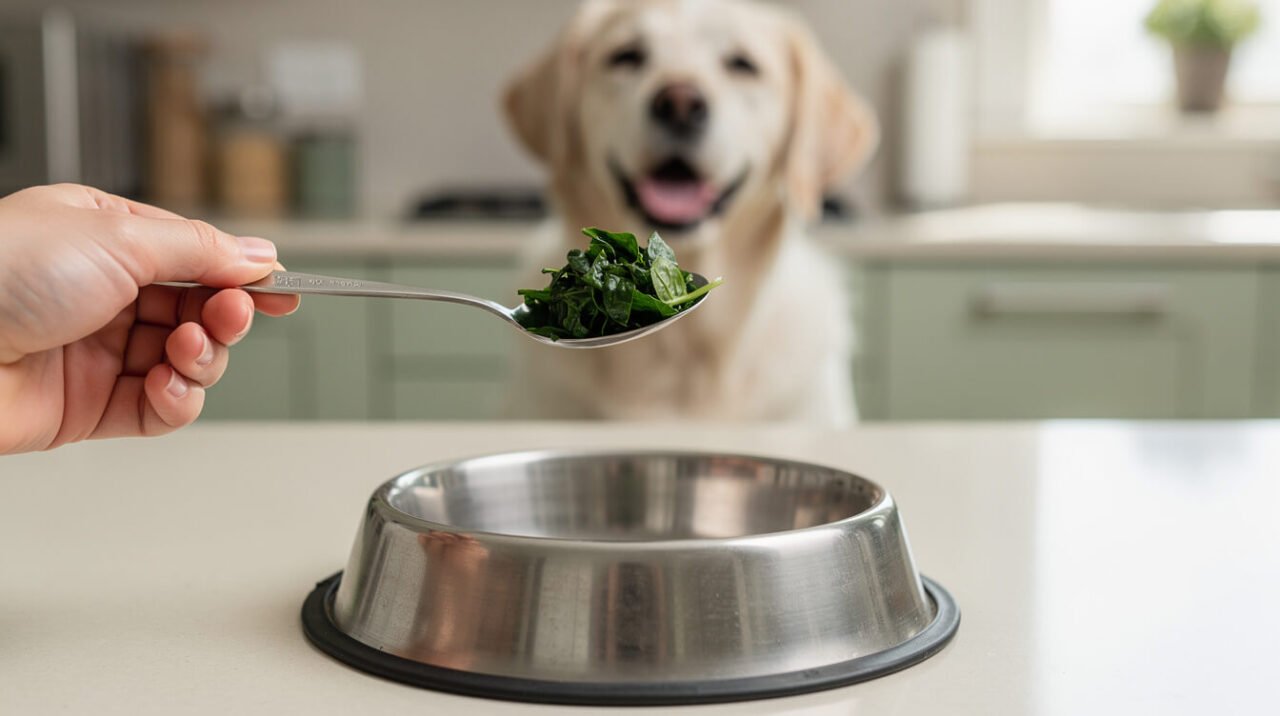
The near-universal answer online is the 10% rule — treats should be no more than 10% of daily calories — and then nothing more specific. That rule is correct for calorie-dense treats, but spinach has almost no calories, so 10% of your dog’s intake in spinach would be an enormous pile of leaves. The limit here is oxalate and fiber, not calories, which is why everyone who cites the 10% rule ends up saying nothing.
Here are real amounts. PetMD publishes a weight-based chart reviewed by a veterinarian — the most credible specific guidance available — so we are using it as the anchor rather than inventing numbers. These are per serving, for steamed and chopped spinach, offered occasionally, not daily:
- Extra-small, 2–20 lb (Yorkie, Chihuahua, Pomeranian, Pug) — about ¼ teaspoon
- Small, 21–30 lb (Beagle, Basenji, Mini Aussie) — about ½ teaspoon
- Medium, 31–50 lb (Border Collie, Basset Hound, Cattle Dog) — about 1 teaspoon
- Large, 51–90 lb (Labrador, German Shepherd, Aussie) — about ½ tablespoon
- Extra-large, 91 lb and up (Newfoundland, Bernese, Great Pyrenees) — about 1 tablespoon
Your first reaction is probably that these look tiny. They are, and that is the point — this is a garnish, not a side dish. If you were picturing a handful of leaves, recalibrate down hard.
Translating that to raw: the chart is for steamed spinach, which is wilted and dense, while raw chopped spinach is mostly air — so the same teaspoon holds considerably less actual leaf. Nobody publishes a vet-reviewed raw conversion and we will not invent one, but the useful consequence is that measuring raw spinach by the same spoon sizes lands you under the steamed equivalent, not over it. That is the direction to err, so matching the chart by volume is a sound, conservative way to portion raw.
Frequency matters as much as size: a couple of times a week at most, not a daily supplement. Oxalate concerns are about sustained intake far more than single servings, so keeping it irregular does more for safety than shaving the portion.
How to actually prepare it
- Wash it thoroughly — pesticide residue and contamination on bagged greens are both real.
- Chop it finely. Whole leaves pass through undigested, and long stringy ones are a choking nuisance in small dogs.
- Steam it lightly if you are cooking — a minute or two. Don’t boil unless your vet suggested it for oxalate reasons.
- Serve it completely plain. No butter, oil, salt, or seasoning, and absolutely no garlic or onion.
- Start below the chart the first time, and watch for 24 hours. Every dog’s stomach has opinions.
We take the same weight-based approach in our guide to whether dogs can eat quinoa, and the raw-versus-cooked question returns in can my dog eat raw sweet potato, where the answer lands quite differently.

Wear the obsession
The GeoZoo shop is merch for keepers who are a little obsessed with their animal. One design is live so far — the Bearded Dragon Crown Sunglasses King T-Shirt — with more species on the way.
Spinach in the dishes it usually shows up in
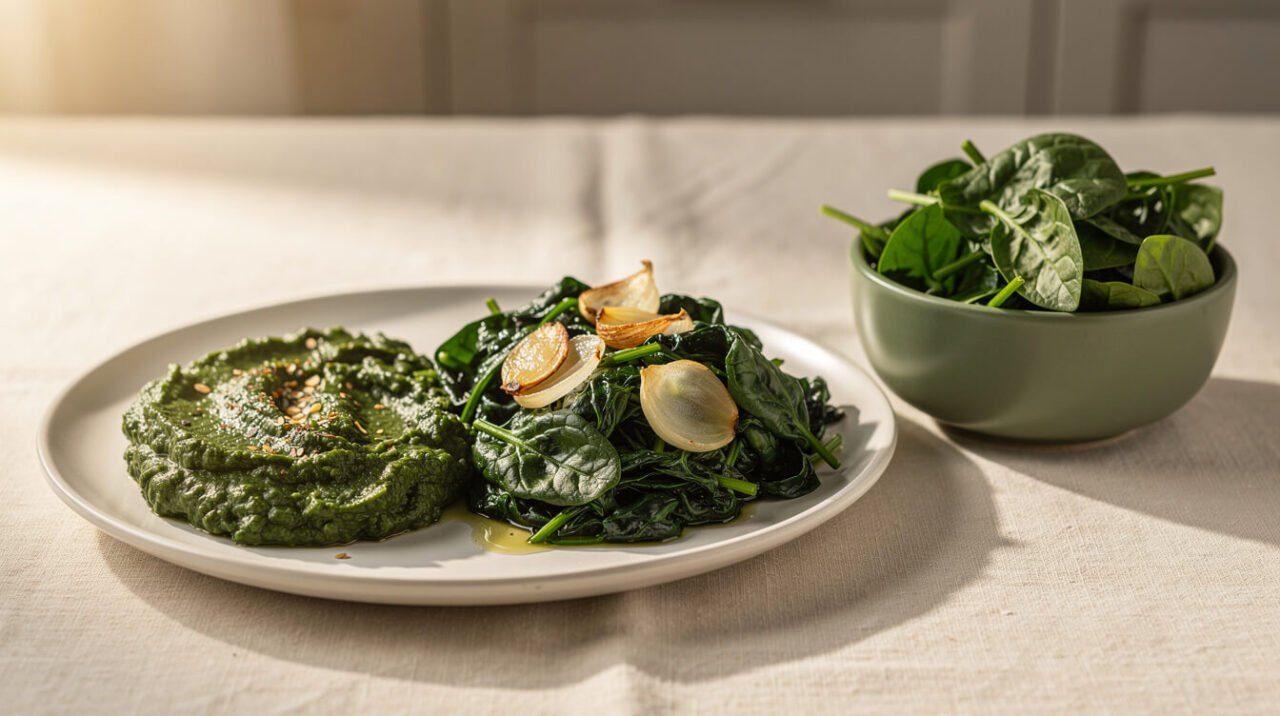
Here is where the actual veterinary risk lives, because almost nobody has a bowl of plain spinach lying around. Spinach arrives with other ingredients, and those ingredients are the problem far more often than the leaf.
Spinach cooked with garlic or onion — this is the real one
Sautéed spinach is usually sautéed with garlic. Both garlic and onion belong to the Allium family, both are genuinely toxic to dogs, and both damage red blood cells in a way that can cause hemolytic anemia — garlic being the more potent by weight. This is not an oxalate-grade “very large amounts over time” caution; it is an actual toxicity with a dose-dependent risk.
If your dog has eaten a meaningful amount of a garlic- or onion-containing dish, call your vet or an animal poison control line now rather than waiting for symptoms. In the US, the ASPCA Animal Poison Control Center is 888-426-4435 and the Pet Poison Helpline is 855-764-7661; both charge a consultation fee and both are worth it. Signs of Allium toxicity are often delayed by a day or more — lethargy, weakness, pale gums, dark urine, rapid breathing — so “they seem fine” an hour later is not reassurance.
Creamed spinach and spinach dip
Both are heavy on dairy and fat. Many dogs are lactose intolerant to some degree, so the dairy alone makes for an unhappy gut. The fat is the bigger concern: a sudden high-fat load is a recognized trigger for pancreatitis, which is painful and, at its worse, a genuine emergency. Spinach dip usually contains onion or garlic too, and creamed spinach commonly contains nutmeg, itself best kept away from dogs. A lick off a finger is not a crisis; a bowl is a call to your vet. Afterwards, watch for repeated vomiting, a hunched or “praying” posture, a painful abdomen, lethargy, or refusing food — those warrant a same-day call rather than wait-and-see.
Canned spinach, leftovers, and the garden
Canned spinach: skip it — it is preserved with a lot of sodium, and excess salt can cause vomiting and diarrhea, raise blood pressure, and worsen existing heart disease. Human leftovers — quiche, lasagna, spanakopita, saag, steakhouse creamed spinach — are built on cheese, cream, butter, onion, garlic, or heavy salt; judge the dish, not the leaf. Garden spinach is fine in principle, as long as you wash off the soil and nothing in the bed has been treated with fertilizer, slug bait, or pesticide.
Easier greens if raw spinach feels like a hassle
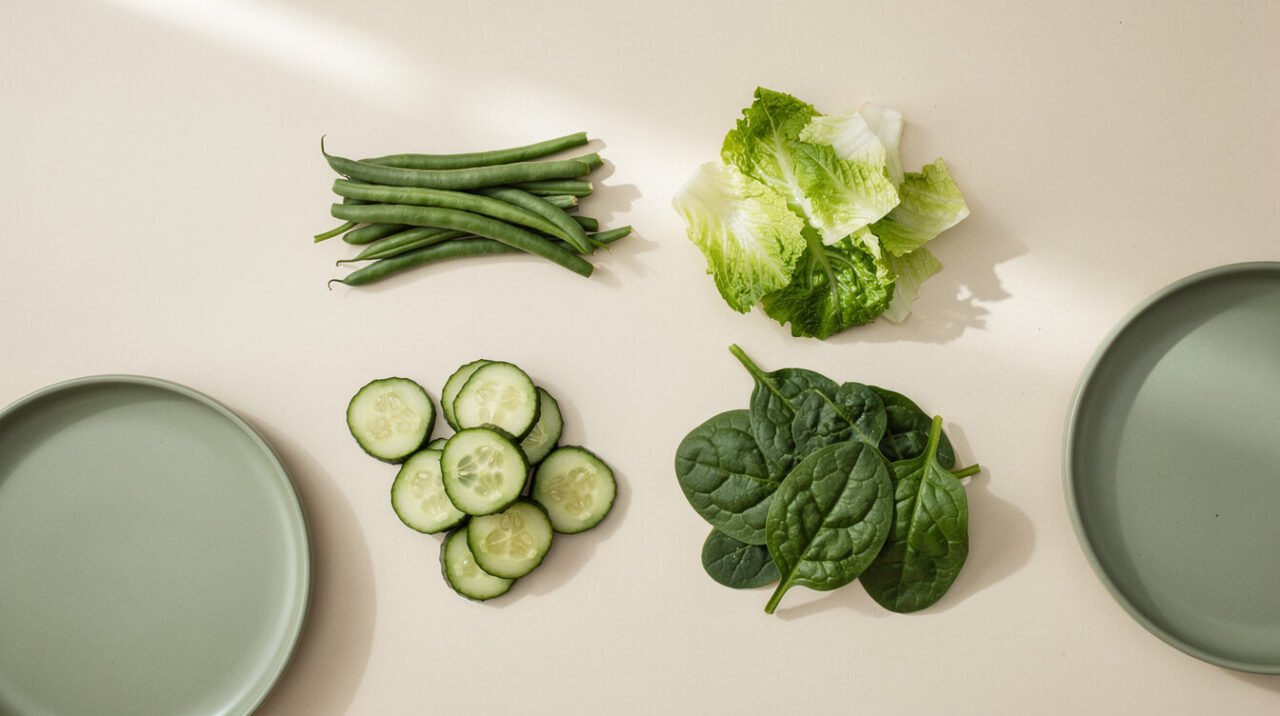
If you have read this far and concluded that spinach is a lot of caveats for a quarter teaspoon of leaf, you are not wrong. There are simpler vegetables, and most make better treats.
Genuinely easy wins. Green beans are the vet-favorite dog vegetable and deservedly so — low calorie, low oxalate, high fiber, and often recommended as a bulking treat for dogs on a weight-management plan. Cucumber is almost entirely water and very low risk; slice it so it cannot be swallowed whole. Carrots are sweet enough that most dogs treat them as a real reward. Romaine is low in oxalate and more nutritious than iceberg. Zucchini is soft, mild, and easy on the stomach.
Same caution as spinach. Swiss chard and beet greens are also high in oxalate, so the section-four list applies to them too. Kale brings oxalates plus isothiocyanates: small amounts only. Broccoli is fine in small amounts and reliably gassy in large ones, for the same reason.
Actually leave these alone. Onion, garlic, leeks, chives, and shallots — the whole Allium family, no safe culinary amount. Rhubarb leaves — extremely high oxalate and genuinely toxic. Raw or green potato — solanine. Wild mushrooms, never. And grapes, raisins, and avocado, each for separate reasons; see our guide to whether dogs can eat avocado.
One housekeeping note, since readers ask: the GeoZoo shop is keeper merch — wear-your-species stuff for people who are a little obsessed — and right now exactly one design is live, the Bearded Dragon Crown Sunglasses King T-Shirt. Dog designs are on the way. If you keep a beardie alongside the dog, and plenty of you do, it is there.
Can my dog eat raw spinach? Your questions, answered
Can my dog eat raw spinach every day?
We would not. Oxalate concerns are driven by sustained intake far more than by any single serving, so a food that is fine twice a week is a different proposition as a daily habit. If you want a daily vegetable in the bowl, green beans are the better choice — and run any daily addition past your vet.
My dog ate a whole bag of raw spinach. What now?
Call your vet and describe the amount along with your dog’s size and health history — especially if there is any kidney or stone history. For a healthy dog, the likeliest outcome is a rough day or two of gas, loose stool, or vomiting from the fiber and isothiocyanate load. Keep fresh water available, and call sooner if the vomiting repeats, the diarrhea is bloody, or your dog is lethargic or not drinking.
Can puppies eat raw spinach?
Ask your vet first. Calcium and phosphorus balance during growth is genuinely consequential for a puppy’s skeleton, and spinach’s effect on calcium availability is not something to improvise with. A tiny amount is probably fine — and “probably” is doing real work in that sentence.
The bottom line
So — can my dog eat raw spinach? For most healthy dogs: yes, a small amount, plain, well washed, and finely chopped, with lightly steamed the better version if you are willing to put a pan on. The right portion is smaller than you expected — about a quarter teaspoon for a little dog, around a tablespoon for a giant one. The oxalate story is real but dose-dependent, and the far more common problem is the company spinach keeps: garlic, onion, cream, butter, and salt.
The one thing to carry away: if your dog has had calcium-oxalate bladder stones, has diagnosed kidney disease, eats a prescription diet, or belongs to one of the breeds that turns up repeatedly in the stone literature, ask your vet before spinach goes in the bowl. It is a thirty-second question at an appointment you were having anyway. For neighboring ground, see our write-ups on eggplant for dogs and vegetables for cats, plus can guinea pigs eat broccoli, where the oxalate-and-stone question matters even more.
You are asking the question before handing over the food. That is the whole job, and you are already doing it.
GeoZoo is a care guide, not a veterinary practice. We inform care; we don’t diagnose or prescribe. For anything involving your dog’s illness, injury, medication, or diagnosed condition, your veterinarian is the right call — they have your dog’s history in front of them, and we don’t.
Before you go
Keep learning your animal
We publish a new guide every day. The best of them land in one short weekly email, so you never miss the one about your species.

Meet Jake Harrington, your go-to guru for all things canine. With over 15 years of professional dog training experience, Jake has transformed the lives of thousands of dogs and their owners. His journey began in the bustling streets of a major city, where he discovered his natural affinity for understanding canine behaviors and communication.