Can Cats Eat Sweet Potatoes? The Safe Thanksgiving Portion, and Why the Vitamin A Pitch Doesn’t Apply to Cats
Can cats eat sweet potatoes? Yes. Plain sweet potato that’s peeled and cooked is safe for most cats in small amounts, and it isn’t toxic. “Small” here means about a teaspoon, not a serving spoon. The reason to share it is that your cat enjoys it. You’ll read online that sweet potato gives cats a vitamin A boost, but that doesn’t hold up for cats. The common correction, that cats can’t convert beta-carotene at all, is wrong too. We’ll walk through both.
Below: the short answer, what a teaspoon of sweet potato actually adds (we did the math with USDA’s numbers), how to prepare it, which Thanksgiving versions to keep off your cat’s plate, and how it compares with pumpkin. If your cat is straining in the litter box and you can’t find fresh urine clumps, don’t reach for sweet potato. Call your vet or an emergency clinic now. The section on why is further down.
Can cats eat sweet potatoes? The short answer
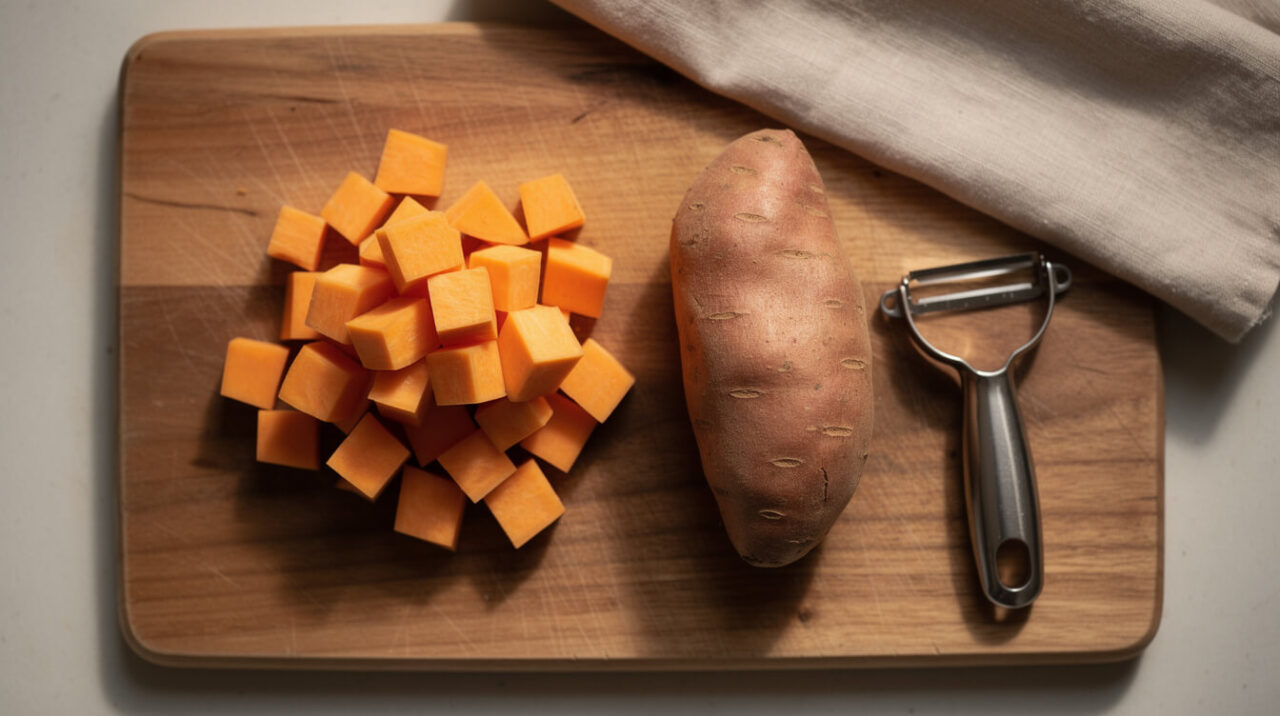
Yes, with three conditions: plain, cooked, and small. Here’s the quick version.
- Safe: sweet potato flesh, peeled and cooked plain until soft. Baked, boiled, steamed, and microwaved all work. Mash it or cut it into pieces smaller than a pea.
- Also fine: canned sweet potato packed in water or vacuum-packed with no added sugar or salt, and plain unseasoned frozen sweet potato once it’s cooked.
- Skip: raw sweet potato, the skin, anything in syrup, and anything made with butter, sugar, marshmallows, spices, onion, or garlic. That rules out almost every holiday version.
- Amount: about 1 teaspoon for an average adult cat, once or twice a week. For a first taste, start with less.
Sweet potato (Ipomoea batatas) belongs to the morning glory family, not the nightshade family like white potatoes, tomatoes, and eggplant. That matters because the alkaloid people worry about in green white-potato skins, solanine, is a nightshade compound. So the “potato” warnings you may have read about white potatoes don’t carry over directly. What does carry over is the bigger point. Cats are obligate carnivores, built to run on meat. A starchy root is a novelty for them, not a nutritional upgrade. Their complete and balanced cat food already covers everything they need.
What sweet potato actually gives a cat (and the vitamin A myth, both directions)
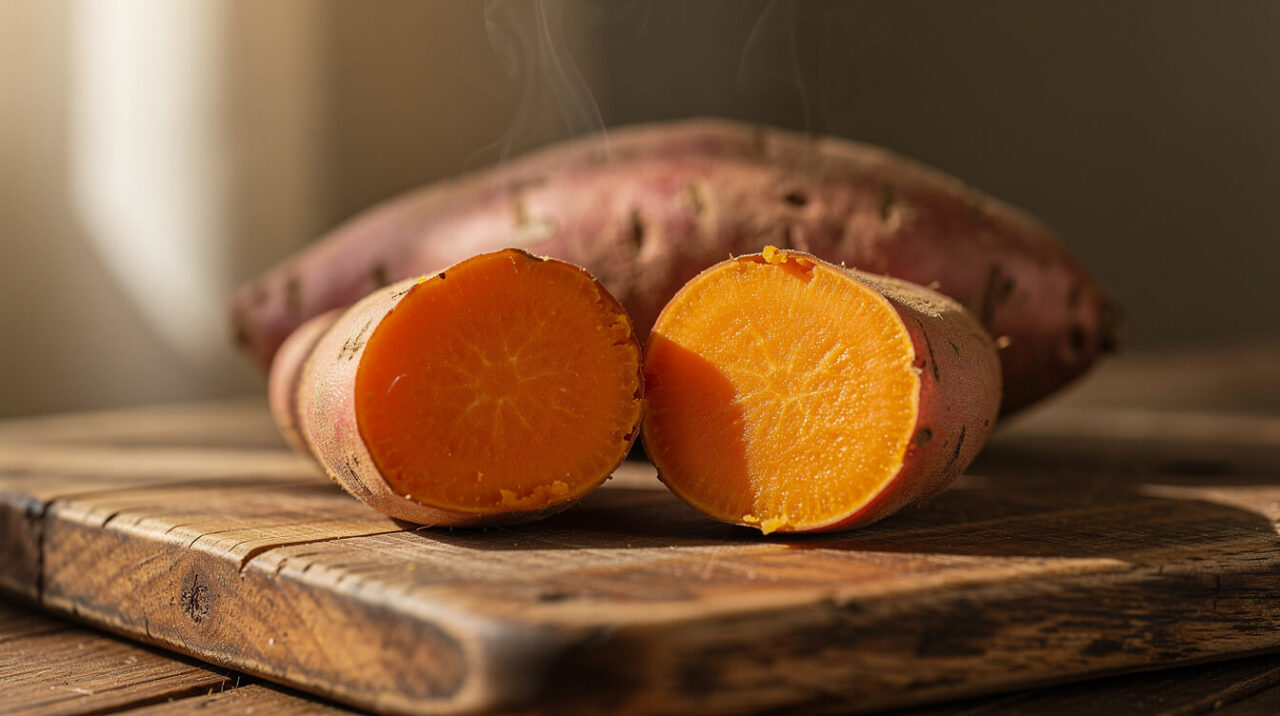
Most “can cats eat sweet potatoes” articles list the same perks: vitamin A, vitamin C, beta-carotene, potassium, and fiber. Those nutrients are really in the vegetable. The trouble is that two of the headline ones work differently in a cat than in a person or a dog.
Vitamin A: what the label means, and what a cat can use
Sweet potato doesn’t contain vitamin A itself. It contains beta-carotene, the orange pigment that many animals convert into vitamin A. USDA’s FoodData Central lists boiled, peeled sweet potato at 9,444 micrograms of beta-carotene per 100 grams, and also shows 787 micrograms of “vitamin A, RAE.” Divide the first number by 12 and you get the second. That figure is a human conversion estimate. It isn’t vitamin A sitting in the potato.
Cats are different. The Merck Veterinary Manual’s nutrition chapter (fully reviewed in November 2023) says cats “cannot convert beta-carotene to vitamin A” because they lack the intestinal enzyme that splits it. That’s why cats need a preformed source in their diet, such as liver, fish oil, or the vitamin A that’s added to commercial cat food. So “sweet potato boosts your cat’s vitamin A” doesn’t hold up.
Here’s the half nobody else mentions. The flat “can’t convert at all” line is too strong. In a 2012 study from UC Davis, researchers gave 10 adult cats a single oral dose of beta-carotene tagged with a tracer. Tagged vitamin A (retinol) showed up in the cats’ blood, so cats can make some vitamin A from beta-carotene. The authors added the caveat that matters, though: conversion is “likely inadequate to meet cats’ VA requirement without the inclusion of preformed VA in the diet.”
Now look at the size of the dose. The cats in that study got 5 to 10 milligrams of beta-carotene per kilogram of body weight, which works out to about 23 to 45 milligrams for a 10-pound cat. A level teaspoon of boiled sweet potato carries roughly half a milligram (our arithmetic from the USDA figures). That’s something like 35 to 90 times less than the study dose. Even that much bigger dose didn’t add up to a meaningful vitamin A supply. A teaspoon of mash won’t either.
There’s a reassuring flip side. Because cats convert so little, the beta-carotene in sweet potato isn’t a vitamin A toxicity risk either. One pet-retailer article we read warns about exactly that. The vitamin A overdoses vets do see in cats come from preformed vitamin A, classically from diets heavy in liver. Merck describes growing kittens fed high-liver diets developing bony changes in the neck.
Vitamin C: cats make their own
Sweet potato does contain vitamin C, about 13 milligrams per 100 grams boiled. But according to Merck, dogs and cats synthesize vitamin C from glucose in the liver, which is why pet food standards set no dietary requirement for it. A teaspoon adds well under a milligram to a body that already makes its own. It’s harmless, but it isn’t a benefit worth feeding for.
What’s left: a little fiber, a little water, and a lot of novelty
Sweet potato does carry fiber, about 2.5 grams per 100 grams boiled. A teaspoon holds roughly 0.15 grams. That’s a small amount, which we’ll come back to in the pumpkin comparison. Potassium and the B vitamins are real but small, and your cat’s food is already formulated to cover them. The honest case for sweet potato is that a cat who likes it gets a safe, low-calorie bit of variety. That’s enough of a reason to share it.
How much sweet potato can cats eat? The teaspoon math
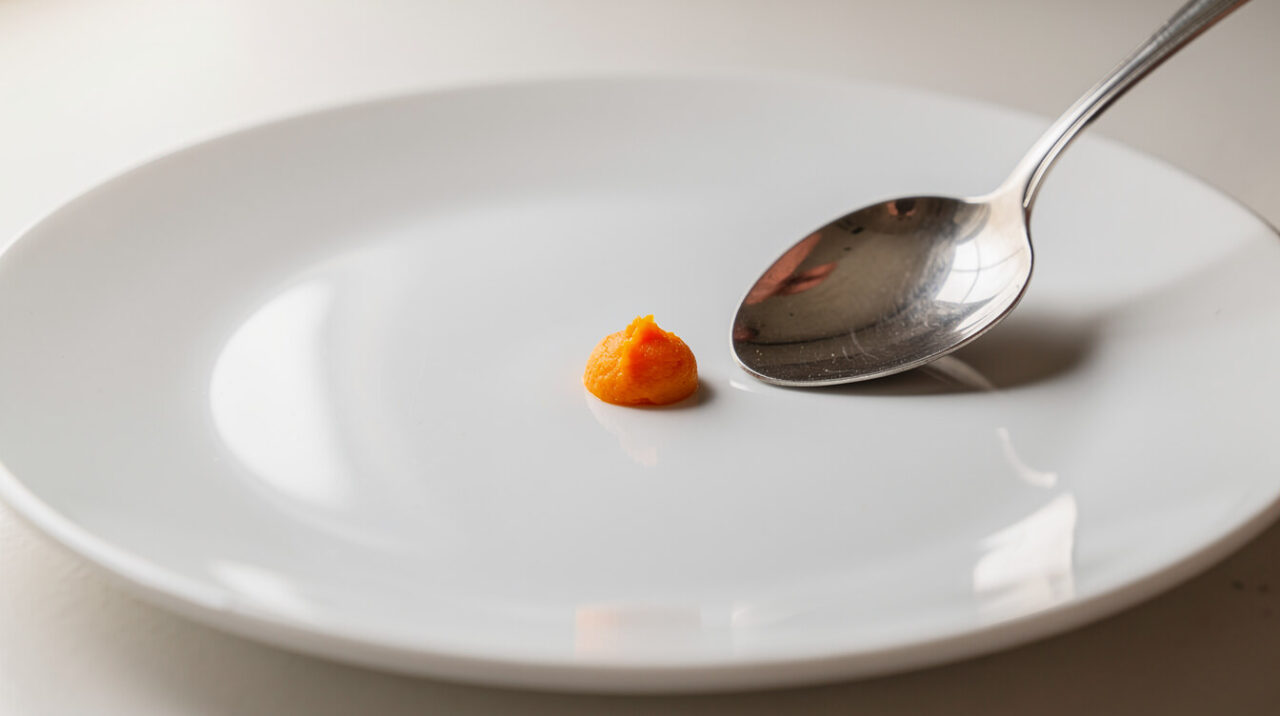
The numbers you’ll find online look like they disagree. PetMD says up to ½ tablespoon once or twice a week. Chewy says 1 to 2 teaspoons for an 8- to 12-pound cat, once or twice a week. Another popular cat site allows up to “a full tablespoon.” Convert the units and the first two mostly agree. One teaspoon is a third of a tablespoon, so ½ tablespoon is 1½ teaspoons. The full tablespoon is the outlier.
The calories, worked out
Here’s the arithmetic, using USDA’s values for boiled, peeled sweet potato (76 calories per 100 grams, with a mashed cup weighing 328 grams) and the Merck Veterinary Manual’s energy formula for cats:
- A 10-pound (4.5 kg) adult cat needs roughly 220 to 260 calories a day. That’s Merck’s resting energy requirement (70 × body weight in kg0.75, about 218) times 1.0 for an obesity-prone cat or 1.2 for a typical neutered adult.
- The usual treat rule keeps all extras under 10% of daily calories. That’s about 22 to 26 calories for this cat, for everything outside the bowl.
- A level teaspoon of mashed sweet potato weighs roughly 5 to 7 grams and carries about 4 to 5 calories, around 2% of the day.
- A full tablespoon is about 15 calories, more than half the day’s treat allowance in one go.
So for a single teaspoon, calories aren’t really the limit. The limits are your cat’s digestion (starch and fiber are unfamiliar fuel for a carnivore’s gut) and the meat-based food that a filling extra can crowd out. That’s why we land on the small end: about 1 teaspoon, once or twice a week, for a healthy adult cat around 10 pounds. A smaller cat gets proportionally less. If your cat already gets other treats, sweet potato comes out of the same allowance.
Watch the recipes, too
Portion advice and recipes don’t always match. Chewy’s own sweet potato “gravy” calls for 1 to 2 tablespoons of mash mixed with tuna water or broth. That’s three to six times the 1 to 2 teaspoons the same article recommends, and up to about 30 calories. For a 10-pound cat, that’s more than the whole day’s treat budget. If you make a topper, measure your cat’s teaspoon first and mix the liquid into that.
The first-taste rule
For the first time, offer a pea-sized dab, much less than a teaspoon. Then watch for 24 to 48 hours. Vomiting, diarrhea, very soft stool, or a cat who seems uncomfortable means sweet potato isn’t for them, and that’s not a problem. If everything stays normal, you can work up to the teaspoon. Introduce only one new food at a time. Otherwise, if something upsets your cat’s stomach, you won’t know which food did it.
How to prepare it: cooked, raw, skin, canned, and “yams”
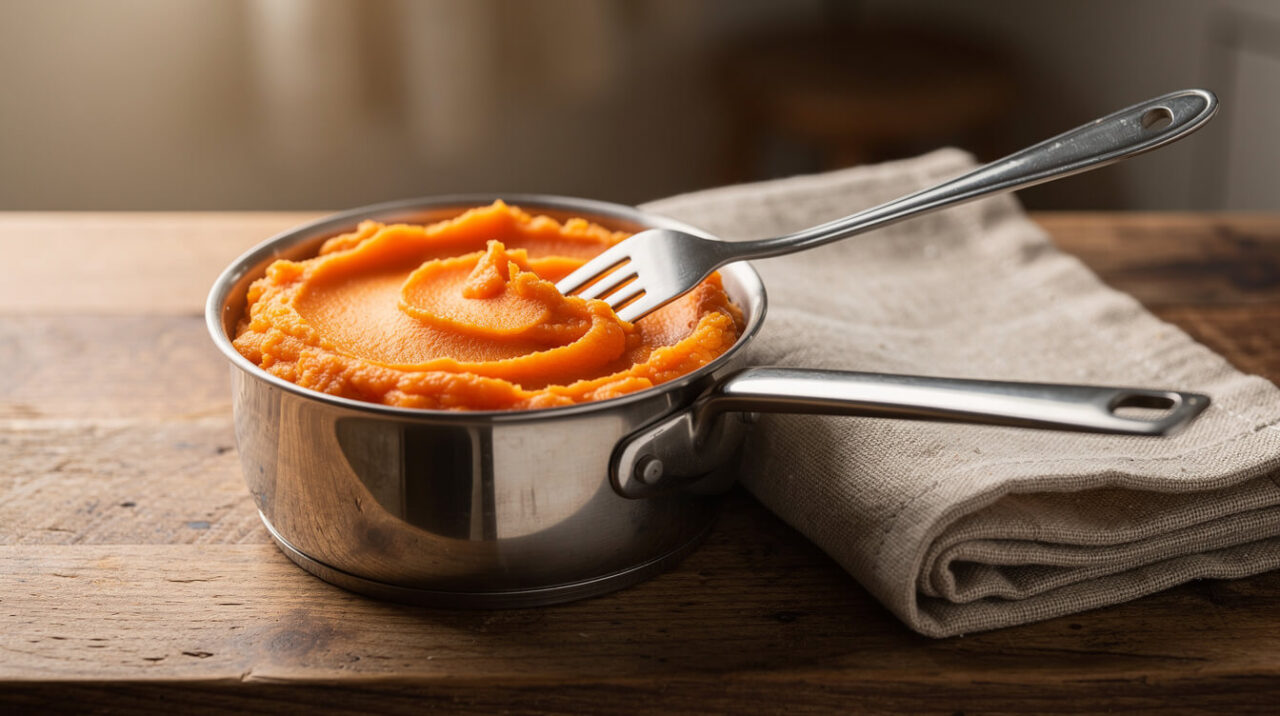
Preparing it is simple. Here’s how each form you might have in the kitchen stacks up.
| Form | For cats? | Why |
|---|---|---|
| Peeled, cooked plain (baked, boiled, steamed, microwaved) | Yes | Soft, easy to portion, nothing added. Let it cool to room temperature first. |
| Raw sweet potato | No | Hard and hard to digest, and a chunk is a choking or blockage risk. It isn’t known to be poisonous, so a nibbled crumb isn’t an emergency. |
| Skin | No | Tough and fibrous, so it’s harder to digest, and it’s where dirt and residue sit. Peel before cooking or scoop the flesh out after. |
| Canned, water- or vacuum-packed | Yes, if the label says sweet potato only | USDA’s vacuum-pack listing is 91 calories and 53 mg sodium per 100 g, close to home-cooked. Brands vary, so read the label. |
| Canned “yams” in syrup | No | Packed in sugar syrup. Rinsing doesn’t fix it. |
| Frozen plain cubes | Yes, cooked | Cook them through and cool them. Frozen-solid chunks are a choking hazard. |
| Fries, chips, and roasted wedges | No | Oil, salt, often garlic or onion seasoning, and skin-on pieces. |
| Moldy, soft, or damaged sweet potato | No | Throw it out. Mold-damaged sweet potatoes can produce a lung toxin documented in cattle (Merck). We found no cat cases, and that’s not something to test. |
Are canned “yams” the same thing?
In US stores, almost always yes. According to the Library of Congress, the soft, orange varieties sold as “yams” are sweet potatoes. True yams (Dioscorea) are an unrelated plant, usually found in international markets, and USDA requires anything labeled “yam” to also say “sweet potato.” So a can of “yams” in syrup is just sweetened sweet potato. If you have a true yam from a specialty store, keep it for the humans. We couldn’t find good feeding data for cats on true yams, and your cat doesn’t need it.
Easy ways to serve the teaspoon
- Straight off a spoon or fingertip. Many cats will lick a little mash off a spoon but ignore it when it’s stirred into food. Let your cat choose.
- As a topper. Stir the teaspoon into wet food, or thin it with a splash of warm water so it reads as gravy.
- On a lick mat. Spread a thin smear in the grooves. It stretches a tiny portion into a few minutes of licking, which is good enrichment for an indoor cat.
- Freeze the rest. One sweet potato makes far more mash than a cat will eat in a month. Spoon teaspoon-sized dots onto a tray, freeze, and bag them. Thaw one in the fridge when it’s sweet potato day.
Our shop doesn’t have a cat design yet. If your house also has a bearded dragon under a basking lamp, the Bearded Dragon Crown Sunglasses King T-Shirt is our nod to multi-species homes.

For keepers with more than one kind of animal
Cat on the windowsill, bearded dragon under the lamp? The Bearded Dragon Crown Sunglasses King T-Shirt is a soft, everyday tee for people who are a little obsessed with their animals, in the best way.
Let your cat set the pace
Some cats ask for sweet potato every time it’s out. Others try it once and never again. Both are healthy cats. The one thing to avoid is turning a fun extra into something your cat expects at every meal, because that’s how a treat starts replacing food. Keep it occasional and small, and it stays a treat.
The weekly care guide
Get it right for your animal, every week
One email a week: new care guides, species deep-dives, and the safety answers keepers search for, written by our specialists. No spam. Unsubscribe anytime.
The Thanksgiving table: candied yams, casserole, pie, and fries
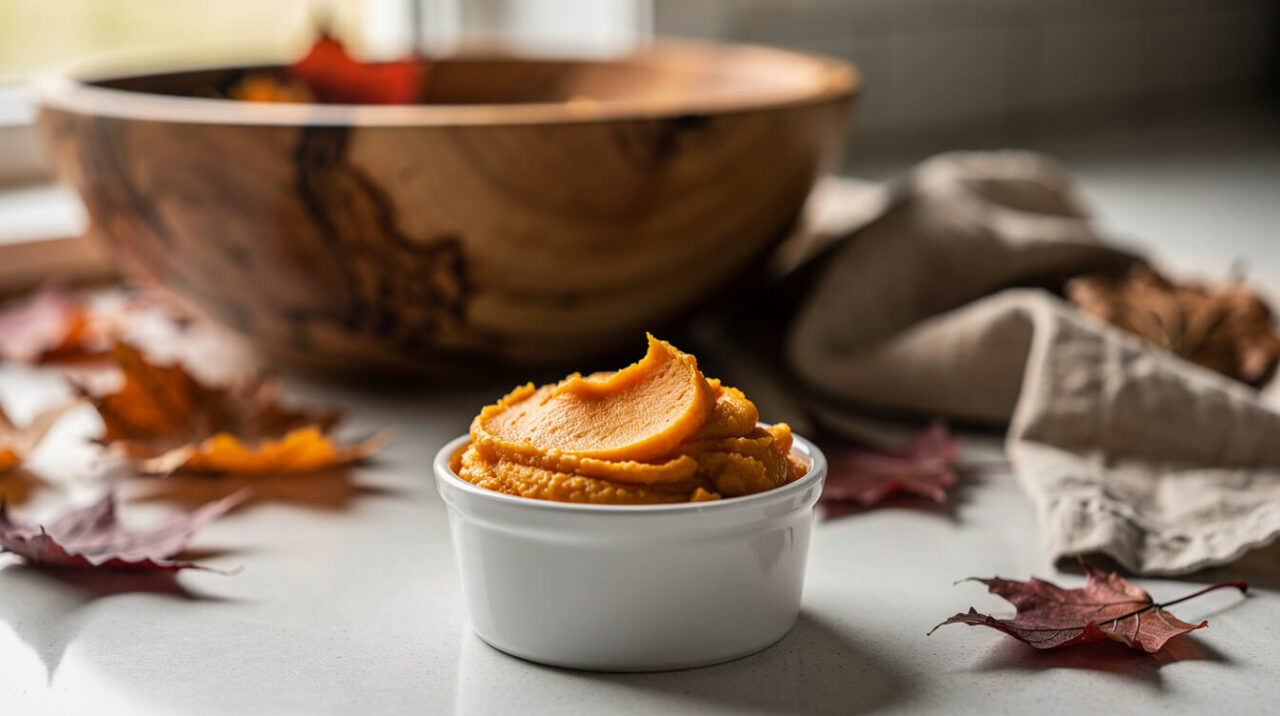
Searches for this question peak in late November, and that makes sense. The sweet potato most cats get offered isn’t plain. It’s whatever’s on the holiday table. Here’s how the classics stack up.
- Candied yams: no. USDA’s listing for home-prepared candied sweet potato is 164 calories, 27 grams of sugar, and 3.5 grams of fat per 100 grams. Plain boiled sweet potato is 76 calories, about 6 grams of sugar, and almost no fat. Butter and brown sugar double the calories and add roughly 25 times the fat, and that’s before the marshmallows.
- Sweet potato casserole: no. The marshmallow-and-pecan topping is sugar and fat. Savory versions are worse, because they’re often built on sautéed onion or garlic.
- Sweet potato pie: no. It’s butter, sugar, eggs, cream or evaporated milk, and warm spices like nutmeg, clove, and allspice. The spices get the attention, but at a lick-of-pie amount the rich, sweet filling is the more likely cause of an upset stomach, and the crust adds more fat. If your cat ate a real portion, call your vet.
- Sweet potato fries and roasted wedges: no. They’re oiled, salted, often garlic-seasoned, and usually skin-on.
- Sweet potato soup or curry: no. These almost always start with onion and garlic, and the broth carries them.
The onion and garlic line is the one that matters
Sugar and butter mostly mean a rough night of vomiting or diarrhea. Onion and garlic are different. The Merck Veterinary Manual calls cats “the most susceptible species” to onion and garlic poisoning, which damages red blood cells. It reports toxicosis in cats after less than a teaspoon of cooked onion, and garlic is 3 to 5 times more potent. Signs can take several days to appear. If your cat ate a savory sweet potato dish with onion or garlic in it, call your vet, even if they seem fine. (We cover this in more depth in our cat-safe Thanksgiving turkey guide, since stuffing and gravy are the usual sources.)
The easy fix: set some aside before you season
If you’d like your cat to share the holiday, set aside a spoonful of plain mash before the butter, sugar, or seasoning goes in. Pop it in a ramekin in the fridge, and serve your cat their teaspoon from that. Everyone at the table gets sweet potato, and nobody spends Friday at the emergency clinic.
Sweet potato vs pumpkin for a constipated cat (and when it’s a blockage instead)
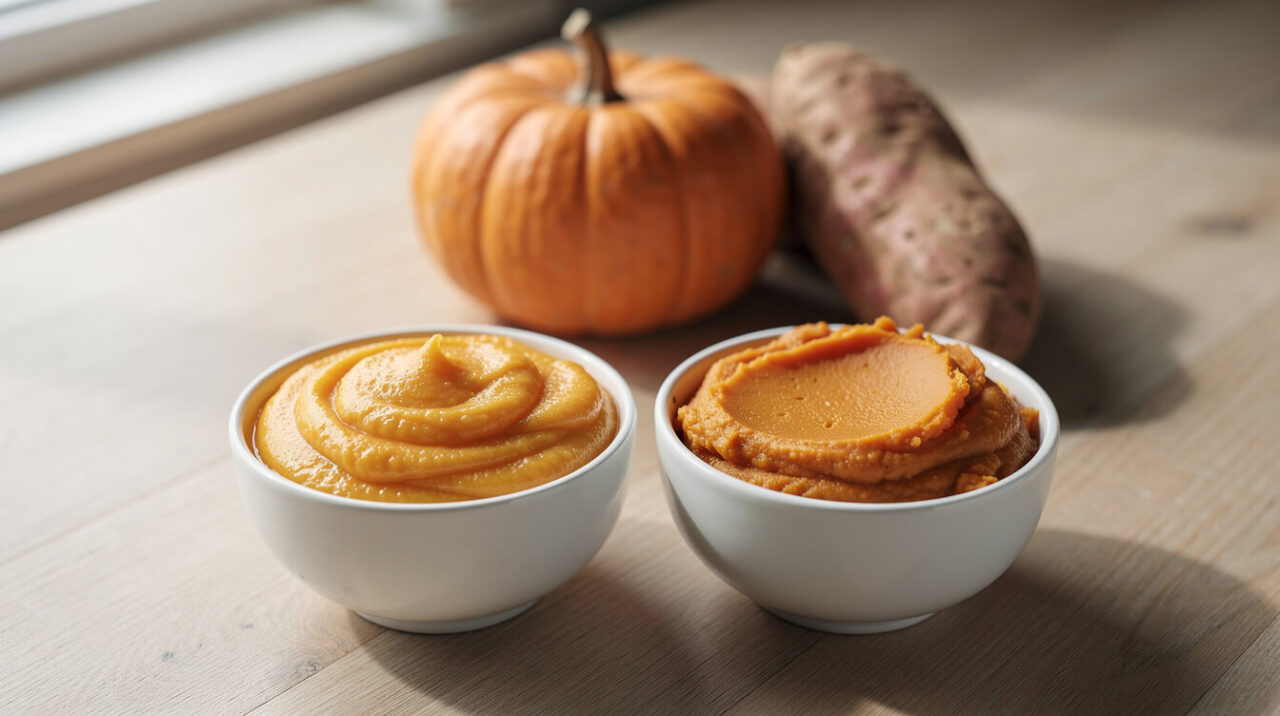
“Is sweet potato or pumpkin better?” comes up a lot, usually from someone whose cat is a little backed up. Most answers say pumpkin is “higher in fiber” and stop there. Here are the numbers, from USDA FoodData Central:
| Per 100 g | Canned pumpkin (no salt) | Sweet potato, boiled, peeled | Sweet potato, baked flesh |
|---|---|---|---|
| Calories | 34 | 76 | 90 |
| Fiber | 2.9 g | 2.5 g | 3.3 g |
| Water | 90 g | 80 g | 76 g |
| Fiber per 100 calories | 8.5 g | 3.3 g | 3.7 g |
Gram for gram, they’re about the same. Baked sweet potato even edges out canned pumpkin. Calorie for calorie, though, pumpkin carries roughly two and a half times the fiber, plus more water. So if a vet suggests adding a vegetable for fiber, pumpkin gets more fiber in per calorie. Sweet potato is the more calorie-dense of the two.
Both are small, though. As we worked out in our cat pumpkin guide, a teaspoon of canned pumpkin holds about 0.15 grams of fiber, and a teaspoon of sweet potato is about the same. Tufts University’s veterinary nutritionists calculated that matching the fiber in one therapeutic high-fiber diet would take more than 2½ cups of pumpkin a day for a cat. Neither one is a constipation treatment. Is sweet potato a laxative for cats? Not really. Too much can loosen the stool, but that’s an upset stomach, not a treatment.
When straining isn’t constipation
This is the part that matters most. A cat squatting and straining in the litter box looks constipated, but sometimes it’s the bladder. A cat with a urethral obstruction, most often a male, strains just the same and produces little or no urine. Cornell’s Feline Health Center calls urethral obstruction “a true medical emergency” that needs immediate veterinary attention. When urine can’t get out, the kidneys can’t clear toxins, and the cat can deteriorate quickly.
Check the box. If your cat is straining and there are no fresh urine clumps, or only tiny ones, call your vet or an emergency clinic now, not tomorrow. Don’t try sweet potato or pumpkin first. If you do see normal urine and your cat simply hasn’t passed stool, call your vet anyway. Cornell recommends treating feline constipation “fairly aggressively to prevent progression,” and the usual first steps are hydration and vet-directed treatment, not a spoonful of vegetable.
Can cats eat sweet potatoes? Your other questions
Can kittens eat sweet potatoes?
It’s best to skip it. Kittens are building a body on a tight nutrient budget, and every bite should be complete kitten food. Their stomachs also react more to new foods. Save sweet potato until your cat is grown, and ask your vet first. Our first-time kitten owner FAQ covers what a growing cat actually needs.
Can diabetic or overweight cats eat sweet potato?
Ask your vet before offering any. Sweet potato is mostly starch and sugar, and diabetic cats are usually managed on carefully controlled, low-carbohydrate diets where small extras can matter. For a cat on a weight-loss plan, the treat allowance is smaller, and a meat-based treat is usually a better use of it. If your cat is losing weight without trying, that’s a vet visit, not a diet tweak. See why a cat might be losing weight.
Why does my cat like sweet potato if cats can’t taste sweet?
Good question, because they really can’t. In 2005, researchers at the Monell Chemical Senses Center showed that cats carry a broken copy of a sweet-receptor gene, which explains their indifference to sugar. Whatever draws a cat to sweet potato, it isn’t the sweetness. Texture, warmth, smell, or plain curiosity about what you’re eating are more likely explanations. Nobody has studied sweet potato specifically.
Why is sweet potato in my cat’s food?
Some grain-free cat foods use it as a carbohydrate and fiber source and to help hold kibble or pâté together. In a complete and balanced food, it’s one ingredient in a formula built to meet a cat’s needs, so it’s fine. It doesn’t mean your cat needs extra sweet potato on top.
Is sweet potato toxic to cats?
No. The flesh isn’t toxic, and a crumb of raw sweet potato snatched off the floor isn’t an emergency. Problems come from too much, from raw chunks big enough to choke on or block the gut, and from what gets added in cooking. If your cat ate a seasoned dish with onion or garlic, or you’re unsure what was in it, call your vet or the ASPCA Animal Poison Control Center at (888) 426-4435 (a consultation fee may apply).
Can I give my cat sweet potato every day?
We’d keep it to once or twice a week. A daily teaspoon isn’t dangerous for a healthy cat, but it adds up. Every bit of starch is a bit of the day that isn’t meat. A treat that shows up every day stops being a treat and starts competing with dinner.
The bottom line
Sweet potato is one of the easy yeses on the “can my cat eat it” list: plain, peeled, cooked, about a teaspoon, and not too often. Share it because your cat enjoys it, not because of the vitamin label. Keep the holiday versions on your own plate. And if your cat is straining in the box, skip the vegetable and call the vet. For more on what’s safe from the produce drawer, see our guide to which vegetables cats can eat. If there’s a dog in the house too, the rules are a little different. Our dog sweet potato guide covers them.
Before you go
Keep learning your animal
We publish a new guide every day. The best of them land in one short weekly email, so you never miss the one about your species.
Dr. Lila Monroe is a seasoned veterinarian with a passion for feline health and behavior, boasting over 20 years of experience in the field. With her extensive knowledge of cat medicine combined with a deep understanding of the nuanced dynamics of cat behavior, Lila offers readers invaluable insights into creating a nurturing environment for their feline friends.