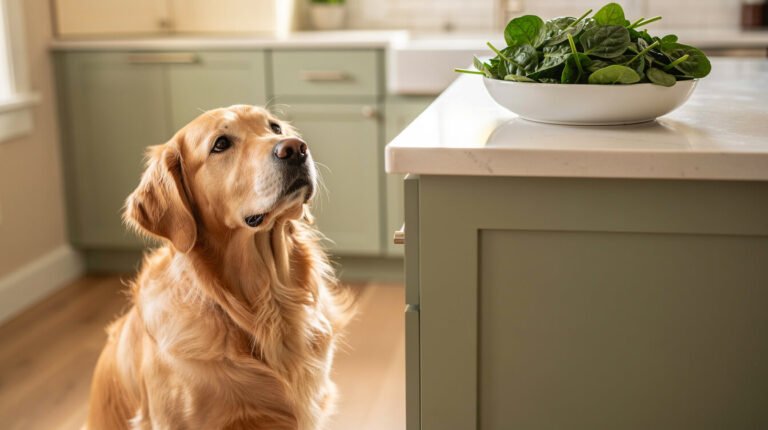
Can Dogs Eat Collard Greens? Plain vs. the Pot, the Oxalate Mix-Up, and How Much to Share
Can dogs eat collard greens? Yes. Plain collards, cooked soft and chopped small, are a safe, low-calorie extra for most healthy dogs. The catch is that collards almost never reach the table plain. The pot on a Thanksgiving or Sunday stove usually holds a smoked ham hock, bacon fat, onion, garlic, and plenty of salt, and the scoop your dog is begging for carries all of it.
So the honest answer depends on which collards you mean. Below we cover the leaf itself; what’s actually in the family pot and the store cans (we read the labels on 77 collard products); the oxalate question, where the top-ranking advice contradicts its own sources; how to prepare collards for a dog; a starting portion by size; and the dogs who should skip them.
Can dogs eat collard greens? The short answer
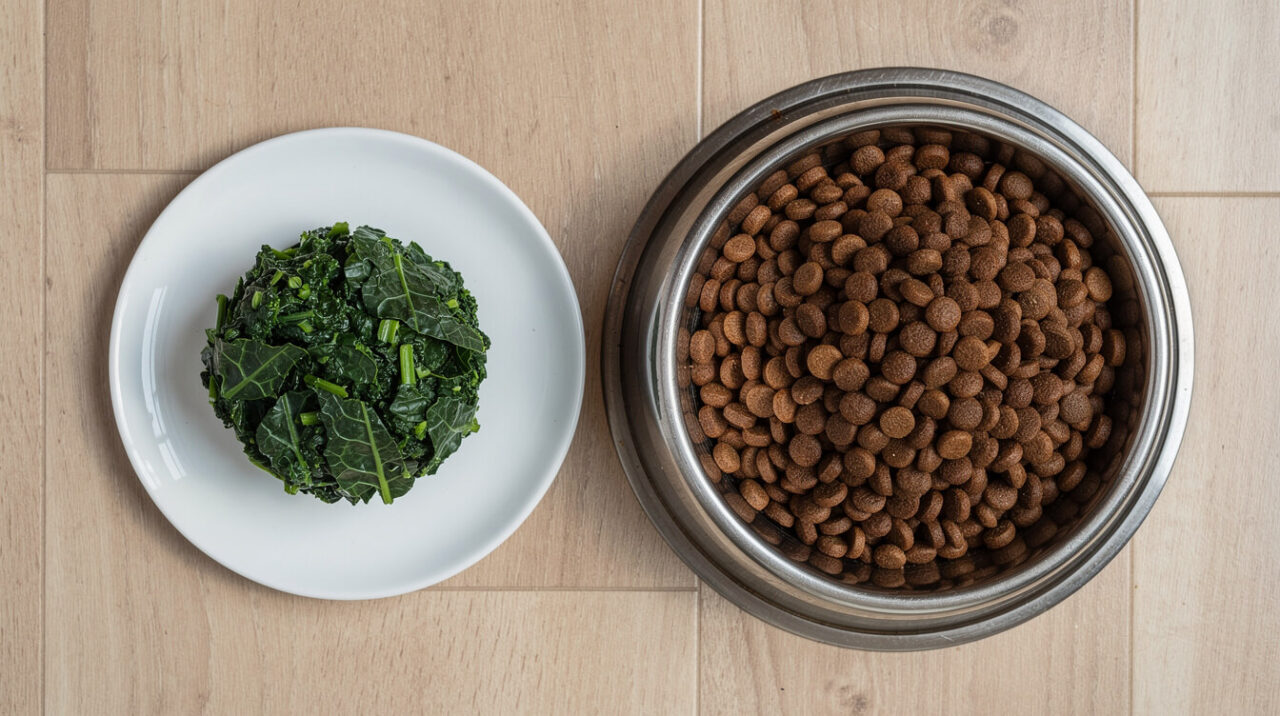
Collard greens aren’t toxic to dogs. They’re a leafy brassica (same species as kale and cabbage), and a dog who snatches a fallen leaf from the cutting board isn’t in danger. When an owner on JustAnswer asked whether their 35-pound dog needed a vet after eating a whole raw collard leaf, stem and all, the general-practice vet said no: collards “aren’t toxic or anything” but can cause stomach upset, and diarrhea from the fiber was the most likely result.
Plain cooked collards are also low in calories. USDA data puts boiled, drained collards (no salt) at 33 kcal per 100 g, about 63 kcal per chopped cup, with 4 g of fiber per 100 g and almost no fat or sodium (15 mg per 100 g) (FoodData Central 170407). They also carry real calcium, vitamin A, and a lot of vitamin K.
None of that makes collards necessary. A dog on a complete and balanced diet already gets every one of those nutrients from their food. Collards are a treat you can share, not a supplement your dog is missing.
Here’s the whole answer in four lines:
- Plain, cooked soft, chopped small: yes, in small amounts.
- Raw: not dangerous, just hard to digest. Expect gas or loose stool if your dog eats much of it.
- From the family pot or a seasoned can: no. The onion, garlic, pork fat, and salt are the problem, not the greens.
- Dogs with a history of bladder stones, pancreatitis, or a prescription diet: ask your vet first.
Plain collards vs. the pot on the stove
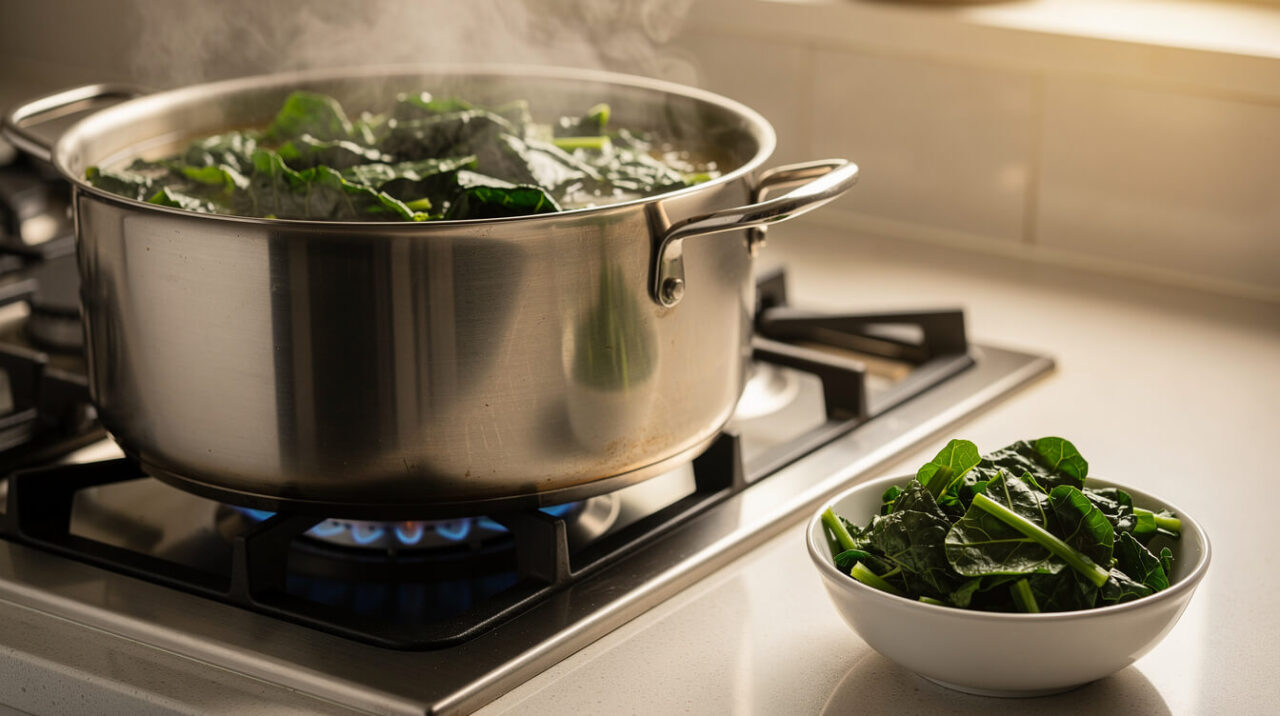
Most articles stop at “don’t add seasoning.” That undersells it, because in Southern cooking the seasoning is cooked into the greens for an hour or more. You can’t rinse it off afterward.
What one serving of ham-hock collards carries
Take a typical, well-loved recipe: All Things Mamma’s Southern collard greens with ham hocks. It makes 4 servings from about 2 pounds of collards, 1½ pounds of smoked ham hocks, 3 tablespoons of bacon fat, 1 large onion, 6 garlic cloves, seasoned salt, and chicken broth. The recipe card lists each serving at 303 kcal, 24 g fat, and 1,465 mg sodium.
Here’s what that means for a dog:
- Fat is the biggest concern. 24 g of fat in 303 kcal works out to roughly 79 g of fat per 1,000 kcal. The Merck Veterinary Manual’s diet for dogs with pancreatitis keeps fat under 20 g per 1,000 kcal, and Merck names dietary indiscretion as “a common risk factor” for pancreatitis in dogs (Merck). For a 20-lb dog, one full serving is also about half a day’s calories.
- The onion and garlic are real but dose-dependent. A large onion weighs about 150 g (USDA) and a garlic clove about 3 g, so each serving holds roughly 37 g of onion and 4.5 g of garlic, assuming they’re spread evenly through the pot. Merck reports clinical signs in dogs after 15–30 g of onion per kg of body weight, and says garlic is “3–5 times more toxic than onion” (Merck). Counting the garlic as 3–5 times onion, one serving holds the equivalent of about 51–60 g of onion. That’s roughly 40% of the lower threshold for a 20-lb dog and 75–90% for a 10-lb dog. That threshold is a reported level, not a safe line below which nothing happens, and the damage builds over repeated days of leftovers.
- Salt matters less for a single serving. 1,465 mg of sodium is about 3.7 g of salt. Merck notes toxicosis signs in dogs can appear after 2–3 g of salt per kg (Merck), so a 10-lb dog would need two or more full servings to get there. A bowl of salty pot liquor is still a bad idea, especially for small dogs or dogs with heart or kidney disease.
- The hock itself is a separate hazard. The hock is a cooked bone in a fatty, salty package. If your dog gets the hock bone, call your vet rather than waiting to see.
What store-bought collards contain
We pulled every collard product in the USDA’s Branded Foods database (FoodData Central) and set aside soups, juices, chips, wraps, and meals. That left 77 collard green products, which split cleanly into two groups:
- 62 plain products (fresh, frozen, or canned collards, sometimes with water). Median sodium was 26 mg per 100 g, and only 2 listed added salt. These are as dog-friendly as fresh leaves.
- 15 seasoned products (“seasoned,” “Southern style,” “specially seasoned”). All 15 list onion or garlic, and 11 list them in dried, dehydrated, or powdered form. Merck notes that toxicosis in dogs and cats is “most commonly associated with ingesting concentrated forms.” 8 of the 15 list bacon, bacon fat, pork, or ham broth, and 2 more use turkey. 13 of the 15 carry 371–719 mg of sodium per ½-cup serving.
The practical rule is simple. If the can or bag says “seasoned” or “Southern style” anywhere on the front, it isn’t for your dog. If the ingredient list reads “collard greens” or “collard greens, water,” it’s fine to cook for them.
The same pattern shows up across the holiday table. Our guides to stuffing and cornbread walk through the onion and fat math for the other two Southern sides most likely to share a plate with collards.
Collard greens and oxalates: why the sources disagree
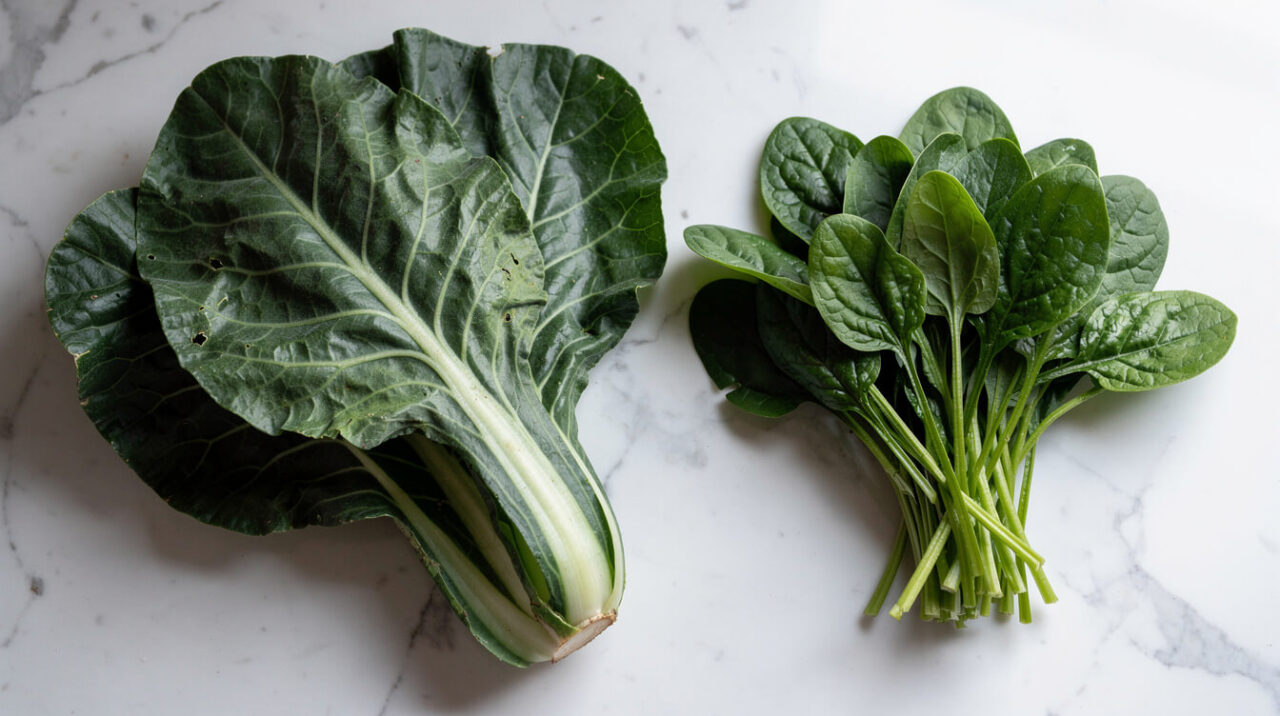
This is where the top-ranking advice gets muddled. One widely read article says collards “have high amounts of calcium oxalate, which can cause kidney stones in some dogs.” Another says collards are “particularly high in oxalates, containing 10 mg in one cup.” A third says they “sit lower on the oxalate scale than chard or spinach.” They can’t all be right, so we went to the oxalate tables themselves.
What the oxalate tables actually say
- The Oxalosis & Hyperoxaluria Foundation’s food list puts boiled or steamed collards at 21 mg per ½ cup, which falls in its “low” band (under 25 mg per serving). Raw collards come in at 6 mg per cup. Boiled spinach on the same list: 493 mg per ½ cup, about 23 times more.
- The UCI Kidney Stone Center’s sheet (the source behind that “10 mg in one cup” line) does label collards “High” at 10 mg per cup. But the same sheet lists cooked spinach at 755 mg per ½ cup, and a single tangerine at 10 mg also earns “High.” That sheet grades foods for people managing kidney stones, where the bands are tight, so a “High” there isn’t the same thing as a lot.
Both tables point the same way. By weight, collards are a low-to-modest oxalate green, nowhere near spinach or chard. The “particularly high” claim comes from quoting a category label without the number next to it.
What the stone guidelines say
For dogs prone to calcium oxalate stones, the 2016 ACVIM consensus statement on uroliths (Lulich et al.) focuses its prevention advice on three things: keeping urine dilute (high-moisture food, more water), avoiding urine-acidifying diets, and avoiding excessive protein. It doesn’t single out leafy greens. VCA’s owner handout tells stone-formers to avoid “high oxalate foods such as nuts, rhubarb, beets, green beans, and spinach” (VCA). Collards aren’t on that list.
There’s one twist almost nobody mentions. The thing collards get praised for, calcium, is also a stone question. Merck lists decreased calcium, along with decreased protein and sodium, among the dietary factors that discourage calcium oxalate stones (Merck). So for a dog who has had stones, the question isn’t really “how much oxalate,” it’s “does anything belong next to the prescription diet,” and that’s a call for the vet managing them.
For a healthy dog, the oxalate in a spoonful of cooked collards isn’t something to worry about. If you’ve read our raw spinach guide, collards are the far easier green on this one point.
How to prepare collard greens for a dog: raw, cooked, stems, and potlikker
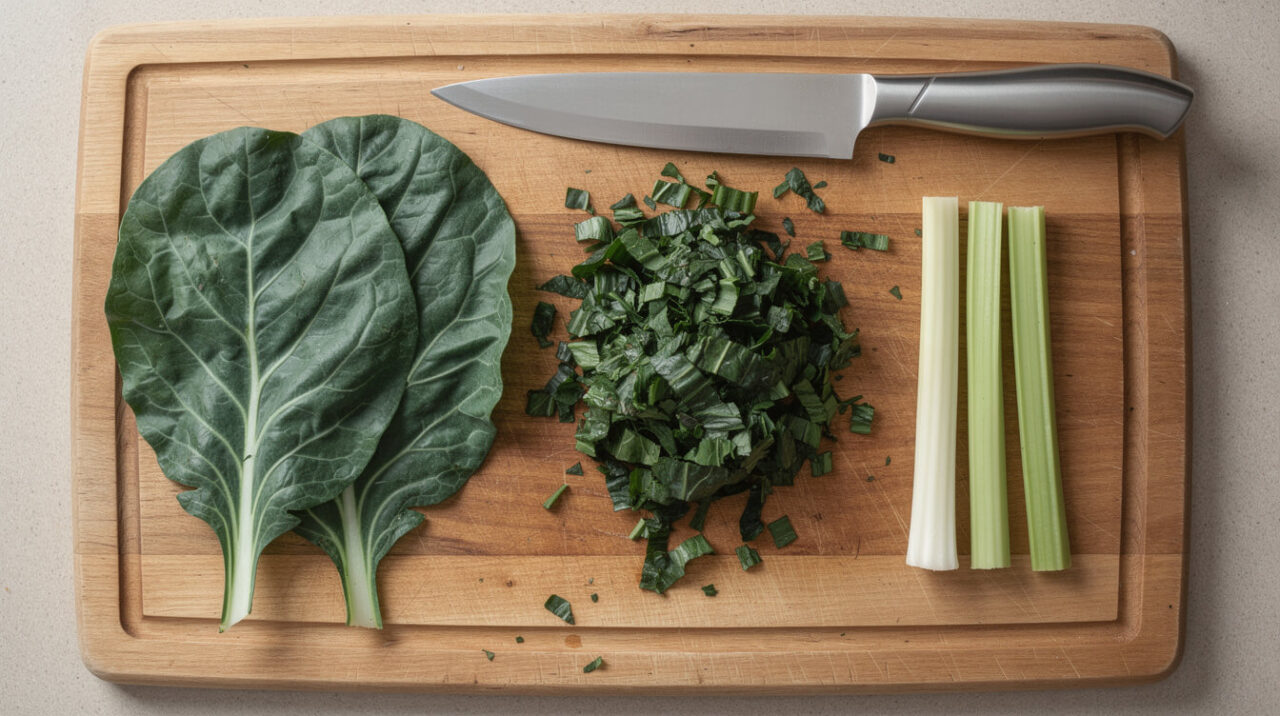
The sources disagree on preparation too. One says never feed collards raw, a UK nutritionist says chop them “ribs and all,” and the vet in that JustAnswer thread says a raw leaf just means some stomach upset. Here’s how it sorts out.
Raw vs. cooked
Raw collards aren’t harmful, but they are tough. A dog’s teeth shear rather than grind, so big raw pieces tend to pass through barely changed, sometimes with gas or loose stool on the way. Cooking the leaves until they’re soft makes them easier to digest, and boiling has a bonus. In a 2005 study of nine vegetables, boiling cut soluble oxalate by 30–87% (steaming, 5–53%), and almost all of the lost oxalate turned up in the cooking water. That range spans several vegetables rather than a collard-specific measurement, so treat it as a direction, not a number for your pot.
The stems
The center rib stays fibrous and stringy long after the leaf goes soft. A dog who gulps a long strip of it may gag or bring it back up. Strip the rib out before cooking (run a knife along both sides of it), or chop it very fine and cook it longer than the leaves.
The potlikker
Potlikker, the broth left in the pot, is the most prized part of a Southern pot of greens, and it’s exactly the part to keep away from a dog. It’s where the ham-hock fat, salt, and onion end up. Per the cooking study above, it’s also where the oxalate goes. Even in a plain pot, pour the water off before you serve your dog.
A simple dog-safe method
- Wash the leaves well (collards hold grit).
- Strip out the center ribs.
- Chop the leaves small, roughly fingernail-sized pieces.
- Boil or steam in plain water until fully soft, usually 10–15 minutes for chopped leaves.
- Drain, discard the water, and cool completely.
- Serve plain: no salt, butter, oil, vinegar, pepper flakes, onion, garlic, or broth.
Cooked plain collards keep in the fridge for a few days. You can also freeze tablespoon-sized portions in an ice cube tray.
The weekly care guide
Get it right for your animal, every week
One email a week: new care guides, species deep-dives, and the safety answers keepers search for, written by our specialists. No spam. Unsubscribe anytime.
How much collard greens can a dog eat?

There’s no published serving size for collard greens in dogs. They aren’t a required nutrient, so nobody has set a target. Most articles fall back on the 10% rule (treats should make up no more than 10% of daily calories), but for a food this low in calories, that rule allows far more than any dog’s gut will thank you for.
What the 10% rule would allow
Here’s that math, using the standard 1.6 × resting-energy estimate for a neutered adult dog and USDA’s 63 kcal per cup of cooked collards:
| Dog weight | Approx. daily calories | 10% treat budget | Cooked collards that would fill it | Fiber in that amount |
|---|---|---|---|---|
| 10 lb (4.5 kg) | ~345 kcal | ~35 kcal | ~½ cup | ~4 g |
| 20 lb (9 kg) | ~590 kcal | ~59 kcal | ~1 cup | ~7 g |
| 40 lb (18 kg) | ~980 kcal | ~98 kcal | ~1½ cups | ~12 g |
| 70 lb (32 kg) | ~1,500 kcal | ~150 kcal | ~2⅓ cups | ~18 g |
A cup of brassica greens for a 20-lb dog isn’t a treat. It’s a recipe for gas and soft stool. With collards, the limit is fiber and fermentation, not calories.
A sensible starting portion
Here’s a starting test, not a published dose, for plain, cooked, chopped collards:
- Under 10 lb: 1–2 teaspoons
- 10–25 lb: about 1 tablespoon
- 25–50 lb: about 2 tablespoons
- 50 lb and up: 3–4 tablespoons
Offer it once, on its own (not on a day with other new foods), and watch for the next day or two. The likely outcomes are nothing at all, a bit of extra gas, or a softer stool. Gas and a slightly soft stool mean the portion was too big, so drop back. Repeated vomiting, diarrhea lasting more than a day, a painful belly, or lethargy aren’t “too many greens” signs. Call your vet.
If your dog does well, plain collards can be an occasional topper a few times a week. Keep everything outside the complete meal, collards and every other extra combined, inside that 10% calorie budget. Our celery guide uses the same start-small approach for another fibrous green.
A dog-safe way to share collards this holiday
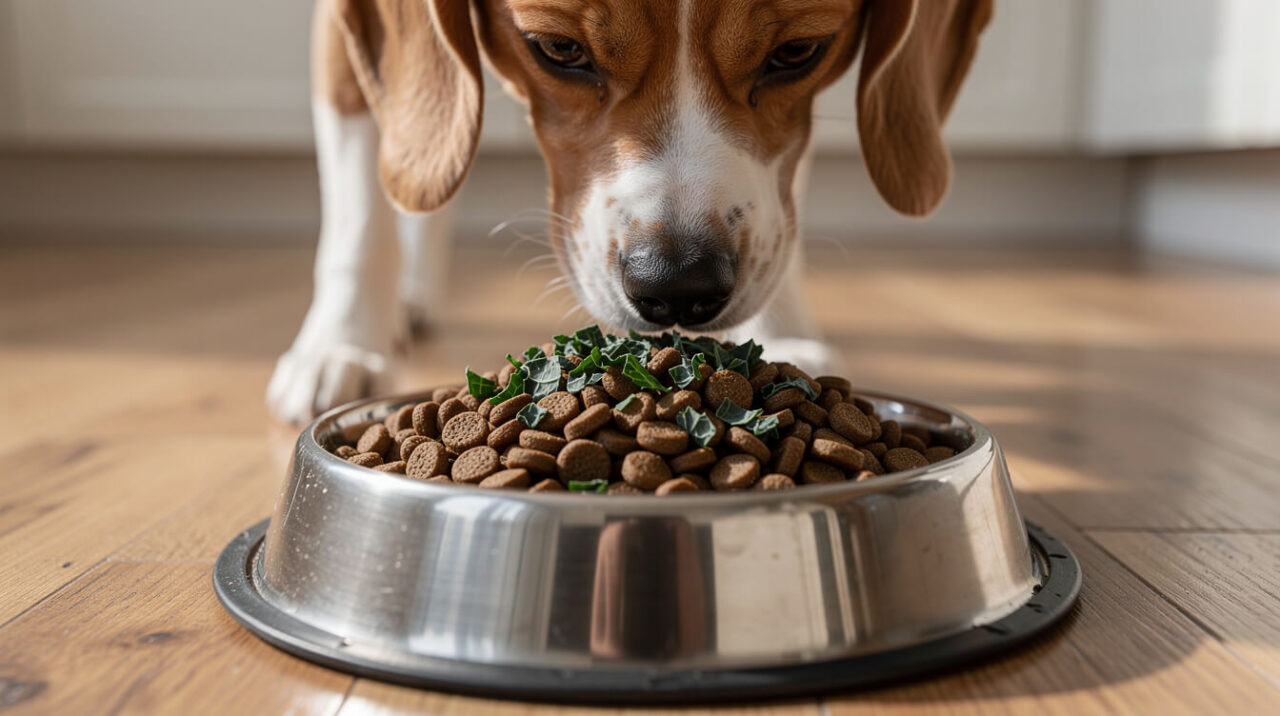
This is the good part. Collards are one of the easiest holiday foods to share safely. It just takes one decision made early, before the ham hock goes in.
Set some aside before the seasoning
When you’re prepping the greens, pull out a handful of washed, de-ribbed leaves before they go into the pot. Steam or boil them plain in a small saucepan while the main pot simmers, drain, chop, and cool. Now your dog has their own “collards” on the holiday plate, made from the same bunch as everyone else’s and with none of the pork fat, salt, or onion.
A dog under the table next to a beardie on the basking rock is a very GeoZoo holiday, and our Bearded Dragon Crown Sunglasses King T-Shirt is made for exactly that kind of multi-species household.

Wear the obsession
The Bearded Dragon Crown Sunglasses King T-Shirt: a crown, shades, and total basking-rock confidence. For keepers with more than one species watching the holiday kitchen.
Ways to serve it
- As a topper: stir the starting portion into their regular food.
- Frozen: press chopped cooked collards into an ice cube tray with a little water. A cube makes a cool, slow treat.
- Mixed with other plain sides: a little plain cooked sweet potato or plain pumpkin works too. Just count all the extras together. Our yams guide and mashed potatoes guide cover which versions of those sides are actually plain.
Tell the guests
The biggest holiday risk isn’t the bowl you prepared. It’s the well-meaning relative who slides a forkful of pot greens, a corner of cornbread, and a strip of ham under the table. A quick “she’s already had her collards, please don’t feed her” at the start of the meal prevents most of it.
Dogs who should skip collards, and when to call your vet

Plain collards are fine for most healthy dogs, but check with your vet first if your dog falls into any of these groups.
Dogs to check with your vet first
- Dogs with a history of calcium oxalate bladder stones. Merck notes that small breeds, including the Miniature Schnauzer, Chihuahua, Bichon Frise, Yorkshire Terrier, Shih Tzu, and Lhasa Apso, are more commonly affected, though any breed can be. Collards are low in oxalate for a green, but they’re also rich in calcium, and a dog on a stone-prevention plan shouldn’t get extras unless their vet says so.
- Dogs on any prescription diet (urinary, kidney, GI, or an elimination trial for allergies). Even a “harmless” vegetable can throw off a diet trial or a carefully balanced formula.
- Dogs with a history of pancreatitis. Plain collards aren’t the issue there, but these are exactly the dogs for whom one sneaked spoonful of pot greens matters most.
- Dogs with sensitive stomachs or recovering from GI upset. Wait until stools are back to normal, then start at the bottom of the portion range.
- Dogs with a diagnosed thyroid condition. Brassicas come up in conversations about thyroid health. We couldn’t find a study showing treat-sized amounts of cooked collards change thyroid function in dogs, but the vet managing your dog’s thyroid is the right person to settle it.
When to call your vet
Call your vet, or an animal poison control line, if your dog:
- Got into the pot or a seasoned can, especially a small dog or a large amount. Onion damage to red blood cells builds over a few days. Merck notes oxidative changes begin within 24 hours and the red-cell breakdown typically shows up 3–5 days after exposure, so a dog who seems fine that evening isn’t necessarily in the clear. Weakness, pale gums, reddish-brown urine, or fast breathing in the days after a holiday meal need a vet.
- Ate the ham hock or any cooked bone.
- Shows signs that could be pancreatitis after a fatty meal: repeated vomiting, a hunched or painful belly, refusing food, or lethargy.
- Has diarrhea lasting more than a day, any blood in vomit or stool, or straining to urinate.
Don’t try to make your dog vomit at home unless a vet tells you to. The ASPCA Animal Poison Control Center (888-426-4435) and Pet Poison Helpline (855-764-7661) are both staffed around the clock (a consultation fee applies).
Can dogs eat collard greens? Frequently asked questions
Can dogs eat raw collard greens?
Raw collards aren’t toxic, but they’re tough and hard for a dog to break down. Expect gas or a loose stool if your dog eats much of them. A dropped leaf is nothing to panic about. If you’re sharing on purpose, cook the leaves soft and chop them small.
Can dogs eat canned collard greens?
Only if the label lists nothing but collards and water. In our scan, all 15 “seasoned” or “Southern style” collard products listed onion or garlic, and 8 listed bacon, bacon fat, pork, or ham broth. Plain canned or frozen collards are fine. Drain and rinse them first.
Can dogs eat collard greens cooked with bacon or ham hock?
No. The greens soak up the pork fat, salt, and onion they’re cooked with. One serving of a typical ham-hock recipe carries 24 g of fat, roughly four times the fat density Merck recommends for dogs recovering from pancreatitis. Set plain leaves aside before seasoning instead.
Are collard greens high in oxalates?
Not for a leafy green. Cooked collards come in around 21 mg of oxalate per ½ cup on the Oxalosis & Hyperoxaluria Foundation’s list, compared with 493 mg for boiled spinach. Dogs with a history of calcium oxalate stones should still get their vet’s OK before any extra food.
Can puppies eat collard greens?
A small taste of plain, well-cooked collards is unlikely to hurt a healthy puppy. Growing puppies have small stomachs, though, and they need that space filled with a complete puppy diet. Keep it to a taste, not a habit.
Will collard greens give my dog gas?
They can. Collards are a brassica with fermentable fiber, and the amount of gas tends to track the size of the serving. If your dog gets noticeably gassy, the portion was too big.
Are collards better for dogs than kale or spinach?
Each has its trade-offs. Collards and kale are both low-oxalate brassicas. Spinach is much higher in oxalate but softer and easier to serve. None of them is necessary for a dog on a complete diet. Pick whichever you have plain, cook it soft, and keep the portion small.
The short version: collard greens are a good dog food as long as they’re just collards. Set a few leaves aside before the ham hock goes in, cook them plain, start with a spoonful, and your dog gets a holiday side of their own.
Before you go
Keep learning your animal
We publish a new guide every day. The best of them land in one short weekly email, so you never miss the one about your species.

Meet Jake Harrington, your go-to guru for all things canine. With over 15 years of professional dog training experience, Jake has transformed the lives of thousands of dogs and their owners. His journey began in the bustling streets of a major city, where he discovered his natural affinity for understanding canine behaviors and communication.