Can My Dog Eat Celery? The Safe Portion — and Why Celery Almost Never Arrives Alone
Your dog is staring at you with the focus of a professional athlete, and you are holding a celery stick. It is a fair question to stop and ask: can my dog eat celery? Short answer: yes. Plain, raw celery is not toxic to dogs — the ASPCA lists it among its non-toxic plants — and in small, properly cut pieces it is one of the lowest-calorie treats in your fridge.
But “not toxic” and “go ahead” are not the same sentence, and the honest version of this answer has two parts that most articles rush past. First, the real limit on celery is not calories — it is fiber, and that changes how much you should actually hand over. Second, and this is the part that sends dogs to the vet: celery almost never arrives alone. It shows up with ranch, with peanut butter, with cream cheese and raisins, in the stuffing, in the soup. The stalk is fine. The things we put on and around it are where the risk lives.
Here is the whole picture: the safe portion for your dog’s size, how to cut it, which dogs should skip it, and a dish-by-dish rundown.
Can my dog eat celery? Here’s the short answer
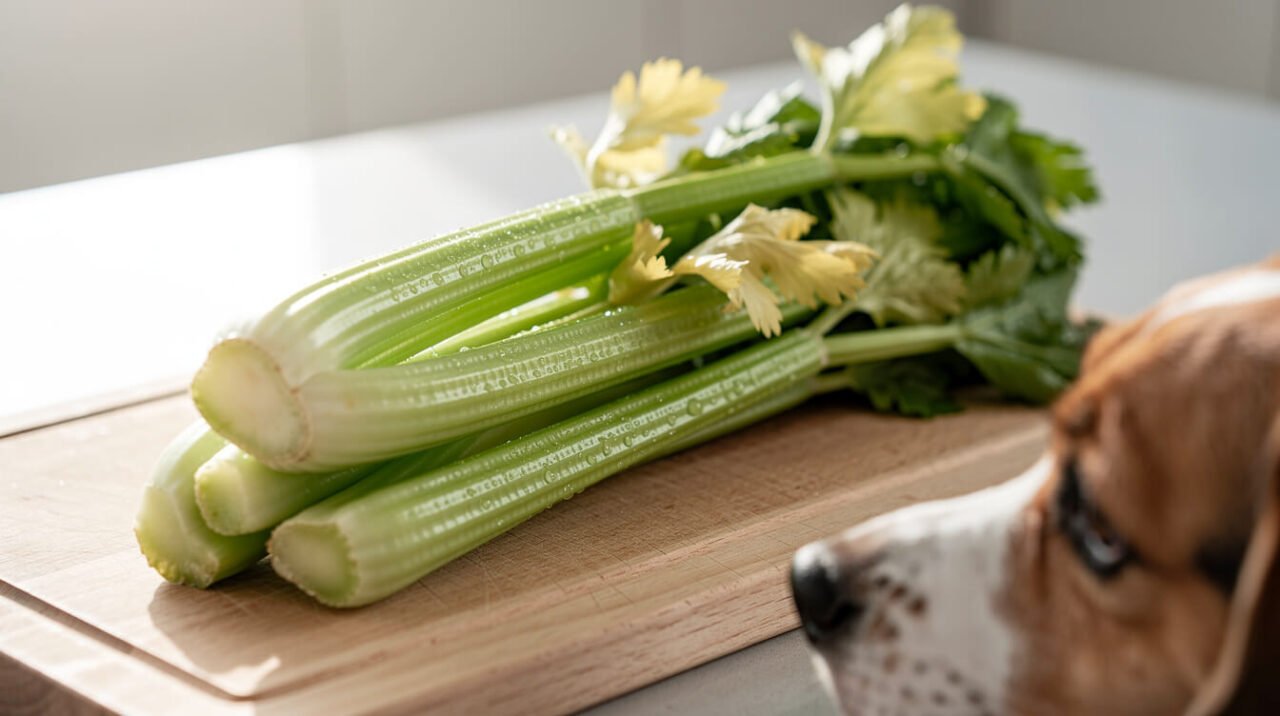
Yes. Plain raw or plain cooked celery, washed and cut into bite-sized pieces, is safe for most healthy adult dogs as an occasional treat. There is no toxic compound in celery for dogs — no allium, no persin, no tartaric acid, none of the things that make us nervous about onions, avocado, or grapes.
What celery mostly offers a dog is crunch and water. It is roughly 95% water, and a medium stalk carries only about 6 to 7 calories. For a dog on a weight-management plan who still wants to participate in snack time, that combination is genuinely useful: you can hand over something with real texture and volume without meaningfully touching their daily calorie budget.
The caveats are all mechanical and digestive rather than toxicological:
- Choking and obstruction. Celery is firm and fibrous. Whole stalks and long chunks are a choking hazard, particularly for small dogs, flat-faced breeds, and the dogs who swallow first and consider later.
- The strings. Those long tough fibers running the length of the rib do not break down much in a dog’s mouth. They can wrap around a tooth or the base of the tongue, or travel through as a stringy wad.
- Fiber overload. Too much celery at once means loose stool, gas, or an uncomfortable night. This is the most common way celery goes wrong, and it is entirely about portion.
- Everything it is served with. See the dish-by-dish section below. This is the big one.
So: a safe yes, with preparation rules. If your dog has a medical condition — heart disease, kidney disease, a history of pancreatitis, or a chronically sensitive gut — talk to your veterinarian before adding any new food, even a harmless-looking vegetable. That is not a formality. Sodium and fiber both matter more in those dogs, and your vet knows the specifics of your dog’s case in a way an article never can.
How much celery can my dog eat? A weight-based starting point
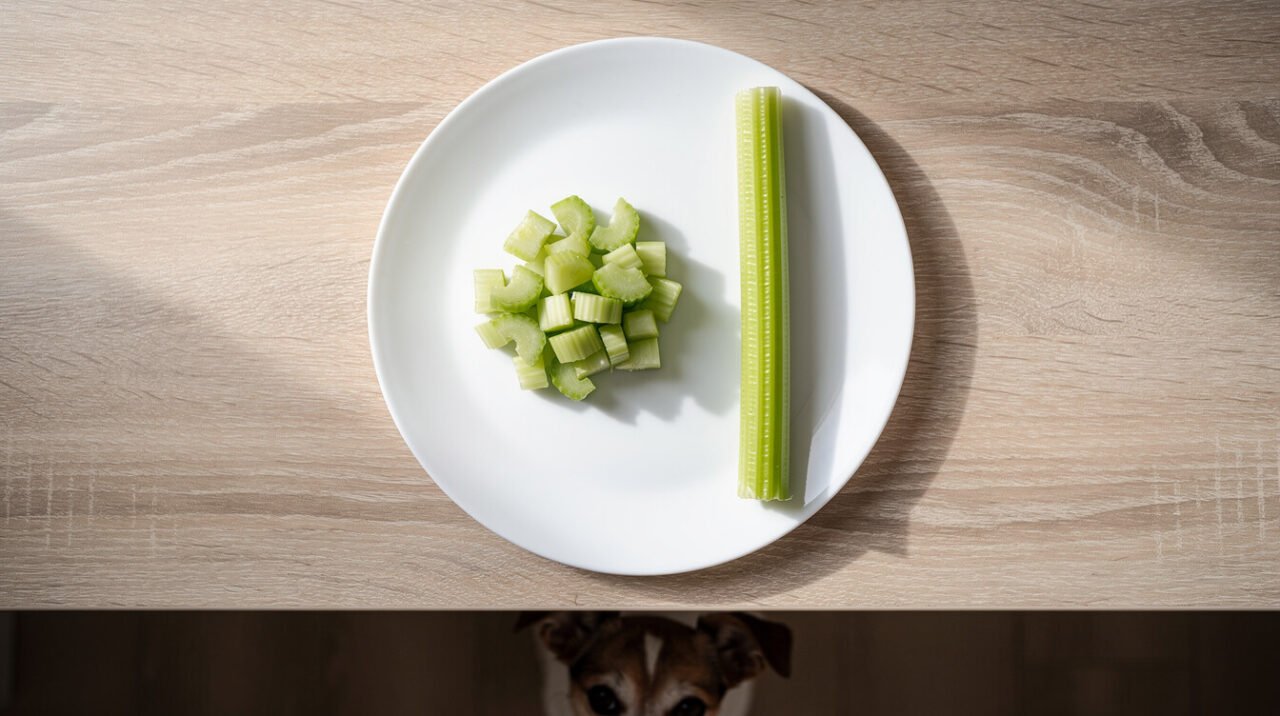
Almost every guide answers this with the 10% rule: treats should make up no more than 10% of your dog’s daily calories. That rule is good practice in general, and with celery it is close to useless. Here is why, with the arithmetic.
A moderately active 30-pound dog needs somewhere in the neighborhood of 700 to 900 calories a day. Ten percent of that is roughly 70 to 90 calories. Raw celery runs about 16 calories per 100 grams. To hit a 10% treat ceiling on celery alone, that dog would have to eat something like 450 to 550 grams of celery — eleven or twelve medium stalks. You would have a very wet, very gassy dog long before you got near the calorie limit.
Which is the actual insight: with celery, the binding constraint is fiber and water volume, not calories. Stop doing calorie math and think about gut load instead. The portions below are starting points for a healthy adult dog who has already been introduced to celery and tolerates it — daily ceilings, not targets.
| Dog’s weight | Piece size | Reasonable daily ceiling |
|---|---|---|
| Under 10 lb (Chihuahua, Yorkie, toy breeds) | ¼-inch dice | 1–2 pieces |
| 10–25 lb (Pug, mini Dachshund, small terrier) | ½-inch dice | 2–4 pieces |
| 25–50 lb (Beagle, Cocker Spaniel, Border Collie) | ½-inch dice | up to about ¼ cup chopped |
| 50–90 lb (Labrador, German Shepherd, Boxer) | ½ to ¾-inch dice | up to about ⅓–½ cup chopped |
| 90 lb and up (Great Dane, Mastiff, Newfoundland) | ¾-inch dice | up to about ½–¾ cup chopped |
Two rules that override the whole table:
Day one is one piece, whatever your dog weighs. A Great Dane meeting celery for the first time gets a single piece, not half a cup. Give it twenty-four hours and look at the stool before you scale up. This is the same gradual-introduction principle we apply to every new food, and it is the single cheapest way to avoid a mess.
Celery counts against the treat budget alongside everything else. If your dog already gets training treats, a dental chew, and the crust of your toast, celery is not free just because it is a vegetable. Our diet and nutrition tips for dogs covers how the pieces fit together, and for a treat where the ceiling really is calories, see our safe popcorn portions by weight.
What celery actually gives your dog — and what it doesn’t
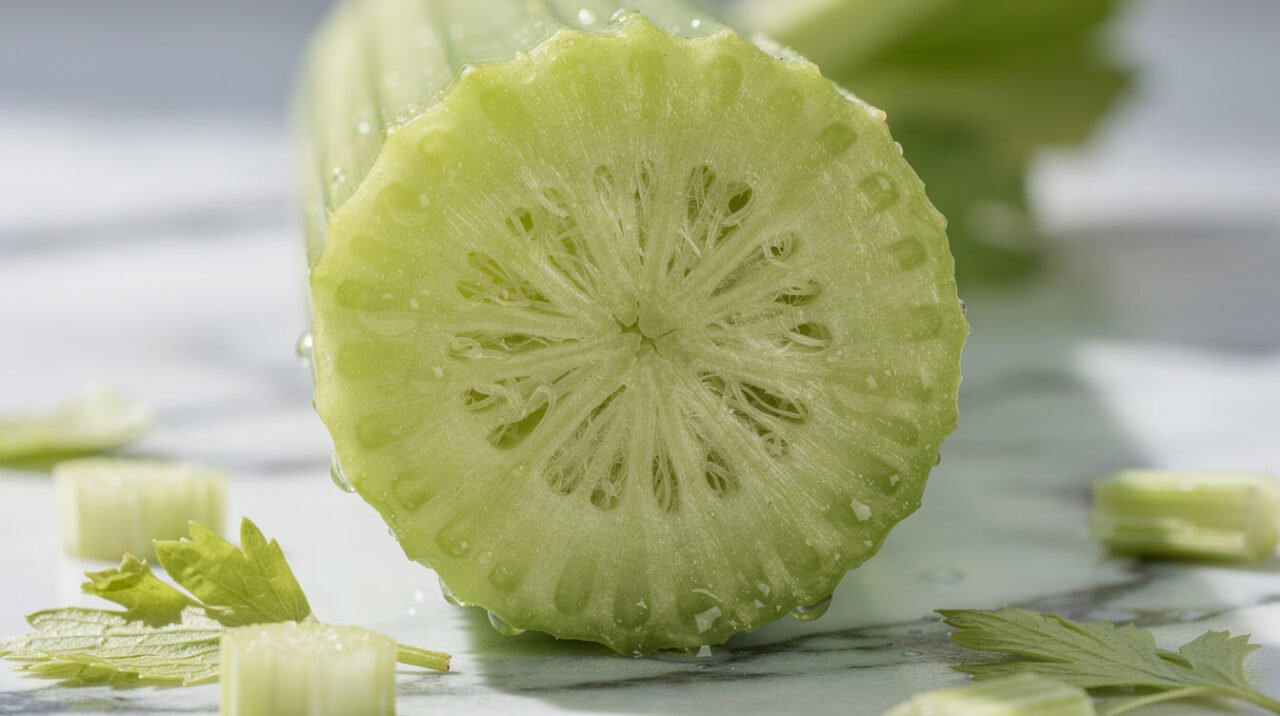
This is where pet-care articles tend to oversell, so let’s be precise about what is in a celery stalk and what that realistically does for a dog eating three small pieces of it.
What it genuinely delivers
- Water. At about 95% water, celery is a legitimately hydrating snack. On a hot afternoon, frozen celery pieces are a nice way to get a bit more fluid into a dog who does not drink enough. Our guide to watermelon for dogs covers the same idea with a fruit most dogs find more exciting.
- Vitamin K. This is celery’s real nutritional standout — it is a solid source relative to its calorie count, and vitamin K matters for normal blood clotting.
- Fiber, in moderation. A little added insoluble fiber can help stool quality. A lot of it does the opposite. The dose makes the difference.
- Potassium and folate. Present in useful amounts, contributing to the overall diet rather than transforming it.
- Volume for very few calories. For an overweight dog, the psychological win of getting a real snack matters, and celery delivers that at close to zero caloric cost.
What gets overstated
Vitamin C. You will read that celery is an “excellent source” of vitamin C. It isn’t — celery is a fairly modest source, and more to the point, healthy dogs synthesize their own vitamin C in the liver. They are not relying on your vegetable drawer for it.
Raw or cooked?
Both are safe plain. They do slightly different jobs. Raw celery is the better choice if you want crunch, hydration, and a long-lasting low-calorie chew. Lightly steamed or pureed celery breaks down those tough plant cell walls, which makes whatever nutrients are inside more available to a dog — dogs are less efficient than we are at extracting nutrition from raw plant matter. If nutrition is the goal rather than entertainment, cooked or blended wins. We walked through the same raw-versus-cooked tradeoff in more detail in our guide to raw spinach for dogs.
One rule for the cooked version: plain means plain. No butter, no salt, no broth, no bouillon, no oil. Steamed in water, that’s it. Which brings us to the part of this question that actually matters.
Why celery almost never arrives alone: the dish-by-dish rundown
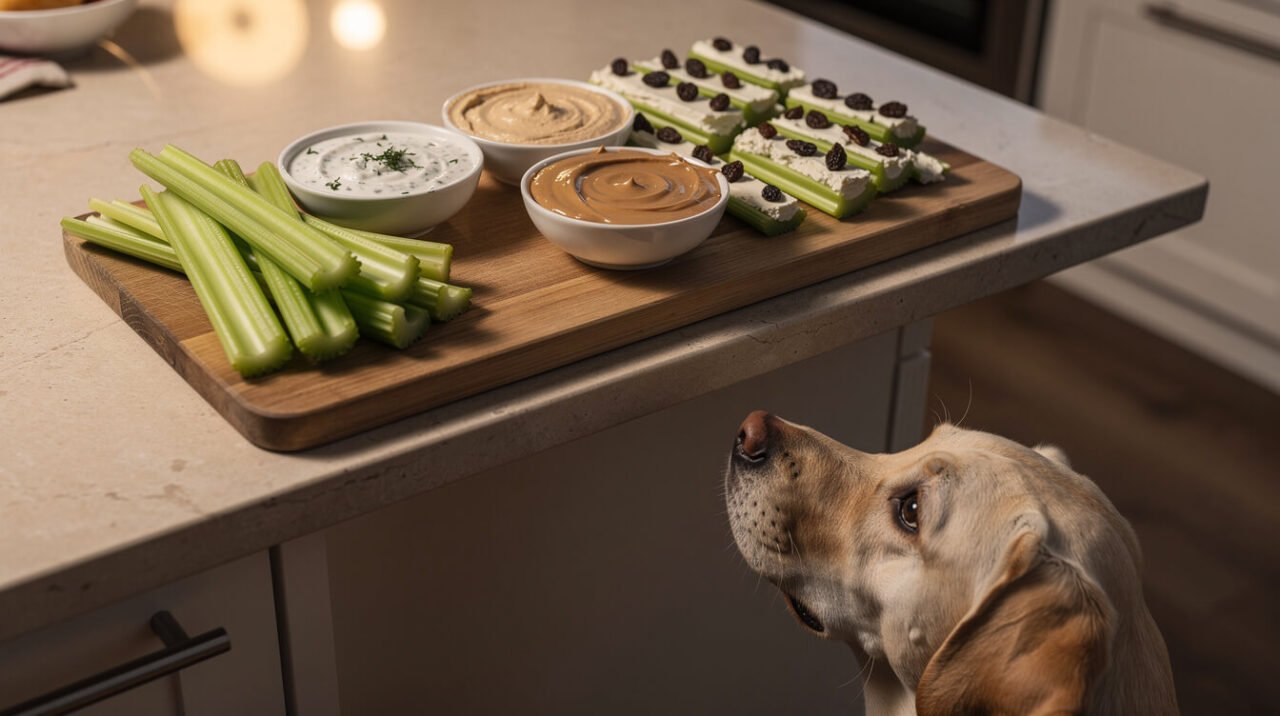
Here is the thing nobody says plainly: almost nobody eats plain celery. We eat it loaded, dipped, stuffed, or simmered into something. So when a dog gets celery, it usually comes with a passenger — and the passenger is the actual safety question. Work down this list.
Ants on a log — check what the ants are
Celery, peanut butter, raisins. Two of those three ingredients are a problem.
Raisins and grapes are genuinely dangerous to dogs. They can cause acute kidney injury, there is no established safe dose, and sensitivity varies unpredictably between individual dogs — small dogs have been seriously harmed by a handful. If your dog ate the raisins off an ants-on-a-log, that is not a wait-and-see situation. Call your veterinarian or a poison control line now. Treat it as urgent even if your dog seems completely fine, because early intervention is what protects the kidneys.
Peanut butter depends entirely on the label. Plain peanut butter whose ingredients are peanuts and maybe salt is fine in small amounts. But some “no sugar added” and “diet” peanut butters are sweetened with xylitol — sometimes labeled as birch sugar — and xylitol is severely toxic to dogs, causing a rapid crash in blood sugar and, at higher doses, liver failure. Read the jar. Every time, including the jar you have had for months.
Ranch, blue cheese, and creamy dips — the fat and salt problem
These are not toxic, but they are a poor idea. A loaded dip is a dense hit of fat and sodium, and a sudden high-fat snack is a recognized trigger for pancreatitis — a painful and sometimes serious inflammation of the pancreas. Dogs with a history of it, and certain breeds that run prone, should get nowhere near the dip bowl. Many ranch and onion dips also carry onion or garlic powder, which takes us to the next item. Our piece on olive oil for dogs gets into why fat load matters more than most owners expect.
Hummus, stuffing, mirepoix, and soup — the onion and garlic problem
This is the risk that hides in plain sight, because the celery itself is innocent.
Onions, garlic, leeks, shallots, and chives all belong to the allium family, and all of them damage dogs’ red blood cells, which can lead to a type of anemia. Powdered and dehydrated forms are more concentrated by weight than the fresh vegetable, which is why a spoonful of soup or a scoop of seasoned stuffing can carry more allium than you would guess.
Celery is a core ingredient in exactly the dishes where allium always shows up:
- Mirepoix — the onion, celery, and carrot base under most soups, stews, and sauces. Onion by definition.
- Thanksgiving stuffing — celery, onion, butter, broth, sage. A bad combination for a dog on several axes at once.
- Chicken noodle and cream of celery soup — onion or onion powder, plus a lot of sodium.
- Hummus — almost always contains garlic.
- Tuna or chicken salad — diced celery, heavy mayonnaise, often onion.
- Bloody Mary garnish — that celery stick has been sitting in alcohol. Alcohol is toxic to dogs.
- Celery salt — predominantly salt. Not a seasoning to share.
The practical rule is simple and easy to remember: if the celery has been cooked with, dipped in, or served alongside anything, it is not dog food anymore. Pull a clean rib off the bunch before you start cooking, chop a few pieces into a separate bowl, and that is your dog’s share. Everything after that point belongs to the humans.
What if a dog just stole a piece off the counter?
If it was plain celery, nothing happens — you have a dog with a crunchy mouthful and a guilty expression. If it had dip, stuffing, or raisins on it, work out as precisely as you can what and how much, then call your vet or poison control. The two lines worth saving in your phone before you need them: the ASPCA Animal Poison Control Center at (888) 426-4435 and the Pet Poison Helpline at (855) 764-7661. Both charge a consultation fee, both are staffed around the clock, and both are worth it at 11pm when you are standing in your kitchen trying to decide whether this is an emergency.
The weekly care guide
Get it right for your animal, every week
One email a week: new care guides, species deep-dives, and the safety answers keepers search for, written by our specialists. No spam. Unsubscribe anytime.
How to prep celery safely: cut size, strings, and the dogs who should skip it
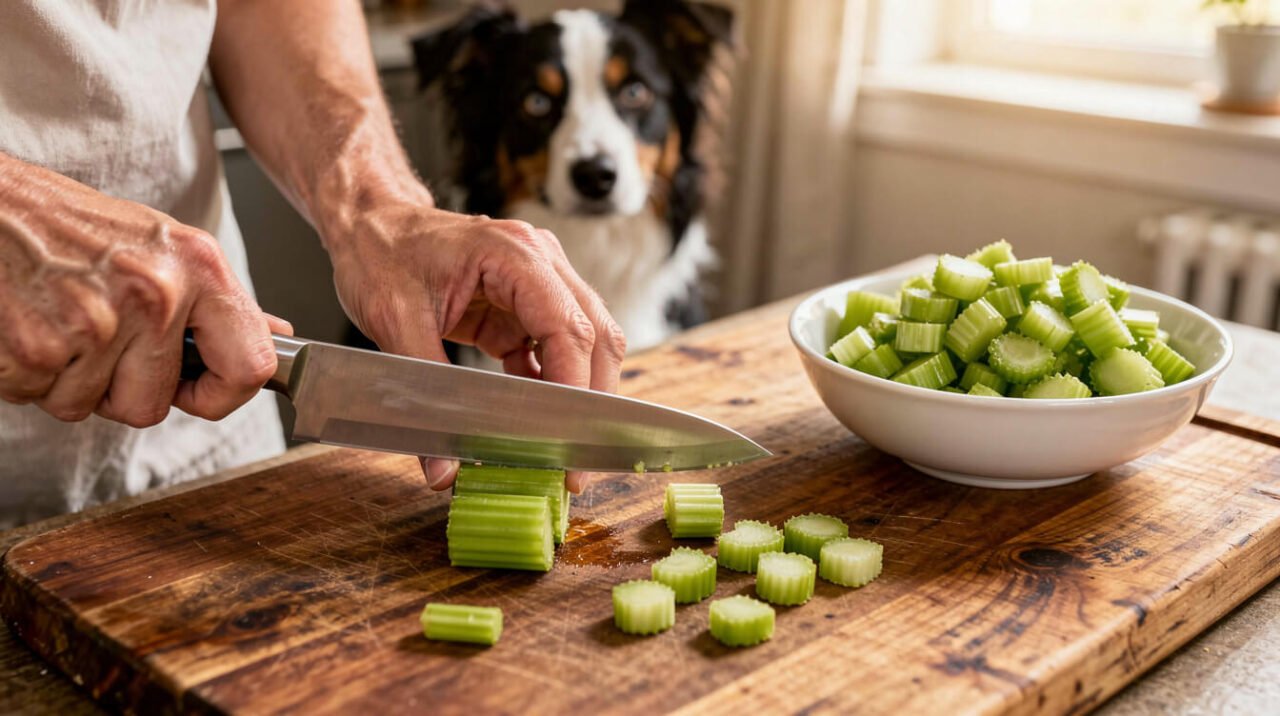
Celery prep takes about ninety seconds and removes nearly all of the risk. Here is the whole routine.
- Wash it properly. Celery’s ribbed, cupped shape traps soil and residue, and it consistently ranks among the higher-residue items in conventional produce testing. Rinse under running water and rub the ribs with your fingers; if you buy organic, wash it anyway.
- Trim the base and separate the ribs. The pale knob at the bottom holds the most grit.
- Deal with the strings. Run a vegetable peeler once down the rounded outer side of the rib. It lifts off the toughest fibers in one pass and takes five seconds.
- Cut across the grain, not along it. This matters more than anything else on the list. Slicing crosswise into short pieces chops those long fibers into harmless lengths. Cutting lengthwise into sticks leaves them full-length, and full-length strings are the ones that wrap around teeth.
- Size the pieces to your dog, not to the recipe. Use the chart above. A piece should be small enough to swallow safely even if your dog does not bother chewing — because plenty of them won’t.
- Serve plain, at room temperature or frozen. Frozen celery pieces make a nice hot-weather treat. Stuff a hollow chew toy with plain plain-yogurt-and-celery if your dog likes a project.
The dogs who should skip celery
Nobody needs celery. If your dog is on this list, this is an easy no, and that is not a failure on anyone’s part:
- Dogs on a veterinarian-prescribed sodium-restricted diet, usually for heart or kidney disease. Celery contains more sodium than most vegetables — modest in absolute terms, around 30 mg in a medium stalk, but if a vet is counting milligrams, they should make this call, not you.
- Dogs with kidney disease, where potassium and mineral intake is often being actively managed.
- Dogs with a history of pancreatitis. Plain celery itself is low-fat and fine, but celery is a gateway to dips, and the margin for error is small.
- Dogs with chronic GI issues or on a strict elimination diet. Do not introduce a new fiber source mid-diagnostic-workup — you will muddy the results your vet is trying to read.
- Puppies. Not unsafe, just unnecessary. Young digestive systems are still settling, and a growing puppy’s calories are better spent on a complete age-appropriate diet. If you want to share, one tiny piece and nothing more.
- Serious gulpers and brachycephalic breeds. If your Frenchie or Bulldog inhales food without chewing, firm fibrous vegetables are a higher-risk texture. Cut smaller, or steam until soft.
One aside, since you have read this far: if you are the kind of keeper who peels the strings off a vegetable because you thought about your dog’s teeth, you will recognize the spirit of our shop. It is a small collection and currently leans reptile — so if there happens to be a bearded dragon in the house alongside the dog, the Bearded Dragon Crown Sunglasses King T-Shirt is the one our readers keep picking up. More species are on the way.

Wear the obsession
Our shop is small and currently reptile-first — so this one is for the keepers with a bearded dragon in the house alongside the dog. Soft cotton, printed for people who actually read the care sheet. More species on the way.
Your dog ate too much celery — or the whole dip bowl. What now?

Two completely different scenarios live inside this question, and it is worth being clear about which one you are in.
Scenario one: too much plain celery
This is a digestive event, not a poisoning. Expect the fiber and water to announce themselves within a few hours to a day: loose stool or diarrhea, extra gas, a rumbly stomach, maybe some urgency to go outside, and more urination than usual simply because celery is mostly water. Most dogs ride it out uneventfully.
What to do: hold off on further treats, make sure fresh water is available, keep their regular meals normal unless your vet has told you otherwise, and give their system a day. Resist the urge to withhold food for a long stretch or to start administering anything from your own medicine cabinet — human anti-diarrheals are not safe to give dogs on your own judgment.
Call your veterinarian if the diarrhea runs past about twenty-four hours, if there is blood in the stool, if your dog is vomiting repeatedly, if they seem genuinely lethargic or painful, if the belly looks bloated or feels tight, or if they are trying to vomit without producing anything. Those signs move this out of upset-stomach territory, and a small dog or a puppy can get dehydrated much faster than a big adult dog — call sooner for them.
Scenario two: celery plus something it shouldn’t have had
Different rules. Do not wait for symptoms, because for several of these the whole point of acting early is to intervene before the damage is done.
- Raisins or grapes — call your vet or a poison control line immediately, regardless of how much or how well your dog seems.
- Anything possibly containing xylitol or “birch sugar” — immediately. Blood sugar can crash fast.
- A meaningful quantity of onion, garlic, or seasoned stuffing or soup — call for advice. Allium damage can take a few days to show up in bloodwork, so “he’s fine today” is not reassurance.
- A large amount of rich, fatty dip — call if your dog is vomiting, refusing food, hunched or tucked up in the abdomen, or clearly uncomfortable. Those can be early pancreatitis signs.
- Alcohol, from a cocktail garnish — call. Dogs are far more sensitive to alcohol than people are.
Have the packaging or recipe in front of you when you call, know roughly how much and when, and know your dog’s current weight. That information changes the advice you get. And a note worth saying out loud: nobody is going to judge you for this. Dogs counter-surf. Guests hand things down. This is the most ordinary thing in the world, and the right move is always to make the call.
We are a care-guide desk, not a veterinary clinic — we can tell you what celery is and how it behaves, but anything that looks like illness or an emergency belongs with a veterinarian who can examine your actual dog.
Can my dog eat celery: frequently asked questions
Can my dog eat celery every day?
Within the portions in the chart above, a healthy adult dog who tolerates it well can have a little celery daily. There is no reason they need to, though. Rotating vegetables is more interesting for your dog and spreads out the nutrition — green beans, carrots, and cucumber all sit in roughly the same low-calorie lane.
Can dogs eat celery leaves?
They are not toxic, so a leaf is not cause for concern. But they carry proportionally more surface residue than the stalk, they are bitter, and most dogs decline them anyway. Easier to leave them out.
Can dogs eat celery sticks whole?
Please don’t. A whole stick is the single most common way celery becomes a choking hazard, and the full-length strings are the ones that cause trouble. Cut crosswise into short pieces instead — it takes one extra moment.
Is celery good for a dog’s teeth?
Marginally, at most. Chewing something firm may dislodge a bit of surface debris, but celery does not remove plaque or tartar in any dependable way. Brushing and professional veterinary dental care do that work; celery is a snack, not a dental plan.
Can puppies eat celery?
A tiny piece is not dangerous, but there is no good reason to offer it. Puppies need their calories going toward growth from a complete puppy diet, and their digestive systems are easier to upset. Wait until they are grown.
Can dogs eat cooked celery?
Yes, as long as it is cooked plain — steamed or boiled in water with nothing added. Cooked celery is actually a bit easier for a dog to extract nutrients from. The moment it has been cooked in butter, broth, or alongside onion, it is off the menu.
Is celery juice safe for dogs?
A splash of plain, unsalted, additive-free celery juice is unlikely to hurt a dog, but juicing concentrates the plant and strips out the fiber that made celery a sensible snack in the first place. There is no benefit here worth seeking out, and commercial celery juices often carry added sodium or other ingredients. Skip it and give water.
My dog hates celery. Should I keep trying?
No. Plenty of dogs find celery boring or dislike the texture, and that is a complete answer. Celery is not a nutritional requirement — it is a low-calorie option for dogs who happen to enjoy it. If yours doesn’t, try blueberries or another vegetable they may prefer, or just use their regular kibble as training rewards.
What vegetables are safer bets than celery?
Carrots, green beans, cucumber, and plain cooked sweet potato are all reliable low-calorie options with fewer stringy-fiber complications. Avoid onions, garlic, leeks, and chives entirely, and know that avocado comes with its own set of caveats worth reading before you share any.
The bottom line on celery for your dog
Can my dog eat celery? Yes — washed, cut crosswise into pieces sized to your dog, served plain, and kept to a small daily amount. It is one of the few treats where you genuinely do not have to worry about calories, and one of the better options for a dog who is carrying extra weight but still wants to be part of snack time.
The two things to actually remember: cut across the grain, and pull your dog’s share off the bunch before the dips and the recipes get involved. Get those right and celery is about as low-stakes as sharing human food with a dog ever gets.
And the fact that you stopped to look this up before handing over a vegetable says something good. That instinct — checking first, even on the easy ones — is the same instinct that catches the xylitol on a peanut butter label one day. Keep it.
Before you go
Keep learning your animal
We publish a new guide every day. The best of them land in one short weekly email, so you never miss the one about your species.

Meet Jake Harrington, your go-to guru for all things canine. With over 15 years of professional dog training experience, Jake has transformed the lives of thousands of dogs and their owners. His journey began in the bustling streets of a major city, where he discovered his natural affinity for understanding canine behaviors and communication.