
Can Dogs Eat Blueberries? A Vet-Informed Safety Guide

Can dogs eat blueberries? Short answer: yes — plain, fresh or frozen blueberries are one of the safest fruit treats you can give a dog, in moderation. They’re low-calorie, packed with antioxidants, and most dogs genuinely love them. The nuance most articles skip is how many is actually right for your dog’s size, whether fresh, frozen, or freeze-dried changes the math, and which dogs need a vet’s input before blueberries become a regular thing.
Below, we’ll walk through the benefits, a weight-based portion guide, how the form of the berry (fresh vs. frozen vs. freeze-dried) changes what you’re actually feeding, and the specific situations — puppies, diabetic dogs, dogs prone to bladder stones — where “safe in general” isn’t the same as “safe for your dog.” Your animal, understood.
Can dogs eat blueberries? The quick answer
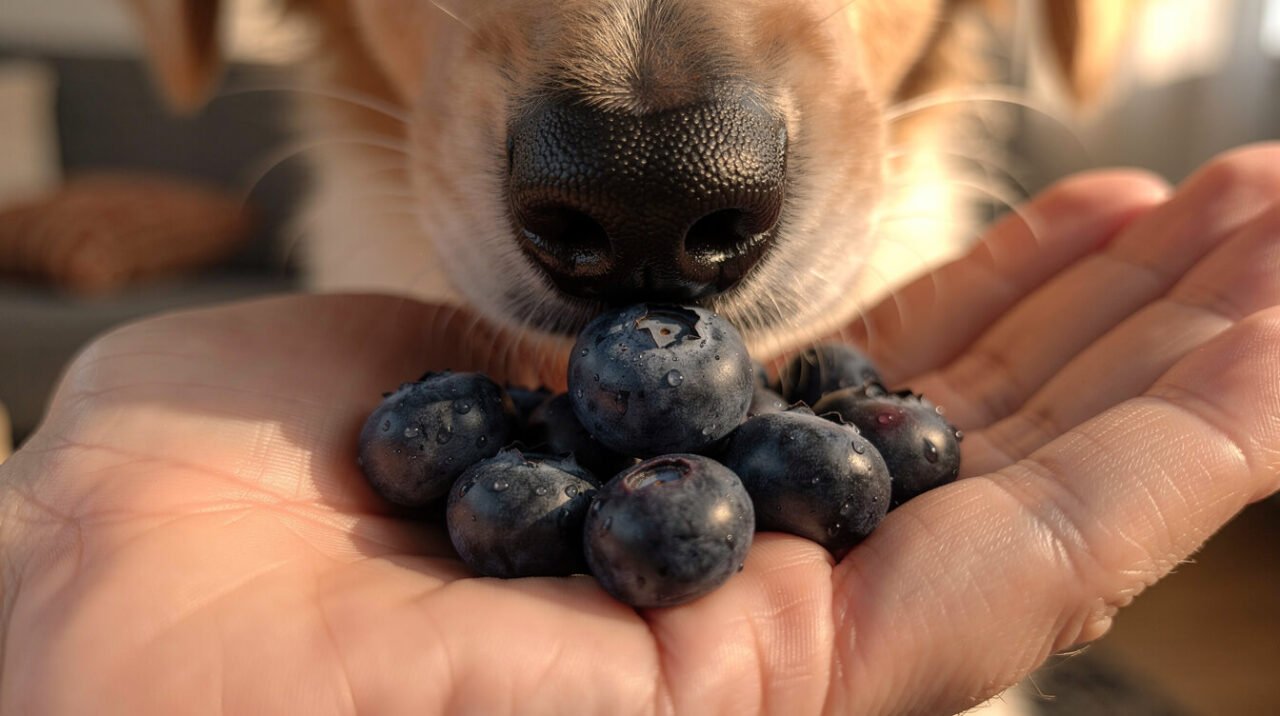
Yes. Fresh or frozen blueberries, served plain and in moderation, are safe for the vast majority of healthy adult dogs. They’re not on any toxic-food list, they’re low in calories, and their small size makes portion control easy once you know the target range for your dog.
What you want to avoid is anything beyond the plain berry: canned blueberries, blueberry pie filling, and blueberry-flavored products with added sugar or artificial sweeteners. Xylitol in particular — a sugar substitute sometimes found in “diet” baked goods and sweetened fruit products — is genuinely dangerous for dogs, so read labels carefully on anything blueberry-flavored that isn’t just the fruit itself.
Blueberries also sit at the safe end of the fruit spectrum for dogs, which is worth saying plainly given how much fear-driven content exists around “can my dog eat fruit” questions in general. Grapes and raisins are genuinely dangerous — linked to acute kidney injury in dogs even in small amounts — and that risk gets lumped into fruit-safety searches often enough that some owners end up unnecessarily nervous about berries too. Blueberries don’t carry that risk. They’re a fundamentally different food, and the caution here is about portion and form, not toxicity.
As with any new food, the honest answer is also: introduce it gradually, watch how your individual dog responds, and check with your veterinarian if your dog has an existing health condition. That’s not a hedge to cover ourselves — it’s genuinely the right first step, because “generally safe” and “safe for your dog specifically” aren’t always the same thing.
Why blueberries are good for dogs
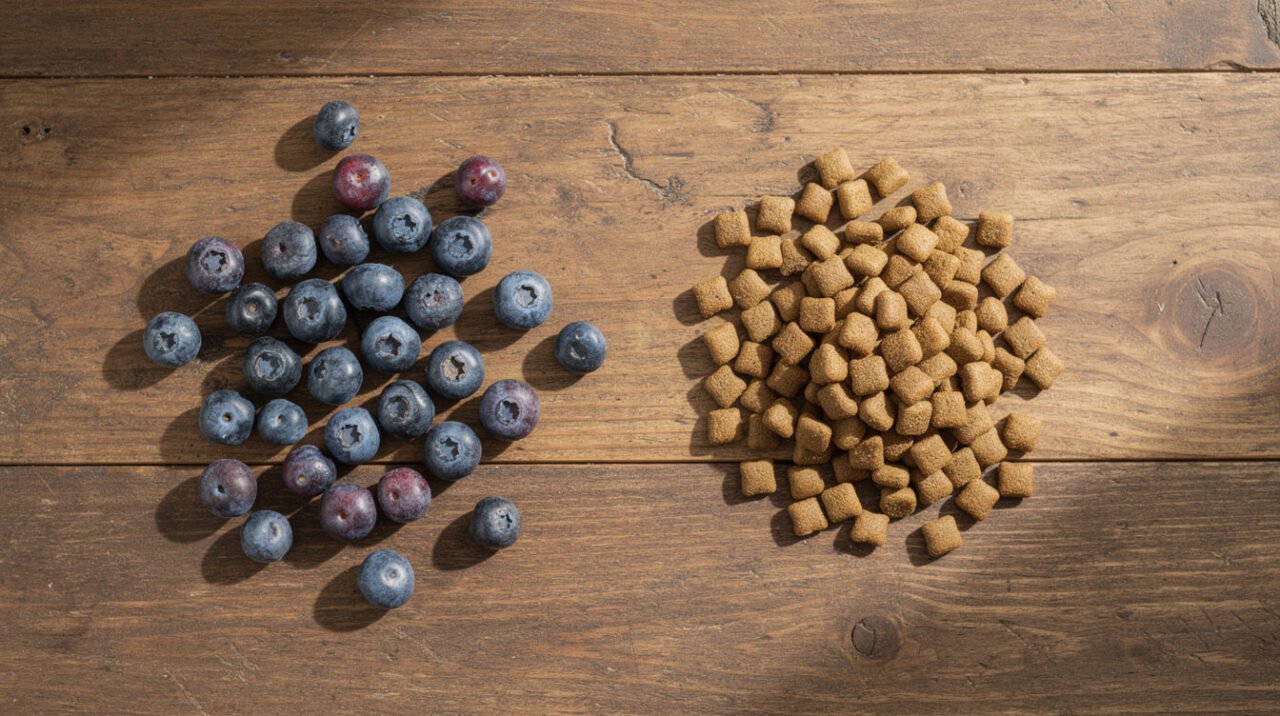
Blueberries earn their reputation as one of the better fruit treats for dogs because of what they bring nutritionally, not just what they don’t bring in toxicity risk.
- Antioxidants. Blueberries are rich in anthocyanins and vitamin C, plant compounds linked to reduced cellular oxidative stress. In dogs, this is most often discussed in the context of senior and working dogs, where some research suggests a supportive role in cognitive function and recovery — supportive, not a substitute for veterinary care.
- Fiber. A modest fiber boost can help support regular digestion, particularly useful as a low-calorie mix-in for dogs already managing their weight.
- Vitamins and minerals. Vitamin K, manganese, and a range of trace nutrients contribute to overall wellness, though — worth saying plainly — a healthy dog eating a complete, balanced dog food isn’t nutritionally deficient without blueberries. Think of them as a bonus, not a requirement.
- Low calorie density. A single blueberry runs close to one calorie, which makes them one of the more forgiving treats for dogs who need to watch their weight, and an easy way to reward frequently during training without blowing the day’s calorie budget.
None of these benefits are dramatic on their own — this isn’t a superfood that changes your dog’s health trajectory. It’s a genuinely good treat choice relative to the alternatives sitting in most pantries, and a better default than most commercial dog treats, which often carry more fat, salt, and filler than a handful of plain berries.
The low-calorie profile is also what makes blueberries a popular choice among trainers working on recall, sit-stay, or any exercise that calls for a high rate of reward. Because a single berry is small enough to deliver quickly and light enough calorically to repeat dozens of times in a session, you can reward generously during training without meaningfully denting your dog’s daily calorie budget — something that’s much harder to do with denser treats like jerky or cheese. If your dog is highly food-motivated, keeping a small container of blueberries in the fridge specifically for training sessions is a genuinely practical use of everything covered above.
How many blueberries can dogs eat? A weight-based portion guide

The standard veterinary guidance for any treat, blueberries included, is that treats should make up no more than about 10% of your dog’s daily calories, with the other 90% coming from a complete and balanced dog food. Blueberries are low-calorie enough that this rarely becomes a real constraint — but it’s useful to translate that percentage into an actual number of berries, because “10% of daily calories” isn’t something you can eyeball at snack time.
Used as a rough, commonly cited starting point across veterinary sources, a size-based daily maximum looks something like this:
| Dog size | Approximate weight | Blueberries per day (rough max) |
|---|---|---|
| Toy | Under 10 lbs | 1–3 berries |
| Small | 10–20 lbs | 3–6 berries |
| Medium | 20–50 lbs | 6–10 berries |
| Large | 50–90 lbs | 10–15 berries |
| Giant | Over 90 lbs | 15–20 berries |
Treat this table as a starting point, not a prescription. Individual factors — your dog’s overall daily calorie needs, activity level, whether they’re managing weight, and any existing health conditions — all shift the real number up or down. If your dog is on a therapeutic or calorie-restricted diet, ask your vet where blueberries fit before adding them in as a regular thing.
A practical way to apply this without counting berries every day: pick the low end of your dog’s range for the first week, watch stool quality and energy, and only move toward the higher end if your dog tolerates it well and you’re comfortable with the extra calories in context of their overall diet.
It’s also worth thinking about blueberries in the context of everything else your dog gets treated with in a day, not in isolation. If your dog already gets training treats, a dental chew, and the occasional bite of your dinner, blueberries need to fit inside that same 10% ceiling alongside those other extras — not stack on top of them. A dog getting a handful of blueberries and a full-size dental chew and a training pouch’s worth of jerky in the same day can end up well over the treat-calorie guideline even though no single item looks excessive on its own. If you’re not sure where your dog’s overall treat load stands, a rough gut-check is easier than it sounds: most treats list calories per piece on the bag, and totaling a typical day’s worth takes a couple of minutes and is worth doing at least once.
Fresh, frozen, or freeze-dried: does the form matter?

Most articles on this topic only compare fresh versus frozen. In practice, freeze-dried blueberry treats — sold as training treats or toppers — are common enough on pet store shelves that the form question deserves a fuller answer.
- Fresh blueberries are the simplest option. Wash them thoroughly to remove pesticide residue and dirt, then offer them whole (for larger dogs) or mashed/halved (for small dogs and puppies, to reduce choking risk).
- Frozen blueberries make a good warm-weather treat and hold their shape well for slow, supervised chewing rather than gulping. For small dogs or dogs that swallow treats without chewing, let frozen berries thaw slightly first, or cut them in half — a frozen berry is harder and rounder than a fresh one, which can make the choking risk this size of fruit already carries slightly worse, not better.
- Freeze-dried blueberries are a different food, nutritionally, from fresh or frozen ones — not because freeze-drying adds anything, but because removing the water concentrates everything else, sugar included, into a much smaller bite. A small handful of freeze-dried berries can pack in meaningfully more sugar per gram than the same volume of fresh fruit. Check the ingredient label on any commercial freeze-dried treat: you want only blueberries listed, with no added sugar, oil, or preservatives, and you should treat the portion size guide above as applying to fewer freeze-dried pieces than fresh ones, since you’re getting a more concentrated dose per bite.
Across all three forms, the same rule applies: plain fruit only. Skip anything canned, syrup-packed, or labeled as a “blueberry” flavored snack rather than the actual fruit — those products are formulated for human taste preferences, not canine safety.
The weekly care guide
Get it right for your animal, every week
One email a week: new care guides, species deep-dives, and the safety answers keepers search for, written by our specialists. No spam. Unsubscribe anytime.
When to be extra careful: puppies, diabetic dogs, and stone-prone dogs

Most of the general “yes, in moderation” guidance you’ll find about blueberries and dogs is written with a healthy adult dog in mind. A few groups genuinely warrant a more careful, vet-first approach — and it’s worth being upfront that even veterinary sources don’t fully agree on all of these, which is exactly why “ask your vet” is the honest answer rather than a formality.
- Puppies. You’ll find real disagreement here: some veterinary sources say puppies can have a berry or two once they’re eating solid food, while others recommend holding off on fruit treats entirely until a puppy is past the most sensitive stage of digestive and nutritional development. Rather than pick a side we can’t verify for your specific puppy, the caring answer is the same one a good breeder or vet would give you: puppies have developing digestive systems and specific nutrient needs for growth, so check with your vet before adding any treat — fruit included — to a young puppy’s diet, and if you do introduce blueberries, start with a single berry and watch closely.
- Diabetic dogs. Blueberries are lower in sugar than many fruits, but they aren’t sugar-free, and a dog managing diabetes needs their carbohydrate intake — treats included — coordinated with their insulin and feeding schedule. Don’t add blueberries to a diabetic dog’s routine without your vet’s sign-off on timing and amount.
- Dogs with a history of calcium oxalate bladder stones. Blueberries contain oxalates, compounds that can play a role in calcium oxalate stone formation in dogs that are already prone to them. This doesn’t mean blueberries are dangerous for the average dog’s urinary health — it means that if your dog has a history of this specific stone type, or is on a vet-prescribed diet to manage it, that’s a conversation to have with your vet before adding blueberries or any new fruit, rather than something to guess about at home.
None of this is meant to make blueberries sound riskier than they are for most dogs — for a healthy adult with no history of these issues, blueberries in the portions above are genuinely low-risk. It’s meant to be honest about the specific dogs where “generally safe” doesn’t automatically apply, because that’s the difference between a content-farm answer and one you can actually trust.
Frequently asked questions
Can dogs eat blueberries every day?
Many healthy adult dogs can have a small, size-appropriate amount of blueberries several times a week without issue, and some owners do offer them daily as a training treat. As long as the amount stays within the 10%-of-daily-calories treat guideline and your dog tolerates them well, daily small amounts are generally fine — but rotating in variety rather than any single treat every single day is a reasonable default for most dogs.
Can dogs eat blueberry muffins or blueberry yogurt?
Not as a rule. Muffins typically contain sugar, butter, and sometimes chocolate or raisins — all things to avoid. Plain, unsweetened dog-safe yogurt with a few fresh blueberries mixed in can be fine in small amounts for dogs that tolerate dairy, but check the yogurt’s ingredient label for xylitol first, since some “no added sugar” yogurts substitute it.
What happens if my dog eats too many blueberries at once?
The most likely outcome is digestive upset — loose stool, gas, or mild vomiting — from the fiber and sugar load, not a medical emergency. Keep an eye on your dog and offer water. If symptoms are severe, don’t resolve within a day, or your dog seems unusually lethargic, call your vet.
Are wild blueberries safe for dogs?
Wild blueberries themselves are safe, but the bigger risk is misidentification — some wild berries that resemble blueberries are toxic. If you’re not confident you can correctly identify a wild berry, don’t let your dog eat it, and stick to store-bought or garden-grown blueberries you know for certain.
My dog ate blueberries off the counter and seems fine — do I need to call the vet?
For a small, unsupervised handful of plain blueberries, most healthy dogs will be fine, and watching for the digestive-upset signs above is a reasonable first step. If your dog ate a large quantity relative to their size, ate anything blueberry-flavored that might contain xylitol, or has an existing condition like diabetes or a history of bladder stones, call your vet or an animal poison control line rather than waiting to see what happens.
Can dogs eat blueberry leaves, stems, or the bush itself?
There’s no established toxicity concern with blueberry plant leaves or stems, but they’re not a food item for dogs either, and aren’t something to intentionally offer. If your dog nibbles some leaves off a backyard blueberry bush during a walk, it’s not typically a reason for alarm on its own — but keep an eye out for any garden chemicals or fertilizers that might have been applied to the plant, since those are the more likely source of a real problem.
Can dogs eat blackberries or raspberries the same way as blueberries?
Generally yes — blackberries and raspberries follow similar safety logic to blueberries: safe in moderation, plain and unsweetened, with the same choking-hazard consideration for small dogs. As with blueberries, stick to the plain fruit, skip anything sweetened or syrup-packed, and keep portions modest relative to your dog’s size.

Wear the obsession
Bearded Dragon Crown Sunglasses King T-Shirt
Price range: $24.99 through $26.99
Shop this designCan dogs eat blueberries? Final thoughts
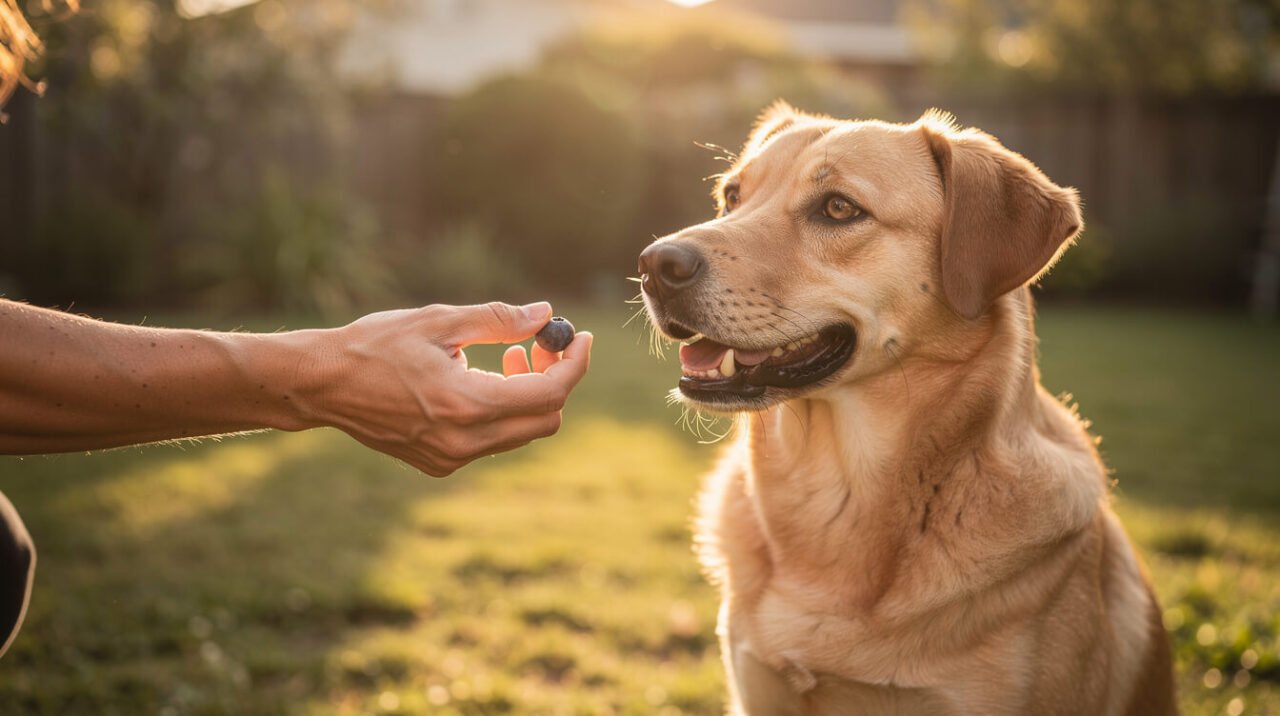
For the overwhelming majority of healthy dogs, blueberries are a genuinely good treat choice — low-calorie, nutrient-rich, and easy to portion once you know your dog’s rough size-based range. Keep them plain, keep the amount in line with your dog’s size, and pay attention to form: fresh and frozen are the simplest choices, while freeze-dried treats deserve a closer look at the label and a smaller portion, since removing the water concentrates everything else.
The dogs worth a vet conversation first are the ones already carrying a health condition where diet matters more than usual — young puppies, dogs managing diabetes, and dogs with a history of calcium oxalate bladder stones. For everyone else, a few blueberries is a safe, easy way to add some variety to treat time. If you’re ever unsure whether a specific amount is right for your dog, that’s exactly what your veterinarian is there for — asking beats guessing, every time.
If you’re building out your dog’s safe-treat list, our guides on whether dogs can eat raw sweet potato and whether dogs can eat quinoa cover two more common kitchen staples with the same weight-based, vet-informed approach. And if cooked proteins are more your dog’s speed, our cooked shrimp safety guide is a good next read.
Before you go
Keep learning your animal
We publish a new guide every day. The best of them land in one short weekly email, so you never miss the one about your species.

Meet Jake Harrington, your go-to guru for all things canine. With over 15 years of professional dog training experience, Jake has transformed the lives of thousands of dogs and their owners. His journey began in the bustling streets of a major city, where he discovered his natural affinity for understanding canine behaviors and communication.