Why Does My Cat Bite Me? Reading the Bite, and the Petting Method Shown to Reduce It
You were stroking her. She was purring. She chose your lap. And then, out of nowhere, teeth. If you’ve typed why does my cat bite me into a search bar with a fresh mark on your hand, you’re in very good company. Petting is one of the most common moments cats bite, and almost every bite has a reason you can learn to see coming.
This guide does three things most bite articles skip. It helps you read your cat’s bite by when and where it happens, rather than handing you a list of ten causes. It walks you through a simple petting method that a controlled study found reduced aggression toward people. And it gives you the real facts about bite wounds, because cat bites deserve more respect than a quick rinse.
One promise first: nothing here is about punishing your cat. A bite is information. Let’s learn to read it.
Why does my cat bite me? Communication, not malice

Start with the reassuring part. A cat who bites is not being spiteful, and you haven’t failed her. Biting is one of the few tools a cat has to say “stop,” “too much,” “that hurts,” or “let’s play,” and cats use it because quieter signals so often go unnoticed.
You’ll see two framings online that sound like they contradict each other. The Ringwood Veterinary Clinic in Australia says plainly that it is “not acceptable, healthy behaviour for a cat to scratch and bite you,” and that it may mean your cat is bored, frustrated, distressed, or in pain. PetMD quotes a Best Friends Animal Society cat expert saying the opposite in tone: “Cats aren’t exhibiting bad behavior when they bite. It’s instinct.” The same PetMD article adds that your cat “won’t ever completely stop biting.”
Here’s how we reconcile them, and we think both camps would agree. A bite is normal communication. Frequent biting is a signal that something in the cat’s day isn’t working. The occasional warning nip when you’ve pushed past her limit is a cat being a cat. Daily ankle attacks, bites that break skin, or biting that’s new in a cat who never did it are the cat telling you something needs to change: more play, a different way of touching, or a trip to the vet.
What a bite is usually saying
Cornell University’s Feline Health Center groups aggression toward people into a handful of recognizable types. The ones behind most bites at home are play aggression, fear aggression, petting-induced aggression, redirected aggression, and pain-induced aggression. Each looks different, and each has a different fix. That’s why the next section matters more than any cause list.
Cornell also makes a point worth taking to heart before you do anything else: any kind of physical punishment can increase a cat’s fear or anxiety and make aggression worse. Tapping her nose, spraying her, or shouting may stop one bite and set up the next ten. Every major source we reviewed, from Cornell to Cats Protection in the UK, agrees on this.
Read the bite: when and where it happens tells you why

Most articles list the causes and leave you to guess which one is yours. A better question is when the bite happened. The context usually points straight at the cause. Think back over the last few bites and find the row that matches.
| When it happens | What it usually means | What to look for first |
|---|---|---|
| Mid-petting, often on your lap, after a stretch of purring | Petting-induced aggression: she’s had enough and the warnings were missed | Tail flicking, skin rippling along the back, ears rotating back, a sudden head turn toward your hand |
| Ambushes at your ankles or hands as you walk past; stalking, pouncing | Play aggression: predatory energy with nowhere to go | A young or single cat, short or no daily play sessions, a history of being played with using hands |
| Right after she’s been staring out a window, hearing a loud noise, or squaring off with another cat | Redirected aggression: she’s wound up by something she can’t reach, and you walked by | A stray cat outside, a recent cat-on-cat scuffle indoors, dilated pupils and a puffed tail |
| When she’s cornered, picked up, restrained, or meeting someone new | Fear aggression: she can’t escape, so she defends herself | Ears flattened out to the sides, crouching, tail tucked, hissing |
| New biting in a cat who never used to, or biting when one particular spot is touched | Possible pain: a medical question first | Stiffness, reluctance to jump, changes in grooming or eating. See your vet. |
Every row above comes from the veterinary and behavior sources we checked: Cornell’s aggression types, PetMD’s overstimulation signals, Preventive Vet’s account of redirected aggression, and the “rule out pain first” advice that every vet source gives. We haven’t invented a category to make the table tidier. Some cats fit two rows at once, and Cornell notes a cat can show more than one type of aggression at the same time.
Preventive Vet suggests keeping a short log of each bite: the time, the place, what you were doing, and what your cat’s ears, tail, and pupils were doing just before. After four or five entries, most people find a pattern they couldn’t see in the moment.
The single most useful question: what happened in the ten seconds before the bite? That’s where the cause usually is.
Love bites and the petting threshold

The bite that confuses owners most is the one in the middle of a cuddle. She asked for it, so why did she bite?
Cornell is candid that the reasons for petting-induced aggression “remain unknown,” with overstimulation and the cat’s wish to control when petting ends as the leading explanations. In practice, many cats have a threshold. The first few strokes feel good, and somewhere after that the same touch starts to feel like too much. The cat usually warns you on the way there. Signs you’ll see before a bite include:
- The tail starts to flick or swish, usually at the tip first
- The skin along her back ripples or twitches under your hand
- Ears rotate sideways or back
- Pupils widen
- She goes still, stops purring, or turns her head sharply to look at your hand
If you stop at the first of these, most cats never get to the bite.
Is a love bite affection or a warning?
Here the sources genuinely disagree. Adopt-a-Pet describes a love bite as a way “to show affection.” Preventive Vet calls the term “a misnomer,” saying the cat is “indicating they are done with the interaction.” PetMD lands in between: love bites “can be a polite and gentle way for your cat to ask you to stop petting them.”
Our read is that it depends on what comes next. A soft mouthing during mutual grooming, with relaxed ears and a still tail, may well be social. A nip that arrives after the tail has started flicking is a request to stop, however gentle. Either way, the safe response is the same: pause, take your hand away, and let her decide whether to ask for more.
Why does my cat lick me, then bite me?
This is one of the most-searched versions of the question, and honestly, no study we found has tested it directly. The common explanation is that cats groom each other with a mix of licks and small nibbles, and some cats bring that routine to us. It’s plausible, but it isn’t proven. What’s observable is the body language. If licking turns into harder biting along with a flicking tail, treat it as overstimulation and pause.
The belly trap
Cats Protection’s clinical behaviourist Nicky Trevorrow makes a point that saves many hands. When a cat rolls over and shows her belly, especially as you come home, she is usually greeting you and showing she feels relaxed, not inviting a belly rub. Cats Protection recommends acknowledging the greeting with your voice. If you want to stroke her, stick to her head.
The CAT method: the petting approach a study found reduces aggression

Plenty of good articles tell you to “let the cat lead” or to “seek consent.” What none of the pages we reviewed mention is that this advice has actually been tested.
In 2021, researchers from Battersea Dogs and Cats Home and Nottingham Trent University published a study in Frontiers in Veterinary Science (Haywood et al., 2021). They filmed 100 cats awaiting rehoming as they interacted with 120 members of the public, 535 observations in total, both before and after those people watched a five-minute training video. The guidelines in the video spelled out a simple acronym: CAT.
C: choice and control
Sit down and gently offer your hand, then let the cat decide. If she wants to be touched, she’ll rub against you. If she doesn’t make contact, don’t stroke her. Let her walk away without following. While you’re stroking, pause every three to five seconds to check in. If she rubs against you for more, carry on. If not, she may be ready for a break.
A: attention to body language
The study’s list of “I need a little break” signals is the most complete one we’ve seen: turning the head or moving away, ears flattening or rotating back, head shaking, fur rippling on the back, nose licking, going still and stopping purring or rubbing, sharply turning to face your hand, a sudden few seconds of self-grooming, and a tail that twitches or swishes vigorously.
T: touch, mostly where cats like it
Most friendly cats prefer touch at the base of the ears and around the cheeks, and some like under the chin too. The guidelines advise avoiding the base of the tail and the tummy, and being cautious with the back, flanks, legs, and tail. Cats Protection’s list of commonly sensitive areas is very similar: belly, paws, armpits, back legs, the lower back, the base of the tail, and fur stroked against the grain.
What the study found, and what it didn’t
After the short training, people’s handling was rated as more closely matching best practice, cats showed more friendly and positive behavior, and human-directed aggression dropped. That’s a meaningful result from a five-minute intervention.
To be honest about its limits: these were shelter cats meeting strangers, not cats at home with their owners. The authors also note that most of the video coding was done by someone who wasn’t fully blind to the conditions. So treat CAT as well-founded best practice with some good evidence behind it, not a guarantee. The authors themselves recommend testing it in homes next.
One more finding the study’s authors cite is worth sitting with. In earlier research, cats described by their owners as merely “tolerating” being stroked had higher levels of stress hormone metabolites than cats who clearly liked or disliked it. A cat who doesn’t bite isn’t necessarily a cat who’s enjoying it. CAT is as much about her comfort as about your hands.
The weekly care guide
Get it right for your animal, every week
One email a week: new care guides, species deep-dives, and the safety answers keepers search for, written by our specialists. No spam. Unsubscribe anytime.
Play biting and ankle ambushes

If the bites come as pounces from under the bed or as attacks on your feet in the hallway, you’re almost certainly looking at play aggression. That’s good news, because it’s the most fixable kind. Cornell notes it’s most common in young cats and in kittens raised without littermates, who never learned from a sibling that biting too hard ends the game.
The fix is to give the hunter a better target than you. The Ringwood Veterinary Clinic’s advice is to mimic the hunt. Use a feather or toy on a string or wand and move it the way prey moves: high and low, dragged across the floor, wriggling, and hiding. Let her wait in suspense, then let her catch it. Schedule the session just before a meal so the “hunt” ends with eating, and make sure she has a comfortable spot to sleep afterward. Hunt, catch, eat, and rest is a cycle that leaves most cats content.
Wand toys matter because they keep your hands out of range. Cornell’s advice is to keep any distraction object at a distance from your hands so the cat can’t bite or scratch you while she works off her energy. If you need ideas, our roundup of the best cat toys includes several wand styles. And if your house is the kind where the cat shares the living room with a reptile tank (more keepers juggle both than you’d think), our Bearded Dragon Crown Sunglasses King T-Shirt is a small nod to the multi-species household.

For the multi-species household
Cat on the couch, dragon under the basking lamp? Our Bearded Dragon Crown Sunglasses King T-Shirt is keeper merch for people who love more than one kind of animal, and who wear the obsession proudly.
If you’re raising a kitten
Kitten biting is normal, and this is the best time to shape it. Cats Protection notes that kittens learn to be comfortable with human handling during their socialization period, around two to seven weeks old, which is mostly before they come home. From the day your kitten arrives, follow the Ringwood Veterinary Clinic’s rules:
- Use toys, never hands or feet, as bait for play. A hand that’s a toy at eight weeks is a target at eight months.
- Hold toys at a distance from your body.
- If teeth meet skin, stop play straight away, move away, and give her five to ten minutes of quiet.
- Stay calm and patient. Positive reinforcement is how kittens learn.
PetMD also suggests considering two kittens rather than one, because littermates teach each other bite inhibition in a way no human can. For more first-month guidance, see our FAQs for first-time kitten owners.
When biting means pain or fear
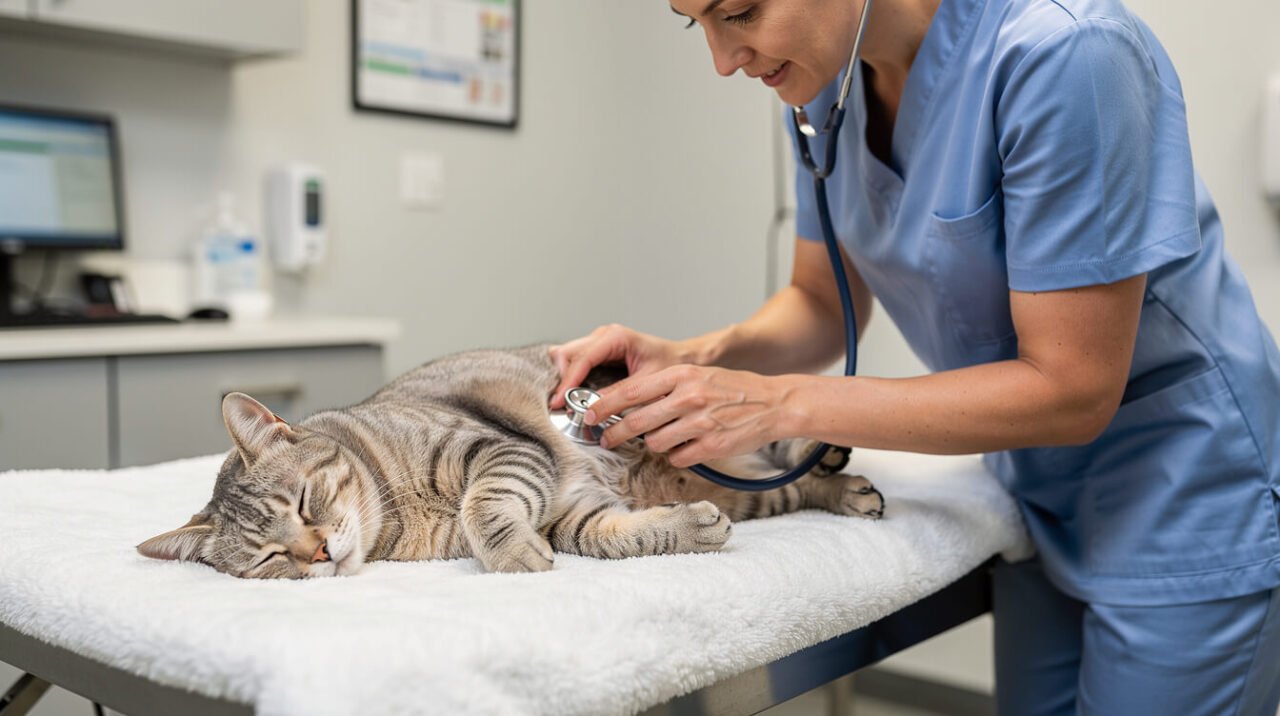
This is the section to take seriously. If your cat has started biting when she never used to, or she bites when one particular area is touched, see your veterinarian before you try any behavior fix. Cornell lists hyperthyroidism, osteoarthritis, dental disease, and central nervous system problems among the medical conditions that can cause aggression. Cats Protection points out that cats are masters at hiding pain, so a bite may be the first sign you get.
Arthritis is especially easy to miss in older cats. A cat who bites when you stroke her lower back or hips may simply be telling you it hurts. Cornell notes that cats with osteoarthritis may resent having their joints touched and “may hiss, bite, or scratch in response.” Our guide to caring for senior cats covers the quieter signs, and if biting comes with appetite or weight changes, our article on why a cat may be losing weight is a useful companion read. Your vet is the one to work out what’s going on. We can help you notice, but we can’t diagnose.
Fear and big changes at home
Fear bites happen when a cat feels trapped. Common triggers are being picked up when she doesn’t want to be, being cornered, a new person or pet, or a visit to the vet. The Ringwood Veterinary Clinic also flags household upheaval such as renovations, a new baby, house guests, and a new animal. These can leave an anxious cat edgy enough to bite.
The response is the same as for the CAT method: give her space and a way out. Make sure she has hiding places and high perches, don’t reach into her hiding spot, and let her come to you. Cornell recommends identifying and avoiding the situations that frighten her, and where that isn’t possible, gradual exposure from a distance paired with treats. If she’s severely stressed, talk to your vet. They can discuss options such as pheromone products or, in some cases, medication alongside behavior work. For aggression that doesn’t improve, Cornell recommends a veterinary behaviorist.
Children and cats who bite
Cornell specifically advises supervising cats with petting-induced aggression around young children, who want to pet and often miss the warning signs. Teaching kids the CAT basics (offer a hand, let her come to you, stroke only her head, stop when she walks away) protects both of them.
If a cat bite breaks the skin

We’ll step briefly outside animal care here, because this part protects you. Cat teeth are long, thin, and sharp. They make deep puncture wounds that close quickly over bacteria. A bite that looks small can become a serious infection, especially on the hand.
What the research actually says
You may have seen a statistic about cat bites and hospital stays. It comes from a 2014 Mayo Clinic study in the Journal of Hand Surgery (Babovic et al.), and it’s often repeated wrongly, so here it is accurately. The researchers reviewed 193 patients treated at Mayo for cat bites to the hand over three years. Of those patients, 30% (57 people) were hospitalized, for an average of 3.2 days, and 67% of the hospitalized patients (38 people) needed surgery to clean out the wound.
That is not “a third of all cat bites end in hospital.” The 193 were people who already needed care at a major medical center, and most cat bites never get there. What the study does show is how badly a hand bite can go. It also identifies who is at higher risk: people who smoke, people with weakened immune systems, and bites over a joint or tendon sheath. Redness and swelling when the patient first came in were also linked to hospitalization.
What to do
Following the UK National Health Service’s guidance on animal bites:
- Wash the wound with soap and warm water, and gently squeeze it so it bleeds slightly (unless it’s already bleeding).
- Pat it dry and cover it with a clean dressing.
- Get medical advice promptly if the bite is on your hand, foot, face, or head, if it becomes hot, swollen, red, or painful, if fluid leaks from it, if you develop a fever, or if your tetanus vaccine isn’t up to date.
- Go to an emergency department if the wound is large or deep, or the bleeding won’t stop.
Our own rule is simpler: if a cat’s tooth went through your skin, especially on your hand, call your doctor or an urgent care clinic the same day. They may prescribe antibiotics, and they will also check your tetanus status and, depending on the cat’s vaccination history and where you live, whether rabies is a concern. Tell them if the cat is a stray or her vaccinations aren’t current. That assessment belongs to your doctor and local public health guidance, not to us.
Cats Protection also notes that scratches can carry Bartonella, the bacteria behind cat scratch disease, which is spread among cats by fleas. Regular flea control protects everyone in the house.
Why does my cat bite me? Frequently asked questions
Why does my cat bite me for no reason?
From the cat’s side, there’s almost always a reason, even when we can’t see it. Cats Protection’s behaviourist puts it plainly: “Cats don’t behave randomly.” The most common invisible causes are redirected aggression (she saw something out the window), overstimulation warnings you missed, and pain. Keep a bite log for a week, and if no pattern turns up, or the biting is new, book a vet visit.
Why does my cat bite me gently?
Gentle, inhibited bites are usually communication rather than attack. Often she means “that’s enough.” Sometimes it’s social mouthing during a cuddle. Watch the tail and ears to tell which, and pause either way.
Should I punish my cat for biting?
No. Cornell, Cats Protection, and the Ringwood Veterinary Clinic all agree that punishment increases fear and anxiety and tends to make aggression worse. Stop the interaction calmly, move away, and change what led up to the bite.
Will my cat ever stop biting?
Most cats can bite far less, and many stop almost entirely once their play needs are met and the people around them learn to stop at the first warning. A cat may never lose the ability to say “stop” with her teeth, and that’s okay, as long as she rarely needs to.
Why does my cat bite my ankles?
Ankles move like prey at cat height. It’s classic play aggression. Regular wand-toy hunts, timed before meals, give that energy a better target. Be patient: you’re replacing a habit, and it can take a while.
So, why does my cat bite me? Almost always because she’s telling you something, and learning to listen is how you love her well. Offer your hand, let her choose, watch her tail, and get anything new or painful checked by your vet. For the bigger picture of everyday cat care, our guide to taking care of your cats is a good next read, and if you’re curious about her plate as well as her play, see can cats eat vegetables?
Before you go
Keep learning your animal
We publish a new guide every day. The best of them land in one short weekly email, so you never miss the one about your species.

Dr. Lila Monroe is a seasoned veterinarian with a passion for feline health and behavior, boasting over 20 years of experience in the field. With her extensive knowledge of cat medicine combined with a deep understanding of the nuanced dynamics of cat behavior, Lila offers readers invaluable insights into creating a nurturing environment for their feline friends.