
Can Dogs Eat Persimmons? Fuyu vs. Hachiya, Backyard Trees, and the Real Blockage Risk
Can dogs eat persimmons? Yes. A few bites of ripe, peeled persimmon with the seeds removed is a safe treat for most healthy dogs. Persimmons aren’t poisonous to dogs. The real risk is mechanical: persimmon tannins can clump into a hard mass in the stomach (a phytobezoar), and a dog who eats several fruits, or gorges on windfalls under a backyard tree, can end up with a blockage. That’s why the amount matters far more here than it does with most fruits.
Most quick answers stop at “remove the pit.” Persimmons don’t actually have a pit. This guide covers what they do have: four kinds of persimmon that behave differently, a portion table showing why the usual 10% treat rule is a poor guide for this fruit, and what veterinary case reports in horses and zoo meerkats show about trees that drop fruit every fall. It ends with a clear list of signs to watch for if your dog got into more than a taste.
Can dogs eat persimmons? The short answer
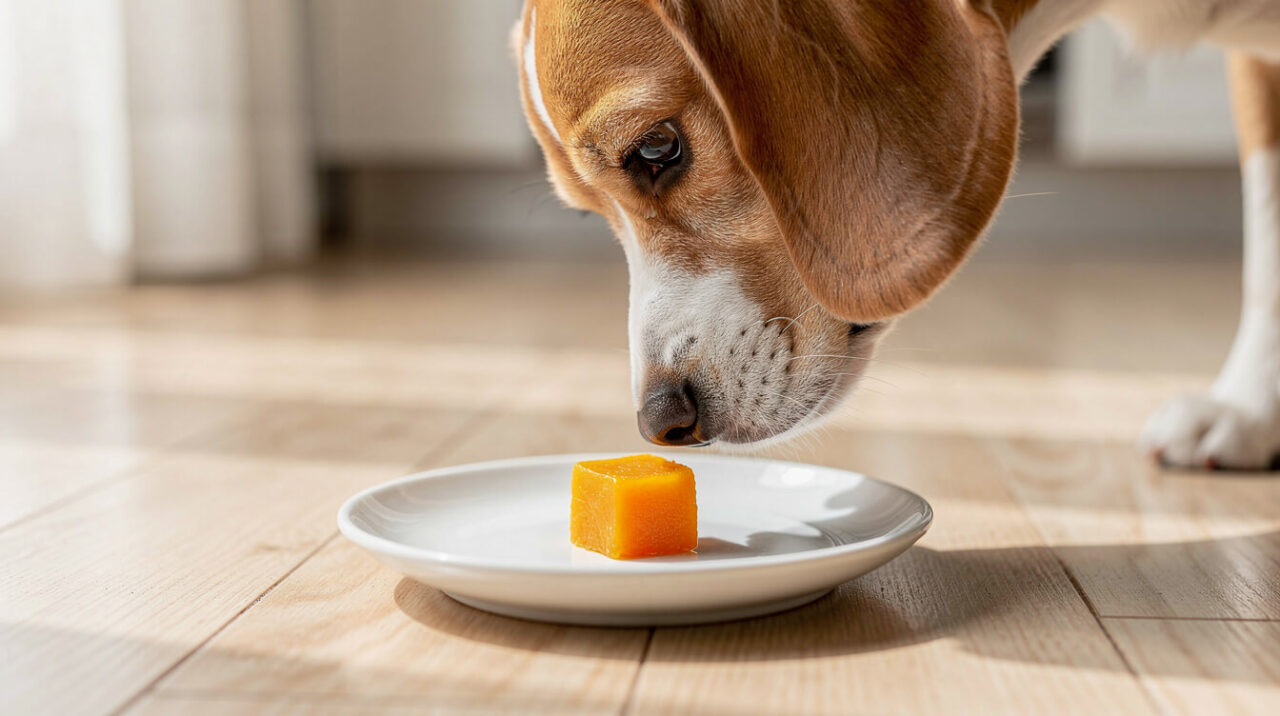
Ripe persimmon flesh is fine for dogs in small amounts. It’s sweet, soft, and mostly water, with some fiber, vitamin A, and potassium. A healthy adult dog who gets a few cubes of a ripe Fuyu as an occasional treat is very unlikely to have any problem.
Here’s what makes persimmon different from, say, blueberries:
- The concern is a blockage, not a poison. Persimmons are rich in tannins. In stomach acid, those tannins can polymerize into what a 2026 veterinary review calls “a glue-like coagulum,” which binds fiber into a hard ball. In people, persimmon bezoars are common enough to have their own name, diospyrobezoar.
- Seeds, not a pit. Most grocery-store persimmons (Japanese, or Diospyros kaki) are seedless or close to it. American persimmons from backyard and wild trees usually hold several flat brown seeds, about 1/3 to 1/2 inch long. They aren’t known to be toxic, but they can be swallowed whole, and that’s a real obstruction concern for a small dog.
- Dose matters more than calories. A large dog’s treat allowance could cover a whole persimmon or more, but the human and animal case reports involve repeated or large amounts. More is not better here.
The ASPCA’s toxic and non-toxic plant database has no entry for persimmon, and neither does Pet Poison Helpline. So you can’t fairly say “the ASPCA lists persimmon as safe,” as some sites do. The better summary is “not a known toxin, with a mechanical risk if a dog eats too much.”
Skip persimmon entirely if your dog has had a gastrointestinal obstruction or GI surgery before, has a sensitive stomach, or is diabetic or overweight (a Fuyu carries about 12.5 g of sugar per 100 g). If you’re not sure, ask your veterinarian. It’s a quick question for them.
Fuyu, Hachiya, American, dried: not all persimmons are the same
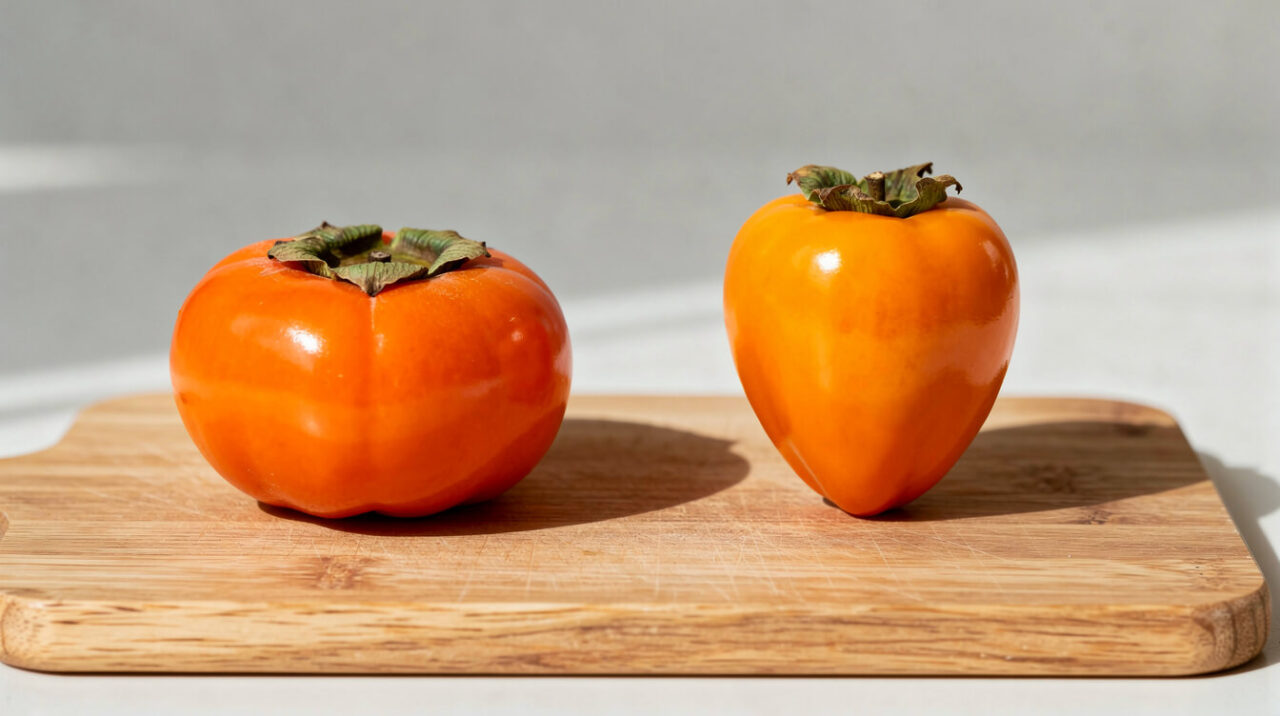
“Persimmon” covers fruit with very different tannin levels, seed counts, and calorie density. Before you share, it helps to know which one you’re holding.
Fuyu (non-astringent): the easy one
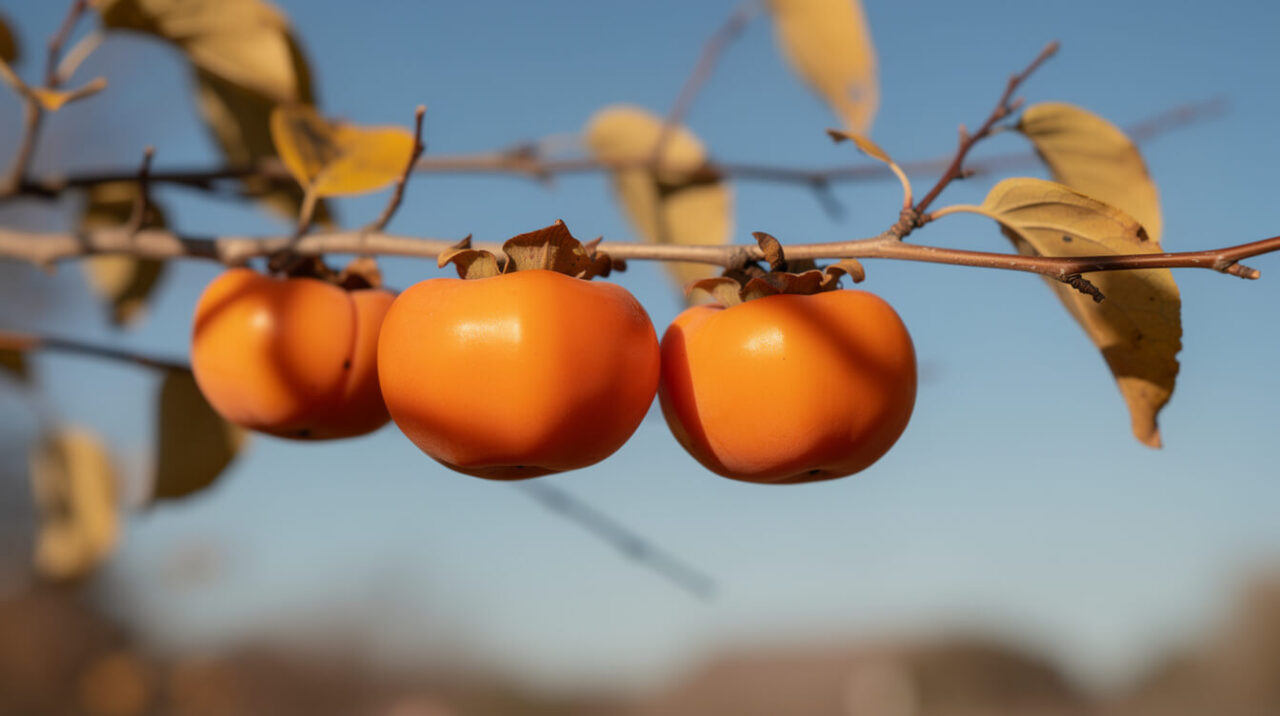
Fuyu is squat and flat-bottomed, a bit like a tomato, and it’s the persimmon most US grocery stores carry. It’s non-astringent: as University of Florida IFAS horticulturists explain, these varieties lose their mouth-puckering tannins during development and can be eaten anywhere from firm to soft. Of all the persimmons, a ripe, peeled Fuyu is the most sensible one to share. Most are seedless.
Hachiya (astringent): only when jelly-soft
Hachiya is taller and acorn-shaped with a pointed tip. It’s astringent, meaning it holds a lot of soluble tannin until it’s fully ripe and soft as pudding. UF/IFAS notes that astringent persimmons “cannot be eaten at the firm stage because of their high tannin content.” If you wouldn’t eat a firm Hachiya yourself (and you wouldn’t twice), don’t give one to your dog. Wait until it’s completely soft, or skip it.
American persimmon (the backyard and wild tree)
The native American persimmon (Diospyros virginiana) grows wild across much of the eastern and southern US and shows up in a lot of backyards. The fruit is small, about 25 g each, and very sweet when ripe. By USDA figures it’s also about twice as calorie-dense as a Japanese persimmon, roughly 127 kcal per 100 g versus 70. Purdue Extension notes these fruits carry “from one to ten large brown, smooth seeds 1/3 to 1/2 inches long.” Several seeds in a fruit smaller than a golf ball makes this the persimmon to be most careful with, especially because ripe fruit drops to the ground by itself.
Dried persimmon (hoshigaki and store-bought slices)
Drying concentrates everything. USDA lists dried Japanese persimmon at 274 kcal and 14.5 g of fiber per 100 g, about four times the fresh fruit. One 34 g piece is around 93 calories, close to a whole 10-lb dog’s daily treat budget. Dried fruit also figures in human bezoar cases: a 2026 Japanese surgical report describes a 74-year-old woman who needed two operations after eating 16 dried persimmons, and the mass removed was 98% tannin. That’s a human case, not a dog case, but it’s a good reason to keep dried persimmon off the dog menu entirely. Store-bought versions may also carry added sugar or preservatives.
Persimmon bread, pudding, and cookies
Holiday persimmon pudding and persimmon bread are a separate question, because the fruit is no longer the main concern. These recipes usually include butter, sugar, and warm spices like nutmeg and cinnamon, and some add raisins, which are a known kidney risk for dogs. If your dog snags a slice, look up the recipe and call your vet or a poison line if it contained raisins or a sugar-free sweetener. Our guide to gingerbread and dogs covers the spice math.
How much persimmon can a dog eat? The calorie math (and why it’s not the limit)
The usual rule for treats is that they shouldn’t make up more than about 10% of a dog’s daily calories. Here’s what that allows for fresh Japanese persimmon (70 kcal per 100 g, USDA), using the standard resting-energy formula (70 × body weight in kg0.75) and a typical adult maintenance range of 1.4 to 1.8 times that.
| Dog’s weight | 10% treat budget | Fresh Fuyu that “fits” | About how much fruit |
|---|---|---|---|
| 5 lb | 18–23 kcal | 26–33 g | ~1/6 of a fruit |
| 10 lb | 30–39 kcal | 44–56 g | ~1/4–1/3 of a fruit |
| 20 lb | 51–66 kcal | 73–94 g | ~1/2 a fruit |
| 40 lb | 86–111 kcal | 123–158 g | ~3/4 of a fruit |
| 60 lb | 117–150 kcal | 167–214 g | ~1 whole fruit |
| 80 lb | 145–186 kcal | 207–266 g | ~1 1/4–1 1/2 fruits |
“Fruit” = one medium (2.5-inch) Japanese persimmon, 168 g, per USDA. Your dog’s real needs depend on age, activity, and body condition, so your vet’s number beats ours.
Look at the bottom rows. By the calorie rule alone, a 60-lb Lab could have a whole persimmon every day. The calorie math allows more than you should give. The 10% rule protects against weight gain and unbalanced diets. It was never meant to guard against tannins clumping in the stomach, and that’s the risk that matters with this fruit.
No study has set a safe persimmon dose for dogs, so we won’t make one up. What the evidence does show is the pattern that leads to bezoars in other species: repeated or large intakes. In the human cases, that meant 16 dried persimmons in one stretch, or two fresh ones a day as a habit. In horses and zoo meerkats, it meant free access to a fruiting tree. So our honest advice is a habit, not a number:
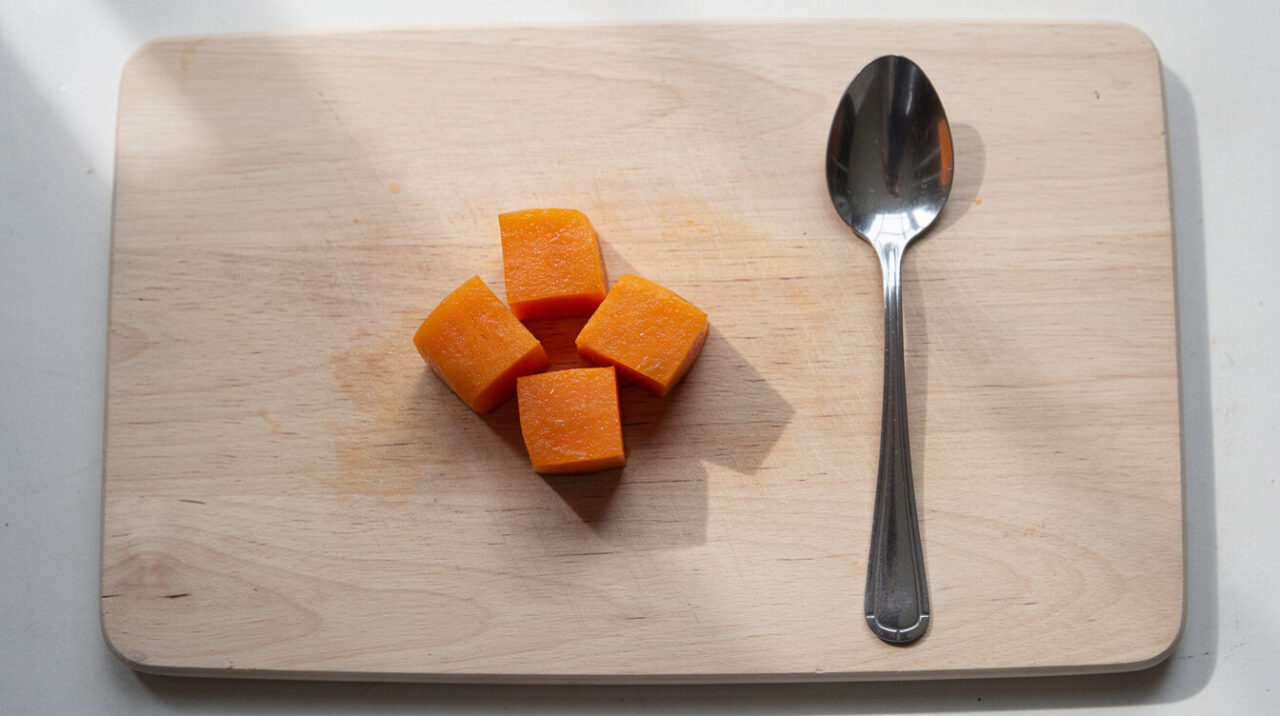
- Think “a few bites,” not “a fruit.” A few small cubes for a small dog. A tablespoon or two of diced flesh for a big one.
- Keep it occasional. Make it an autumn treat now and then, not a daily topper.
- Stay well under the budget above, especially if your dog also gets other treats that day.
That’s the same “plain, small, and sometimes” approach we use for other seasonal favorites like pumpkin and yams.
The backyard tree problem: what horses and meerkats teach us
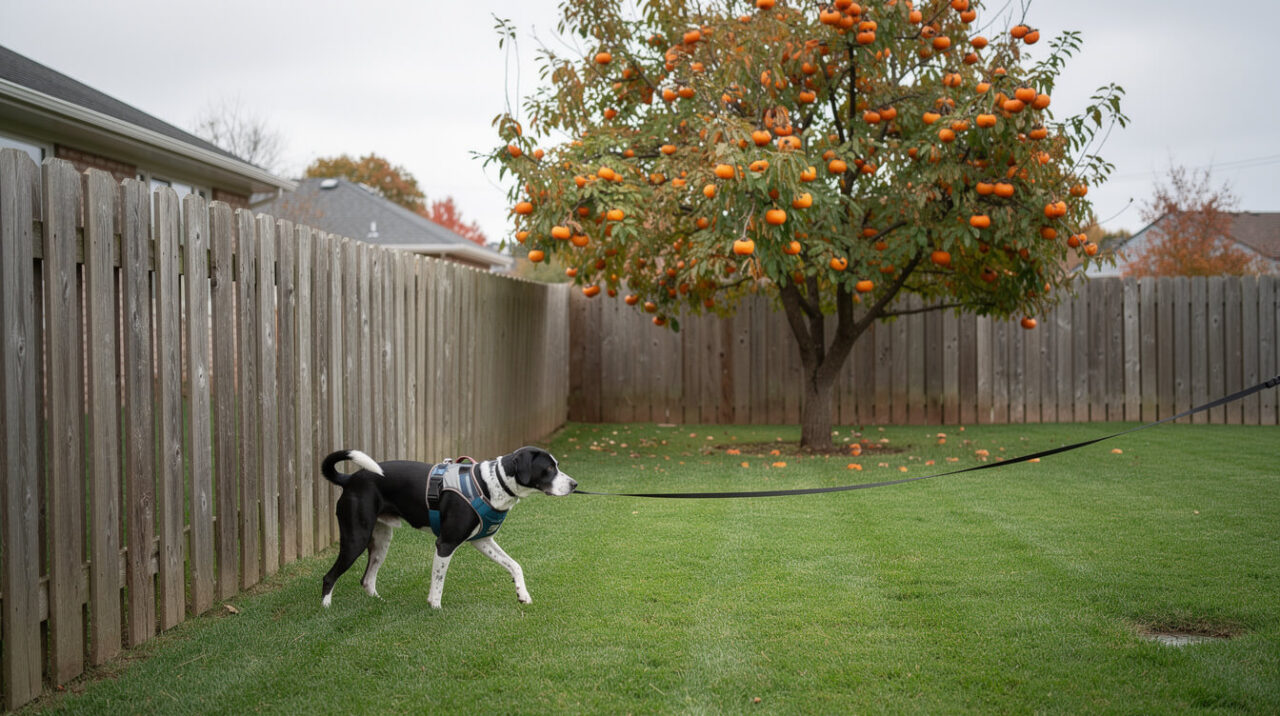
A dog eating a cube of persimmon from your hand is low risk. The situation that worries us more is a dog with unsupervised access to a fruiting tree in October and November, when ripe fruit drops every day and a food-motivated dog can eat as much as it likes.
We want to be precise here. We could not find a single published case of a persimmon bezoar in a dog. The best evidence comes from other animals, and it’s worth knowing because it describes exactly this situation.
Horses
A 2011 study in the Journal of the American Veterinary Medical Association (Banse et al.) described 13 equids (10 horses, 2 donkeys, and a pony) with persimmon phytobezoars. Ten were seen in the fall, September to November. Two were euthanized before treatment. Bezoars that stayed in the stomach usually responded to treatment: 7 of 8 of those animals survived more than a year. Bezoars that moved into the intestine were far more serious, and only 1 of 5 of those animals survived past a year. An earlier JAVMA case (Kellam et al., 2000) involved a young horse that ate American persimmons and showed six weeks of mild colic, lethargy, and weight loss before surgery. The horse recovered fully, and the authors advised that persimmon bezoars “should be considered in the fall and winter.”
Zoo meerkats
At the Oklahoma City Zoo, meerkats ate fruit from a persimmon tree growing in their exhibit (Hahn et al., 2013). Two died suddenly, and gastric bezoars were found at necropsy. Four of the remaining eight had bezoars on X-ray and needed surgery to remove them; all four recovered. The authors pointed to the fruit, noting that “tannins found in ripe persimmons are known to coagulate in the presence of gastric acid.” Note the word ripe: ripe fruit isn’t automatically harmless in quantity.
What we know about dogs
Plant-based bezoars do happen in dogs. A 2026 Italian study (Maggi et al.) described 18 cases, 17 dogs and one cat. Most were grass. One was fruit of an unnamed type, and none were identified as persimmon. Seven needed surgery, three were removed endoscopically, and six passed on their own. A 2025 Korean imaging study of dogs and cats (Koo et al.) found that bezoars caused signs for longer before diagnosis than other foreign bodies (a median of 14 days versus 5.5), and that plain X-rays caught only one of the six bezoars that were X-rayed.
So the honest summary is this: a persimmon blockage in a dog is plausible and well documented in other animals, but it hasn’t been reported in dogs yet. That’s enough to manage the tree sensibly without fearing the fruit.
If you have a persimmon tree
- Pick up windfalls daily during fruiting season, before your dog goes out. Overripe and split fruit can also spoil or mold, which brings its own stomach upsets.
- Fence off the drip line or walk the yard on leash in October and November if your dog is a scavenger.
- Watch the “quiet grazer.” A dog that slips off to the back fence and comes back sticky-faced is telling you something.
- Know your neighbors’ trees. American persimmons often overhang fences and line park trails.
The weekly care guide
Get it right for your animal, every week
One email a week: new care guides, species deep-dives, and the safety answers keepers search for, written by our specialists. No spam. Unsubscribe anytime.
How to share persimmon with your dog safely
Now for the good part. If you’re eating a ripe Fuyu at the counter and a pair of hopeful eyes is watching, here’s how to share without worry.
- Choose ripe, non-astringent fruit. A Fuyu that gives slightly when pressed, or a Hachiya that’s fully jelly-soft. Never a firm Hachiya.
- Wash and peel it. The skin is tougher to digest than the flesh, and leaving it on gains your dog nothing.
- Remove every seed and the calyx (the leafy green cap). Cut the fruit open and check, especially with American persimmons.
- Dice small. Cut it into cubes no bigger than your dog’s usual training treat, so nothing gets gulped whole.
- Offer a few pieces once, then wait a day. Watch for loose stool or an upset stomach before you make it a regular treat.
Our shop is small and reptile-first for now, so there’s no dog design yet. But if a bearded dragon is watching from its tank while the dog gets persimmon, our Bearded Dragon Crown Sunglasses King T-Shirt is the one we’d point you to, and it’s one fruit-free thing in the house that nobody has to share.

For the keeper with a beardie and a fruit-loving dog
Our crowned, sunglasses-wearing bearded dragon tee, for multi-species homes where every snack time draws a crowd.
Three easy ways to serve it
- Fresh cubes as training rewards. Soft, sweet, and easy to break smaller. Count them as part of the day’s treats.
- Frozen cubes. Freeze a few peeled cubes for a cold, slow treat. As a bonus, UF/IFAS notes that freezing to around −4°F (−20°C) turns persimmon’s soluble tannins into insoluble ones, which is how growers take the pucker out of astringent fruit. Don’t treat that as a license to give more, though. It changes the taste, not the advice.
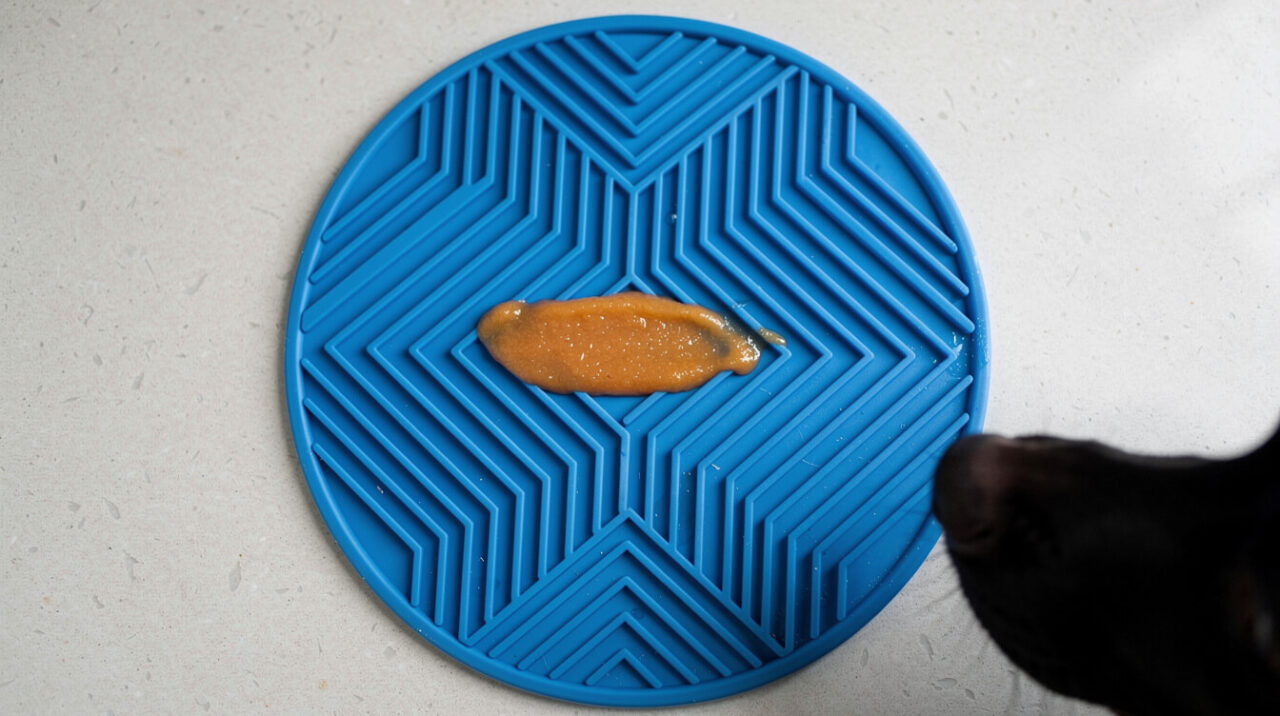
- A thin smear on a lick mat. Mash a spoonful of ripe flesh and press it thin into the grooves. Licking a thin layer takes far longer than eating it, so a little goes a long way.
Persimmon also mixes well with other dog-friendly fruits for a small autumn sampler: a cube of persimmon, a couple of blueberries, and a segment of orange. Just keep the whole plate within the treat budget. And keep avocado off it.
My dog ate a whole persimmon (or several): what to watch for

First, take a breath. A medium or large dog who ate one ripe Fuyu will most likely be fine, perhaps with a softer stool. Your job now is to know what you’re watching for and call your vet early if anything seems off. You shouldn’t try to treat this at home.
Call your vet now if:
- Your dog is small (under about 20 lb) and ate a whole fruit, several fruits, or seeds.
- Your dog ate several American persimmons with seeds, dried persimmons, or an unknown number of windfalls.
- Your dog has had a GI obstruction or abdominal surgery before.
- Whatever was eaten contained raisins, a sugar-free sweetener (xylitol), or a lot of nutmeg, as persimmon bread or pudding might.
Your vet will tell you whether to come in or watch at home. Don’t try to make your dog vomit unless a veterinarian tells you to. Some horse and human cases were treated with cola, but that was done by clinicians, under monitoring, for a diagnosed bezoar. It isn’t something to try at home.
Signs to watch for over the next days to weeks
The Merck Veterinary Manual describes GI obstruction in dogs as “an emergency condition,” and notes that “pain, vomiting, and diarrhea are typical clinical signs.” Bezoars can build slowly, so watch for days, not just hours:
- Repeated vomiting, especially if your dog can’t keep water down
- Loss of appetite, or walking away from food your dog normally loves
- A tense or painful belly, hunching, or a “praying” stretch
- Straining with little or no stool, or diarrhea that doesn’t settle
- Lethargy, hiding, or just “not right”
Any of these after a persimmon binge means you should see your veterinarian the same day. If it’s after hours, go to an emergency clinic. Tell them about the persimmons, even if it was a week ago. The Korean study above found bezoar signs often ran about two weeks before diagnosis, and that history helps your vet choose the right imaging.
If you think something toxic was involved, like raisins in a persimmon bread, you can also call Pet Poison Helpline (855-764-7661) or the ASPCA Animal Poison Control Center (888-426-4435). Both are staffed around the clock, and consultation fees apply.
Can dogs eat persimmons? Quick answers to common questions
Can dogs eat persimmon skin?
A little skin on a cube is unlikely to cause trouble, but we recommend peeling. The skin is tougher than the flesh, and peeling costs you ten seconds.
Are persimmon seeds poisonous to dogs?
We found no evidence that persimmon seeds are toxic to dogs. The concern is size and number. Swallowed whole, several firm seeds could contribute to a blockage, especially in a small dog. Remove them every time.
Can dogs eat dried persimmons?
We’d skip them. They’re about four times as calorie-dense as fresh fruit, and dried persimmon shows up in human bezoar case reports.
Are persimmon leaves or branches safe?
We couldn’t find good toxicity data either way, and the ASPCA plant database has no persimmon entry. Leaves and twigs aren’t food, so discourage chewing, as you would with any yard tree.
Can puppies eat persimmons?
Puppies have small intestines and big appetites for things they shouldn’t eat. A single tiny cube of ripe, peeled Fuyu is unlikely to hurt a healthy pup, but there’s no benefit that makes it worth pushing. Their regular food covers what they need.
Is persimmon good for dogs?
It’s a reasonable occasional treat, not a superfood. Ripe Japanese persimmon contains vitamin A (81 µg RAE per 100 g), fiber, and potassium, but a complete dog food already supplies those. Share it for the pleasure, not as a supplement.
Can cats eat persimmons?
Cats are obligate carnivores and get nothing they need from fruit. Most aren’t interested anyway. The same blockage logic applies, and their small size makes it matter more, so keep persimmons away from cats.
Final thoughts
So, can dogs eat persimmons? Yes, and you don’t need to be afraid of one of autumn’s nicest fruits. A few peeled, seed-free cubes of a ripe Fuyu make a lovely treat for most dogs. Just treat persimmon a little differently from other fruits. It isn’t poisonous, but its tannins can bind into a mass in the stomach, so the 10% calorie rule isn’t the right limit here.
Keep portions small and occasional. Skip dried and firm Hachiya fruit. If you have a tree, pick up windfalls every day while it’s dropping fruit. And if your dog gets into a pile of persimmons, call your vet early and mention the fruit, even days later.
If you’re planning a holiday menu with your dog in mind, our guides to cranberry sauce and cold-weather walks pick up where this one leaves off.
Before you go
Keep learning your animal
We publish a new guide every day. The best of them land in one short weekly email, so you never miss the one about your species.

Meet Jake Harrington, your go-to guru for all things canine. With over 15 years of professional dog training experience, Jake has transformed the lives of thousands of dogs and their owners. His journey began in the bustling streets of a major city, where he discovered his natural affinity for understanding canine behaviors and communication.